Times of Israel
Times of Israel··6 min read
West Bank archaeology conference unearths controversy as politics takes center stage
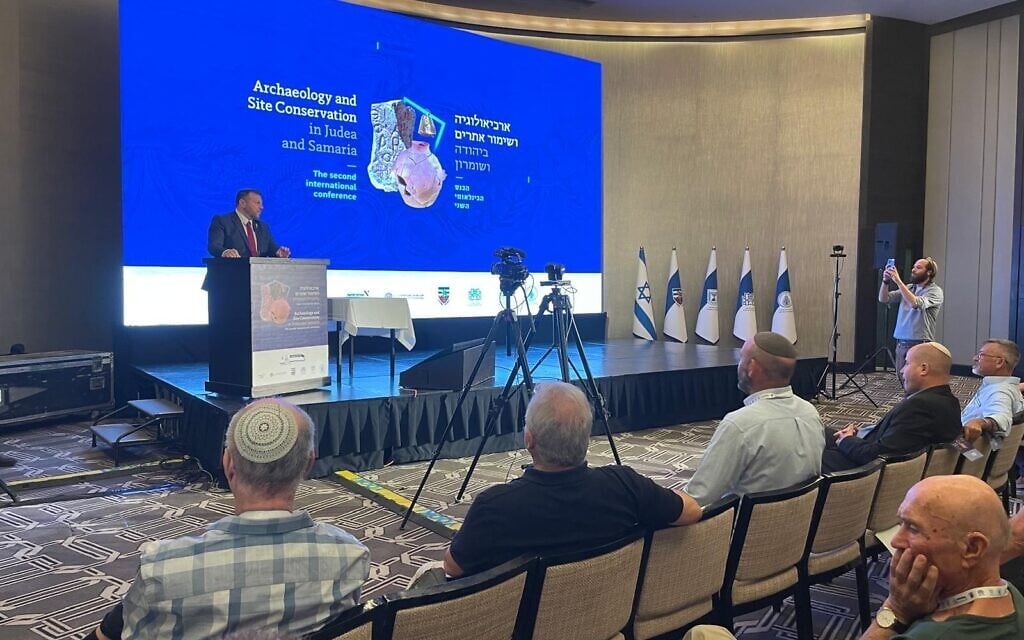
Hundreds of people, including dozens of archaeology scholars affiliated with Israeli universities, on Wednesday attended the first day of a controversial academic conference devoted to antiquities in the West Bank.
Like its first edition, the second international “Archaeology and Site Conservation in Judea and Samaria” — the biblical name for the West Bank — is centered around presenting research and findings of archaeological work across the region, with sessions devoted to excavations in the Hebron area, the Judean Desert, Tel Shiloh and elsewhere. However, political controversies also took center stage at the conference, held at the Orient Hotel in Jerusalem.
“The sites we study are part of the landscape in which we live, teach, travel, and pass by almost every day. This proximity gives research depth and meaning, but also imposes responsibility on us,” said Adi Eliyahu Behar, head of the Department of Land of Israel and Archaeology at Ariel University, which is located in the West Bank and is the only Israeli university that is an academic sponsor of the conference.
“Precisely for this reason, it is important that we continue to promote research based on scientific integrity, critical examination of the evidence, and constant striving for an understanding of the past that is as reliable and objective as possible,” she added.
In the past few months, the field of archaeology, and especially the work carried out by Israeli bodies in the West Bank, has become increasingly controversial.
Get The Times of Israel's Daily Edition
by email and never miss our top stories
By signing up, you agree to the terms
Members of the governing coalition have been pushing through a highly contentious bill seeking to establish direct Israeli civilian control over heritage sites in the West Bank and even Gaza, a legislation initiative that is widely seen as a significant step toward annexation and has been harshly criticized by many Israeli archaeologists, as well as by the army and officials at both the defense and justice ministries. Earlier this month, legislative work on the bill was reportedly paused by Prime Minister Benjamin Netanyahu.
Most experts in Israel agree that for decades, conditions at antiquities sites in the West Bank, estimated at several thousand sites, has been very problematic, marked by neglect and frequent vandalism and looting.
Many have therefore applauded the initiative of the Heritage Ministry, led by ultranationalist Minister Amichay Eliyahu, to dramatically increase the budget of the Staff Officer for Archaeology of the Civil Administration, a branch of the Defense Ministry’s Coordinator of Government Activities in the Territories (COGAT), which is responsible for civilian affairs in the West Bank.
However, Eliyahu’s support for the West Bank and Gaza antiquities bill, along with other initiatives, has been widely criticized by many archaeologists as political. This includes his recent decision to tap a new head of the Israel Antiquities Authority, the organization responsible for archaeology in Israel’s sovereign territory, who is seen by some as inexperienced and chosen for ideological rather than professional reasons.
Recently, the Civil Administration has also issued several expropriation orders of Palestinian land for archaeological purposes for hundreds of acres at iconic sites such as Sebastia and Herodium, which made headlines in Israel and abroad.
Both the bill and the appointment of the new IAA head were proudly mentioned by Eliyahu as he addressed the conference.
“The heritage of this country is the heritage of the Jewish people, but also the heritage of the entire world. It’s been my privilege to change the priorities [of the ministry],” he said. “Changing the priorities has meant increasing the budget of the Staff Officer from [NIS] 5 to 7 million to tens of millions,” he said.
“There is also legislation, not legislation that we initiated, but legislation whose underlying idea we support, to transform the Archaeology Unit [of the Civil Administration] into an Antiquities Authority,” he added.
Eliyahu vowed that Esti Schreiber, the head of an organization promoting Jewish values and connected to the Hasidic movement Chabad, will soon enter her role as the new IAA head.
“God willing, in the coming month, we’ll bring in the new director,” he said. “Everyone will see her talent.”
Eliyahu delivered his speech during the first session of the conference, which was devoted to the Persian period (586-333 BCE) in Judea and its southern neighbor Edom. The session was chaired by Aren Maeir, head of Bar-Ilan University’s Institute of Archaeology, who has been a harsh critic of the minister.
In 2025, Bar-Ilan was also an academic sponsor of the conference, but this year, Maeir said the university was against doing so, after seeing how political the event had become.
“I participated in the conference because a colleague asked me to be a chairman of a session, and I respect him,” Maeir told The Times of Israel. “However, I was somewhat surprised, I would say disappointed, that in the midst of the session that I was chairing, they gave a break, and let Minister Eliyahu speak.”
When Eliyahu took the podium, Maeir walked out from the hall together with a few other participants.
Maeir said he disagrees with the minister “on anything he says when he opens his mouth.” Recently, he has been among the dozens of archaeologists who submitted a petition to the Supreme Court seeking to block Schreiber’s appointment.
Dozens of experts affiliated with all Israeli universities offering archaeology studies, including Hebrew University, Tel Aviv University, Ben-Gurion University, Bar-Ilan and University of Haifa, were set to address the conference, in addition to a large number of archaeologists working for the Staff Officer, different colleges, the IAA and some international scholars.
Compared to 2025, however, the program included only two full days of lectures, down from four, and a significantly weaker international presence.
In his opening speech, Alon Shavit, director of the Israel Institute of Archaeology, acknowledged the risks of politicization in the field. A nonprofit devoted to promoting archaeology among the Israeli public, including through community-based excavations, the institute was another academic sponsor of the conference.
“While I congratulate everyone present, allow me to speak with some sensitivity about those who are not here with us,” Shavit said. “It would have been appropriate for such a conference to have official representation from all the archaeological institutes active in the country, and unfortunately, this is not exactly the case.”
“We have a great challenge to ensure that in the coming years, this conference will have a consensus and reflect the entire archaeological community in the country,” he added.
Maeir charged: “It’s very unfortunate that if they’re already making a conference on the archaeology in the West Bank, Judea and Samaria, trying to say that they are not political, and they don’t understand why many of the archaeologists in Israel don’t participate, and then they prove why [archaeologists] don’t [participate], because [the organizers allow for] highly politicized, one-sided right-wing, quasi-fascistic views being spoken out loud during the conference.”
Outside the hotel, a few demonstrators protested against the event, holding signs reading “No to archaeology in the service of transfer [of Palestinians]” and “Antiquities, not at any price.”
Among the new findings presented at the conference on Wednesday was a small engraved symbol, documented in the Tomb of the Patriarchs in Hebron by Haim Skolnik of the Staff Officer and Gershon Bar-Kochba of Orot College.
The researchers found that the figure, shaped like the head of a bird, also appears on several churches and 12th-century CE buildings in the city of León in northwestern Spain, and that it was used by the family ruling the city during that period.
Other lectures covered Hasmonean coins minted under King Mattathias Antigonus found across the region and on several sites in the Manasseh Hills, in the northeast of the West Bank.
View original source — Times of Israel ↗
Related stories

Lovin Malta
BusinessJun 9, 2026 · 1 min
Peppi Azzopardi Contrasts Pride Backlash With Silence Over Foreign Worker Abuse
Lovin Malta

Portugal Resident
TechnologyJun 16, 2026 · 1 min
Science is being harmed by visa refusals to conference guests – academics
Portugal Resident

Euronews
PoliticsJun 18, 2026 · 1 min
UK: Tommy Robinson’s Oxford Union debate sparks protests and free speech backlash
Euronews

Daily Trust
TechnologyJun 9, 2026 · 1 min
Gumi: Islamophobia shaping South-West Politics
Daily Trust