Indian Express
Indian Express··5 min read
From the Urdu Press: ‘Kejriwal and Mamata to Uddhav, Oppn must unite, hit the streets against defection politics’
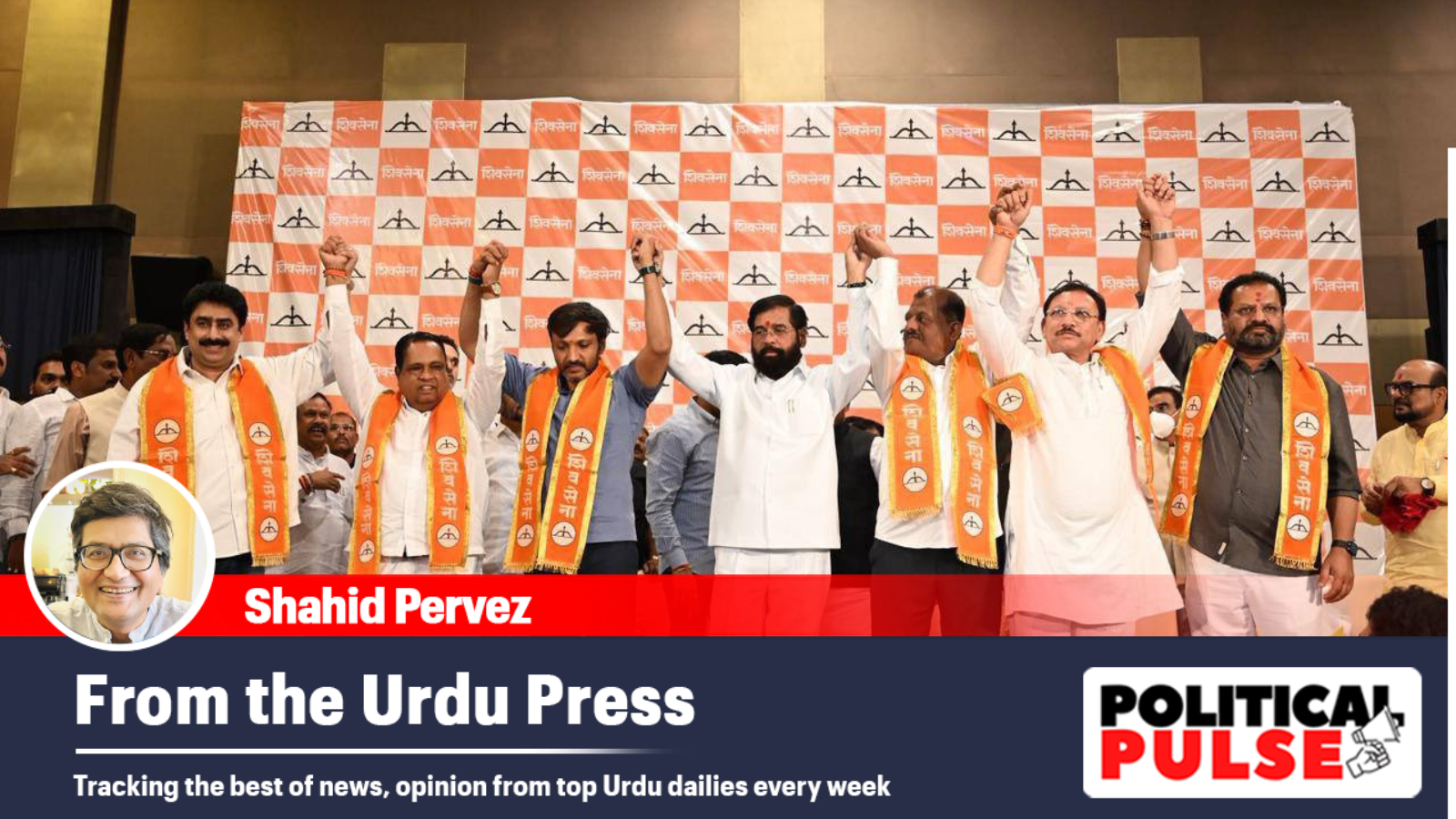
The switch of six Lok Sabha MPs of the Uddhav Thackeray-led Shiv Sena (UBT) to the Eknath Shinde-led Shiv Sena, a BJP ally, marks the latest split that an Opposition party has suffered in recent weeks, which starting with the Aam Aadmi Party (AAP) has now engulfed the Trinamool Congress (TMC) in dramatic ways. The cycle of such defections remained the key political story in several Urdu dailies over the week, which see in them grim implications for our democracy and political system.
Referring to serial defections of MLAs and MPs of some regional Opposition outfits, the Hyderabad-based Siasat, in its June 18 editorial, says that these exits have escalated the shrinking of the Opposition parties in the country, dealing a blow to the world’s largest democracy. “While these crossovers have allegedly been engineered at the behest of the BJP to help the ruling dispensation push its agenda, it has undermined our cherished democracy, which had been a model for the world,” it says. “In the recent phase, this cycle began with the defection of seven Raghav Chadha-led AAP Rajya Sabha MPs to the BJP, which spiralled to include 20 TMC MPs who planned their moves at a Union minister’s residence. The already-splintered Uddhav Sena has become its latest casualty.”
There has now been a buzz about the impending defections in the Samajwadi Party, the daily notes. “The spectre of central agencies is being invoked to pressure several Opposition lawmakers to drive them into rebellion. It is another matter that the onus to preserve and strengthen democracy is largely on the ruling party,” it says, adding that the politics of defections has cast a shadow on our electoral system.
The edit points out that the unrelenting targeting of the Opposition has created a disturbing political situation in the country. “All Opposition parties must close their ranks and work out joint strategies to protest these developments. They must take their defector MPs and MLAs to the courts. They should also create widespread public awareness on the issue and take to the streets. Their silence would harm our democracy.”
AAG
Highlighting the educational backwardness of the Muslim community, the country’s largest minority group accounting for over 14% of its population, the Lucknow-based Aag, in its June 18 editorial, says that the lack of their educational empowerment, reflected in Muslim students’ high dropout rates across multiple levels, is a “festering social and national issue”. “If this problem is not promptly addressed, the dream of our country’s multi-dimensional development could not be fulfilled,” it says. “Education is a barometer of any community’s social, economic and intellectual progress, but the bitter truth is that even more than seven decades after Independence, Muslims have lagged far behind other other communities on various developmental and educational parameters,” the edit states. It points out that while the enrolment rate of Muslim children in primary classes is high, their dropout rates rise as they move on to secondary and high-secondary levels, which exceed their corresponding national average figures.
The daily states that a large section of Muslims in India are living in poverty or even below poverty line. Underlined by the Sachar Committee report and various other reports and surveys since, a major chunk of the Muslim community is earning their livelihood as labourers, artisans, mechanics or small shop workers in the unorganised sector, it says. “The financial woes of Muslim households force them to pull out their children from schools, who are then deployed in small jobs to support their families. The situation is worse for Muslim girl students who face more challenges and discrimination in their homes and schools.”
There have been a glaring lack of quality schools and colleges in Muslim localities across the country, the editorial notes. “Parents have concerns and fears in sending their children, especially girls, to educational institutions located far away from their areas. The shrinking of job opportunities even for educated people demoralises them too,” it says. “The resolution of this issue is not only crucial for Muslims but also the country. It needs a comprehensive roadmap. In light of the Sachar panel’s recommendations and the National Education Policy’s provisions, the government must set up model schools and high schools in Muslim belts.”
Noting that the Centre has scrapped several scholarships schemes for Muslim students in recent years, the edit says all these programmes must be restored, considering their critical importance for many Muslim students’ education. Special focus must be given on retaining girl students in schools. “While Muslims must pledge to bring about an education revolution in the community, it is imperative for the government to rise above political considerations and take urgent measures to ensure their educational empowerment.”
URDU TIMES
Flagging “tod podh ki siyasat” or the politics of breaking parties, the Mumbai-based Urdu Times, in its June 18 leader, points out that the BJP-led NDA has not had two-thirds majority in both the Lok Sabha and the Rajya Sabha since the 2024 parliamentary elections. The situation posed a challenge to the BJP as it could not muster the numbers needed to pass the constitutional amendment legislation, it says. “This led to the bids to engineer defections in the Opposition parties and poach their legislators through fear or greed.”
The rebel MPs of the Arvind Kejriwal-led AAP started this defection trend, the editorial says, adding that 20 of the Mamata Banerjee-led TMC’s 28 Lok Sabha MPs then broke away from the party to align with the BJP. And now, six Uddhav Sena MPs have jumped ship to cross over to the Shinde Sena, it says. “The NDA would need about 360 seats to secure a two-thirds majority in the Lok Sabha, but it is still well behind this mark,” the edit notes. “Meanwhile, common people continue to beset with multiple problems. The development works have stalled, price rise is soaring and youths are running from pillar to post in search of jobs.”
The daily says this brand of politics marked with ruptures and horse-trading undermines democracy while posing a threat to the Constitution. “It needs urgent resolution. The future of lakhs of students is at stake. The country’s development journey would be disrupted and public disquiet would deepen if the politics of splintering parties is not halted,” it adds.
View original source — Indian Express ↗
Related stories

The Punch
NewsJun 23, 2026 · 1 min
INEC presents certificates of return to June 20 by-elections winners
The Punch
The Punch
NewsJun 23, 2026 · 1 min
Sowore’s remand dangerous for democracy — Peter Obi
The Punch
The Punch
NewsJun 23, 2026 · 1 min
Suspect in viral abuse video now in custody, 18-year-old taken as child — Activist
The Punch
The Punch
NewsJun 23, 2026 · 1 min
Lagos seals i-Fitness gym over pollution
The Punch