Times of Israel
Board of Peace members to ‘recalibrate’ at Cyprus resort after rocky first six months
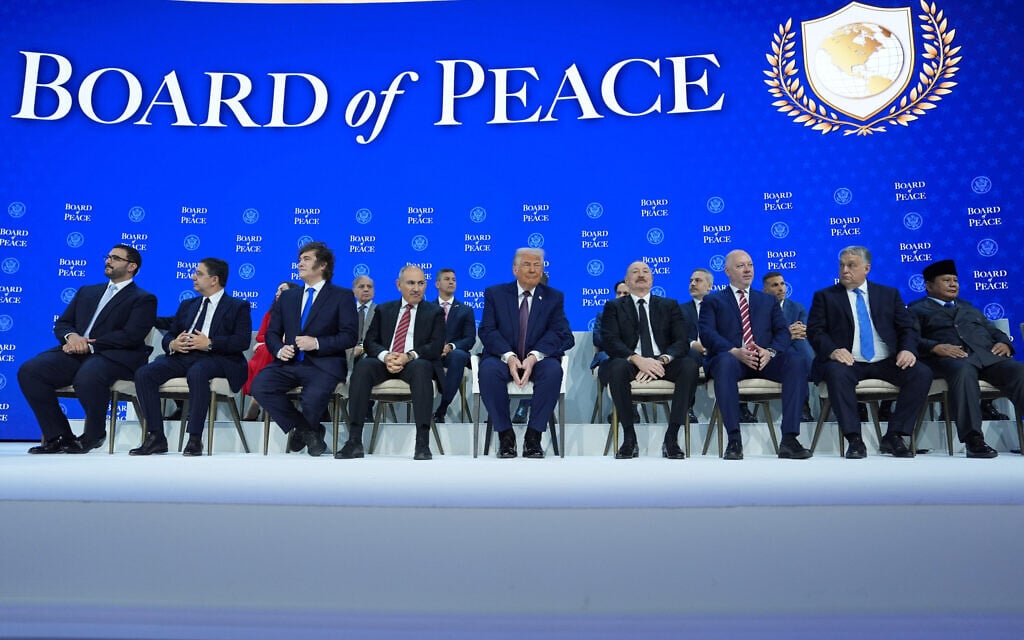
Representatives from the various bodies of the Board of Peace will gather at a resort in Cyprus next week, as the US-led international panel overseeing the postwar management of Gaza seeks to recalibrate after a rocky six months since its establishment.
Participants at the gathering will include representatives from the Board of Peace umbrella body, the committee of Palestinian technocrats tasked with replacing Hamas in governing the Gaza Strip, and the Office of the High Representative, which coordinates between those two bodies.
An Arab diplomat from one of the mediating countries and a Palestinian official familiar with the matter described the gathering as an opportunity for everyone involved to “reset,” “recalibrate” and get on the same page after the past half a year produced limited results for the people of Gaza.
While the Board of Peace enjoyed initial international support and even a degree of buy-in from both Israel and Hamas, the initiative has slowed as global attention shifted to the Iran war and talks, and as talks with Hamas on giving up its weapons remain entrenched. The terror group argues that Israel should first abide by the terms of the October ceasefire, which required it to halt strikes deep into the Strip, pull back its troops toward the border and allow in more humanitarian aid.
The stalemate has left the war-ravaged Strip with very limited relief, with Israel refusing to allow the entry of even certain temporary housing structures until Hamas disarms, leaving nearly half of the population of over 2 million living in flimsy tents after nearly three years of conflict, sparked by Hamas’s October 7, 2023, invasion and onslaught.
Get The Times of Israel's Daily Edition
by email and never miss our top stories
By signing up, you agree to the terms
While a February donor conference in Washington brought in $17 billion in pledges, only a tiny fraction of those funds have actually been transferred, as the Gulf countries that offered the largest sums were the most targeted by Iran in the weeks that followed, in what will likely force a budget reprioritization.
Meanwhile, the Board of Peace’s sub-panel of Palestinian technocrats — the National Committee for the Administration of Gaza (NCAG) — hasn’t even entered the Strip, amid Hamas’s refusal to disarm and amid mounting Israeli restrictions on its ability to operate, according to two Arab diplomats from separate mediating countries.
The 15-member panel has been stuck in Cairo since its establishment in January, using the time to craft plans for its Gaza launch, meet with Egypt-based and visiting diplomats and even undergo several training sessions run by senior Board of Peace official Tony Blair’s Institute for Global Change government consulting firm.
Optics concerns
While next week’s gathering will provide the NCAG with an opportunity to get out of Cairo for several days, some members expressed discomfort with the optics of holding a meeting at a Cyprus resort amid the ongoing suffering in Gaza, a Palestinian official told The Times of Israel. A decision was accordingly made to scale back the guest list for next week.
A Board of Peace official pushed back on the notion that next week’s confab is anything out of the ordinary, pointing out that members of the umbrella group’s various bodies have met several times this year, including on the sidelines of an April donor conference for Palestinians in Brussels and a smaller, more recent gathering in Cairo.
While the Board of Peace official acknowledged that the Iran war had slowed progress for several weeks, he insisted that the initiative is otherwise on track, despite Israeli violations of the ceasefire and Hamas’s refusal to give up its weapons.
The terror group has more recently made concessions in disarmament talks, putting forward proposals that would see it gradually give up some of its weapons after previously ruling the idea out entirely. However, the offers are conditioned on significant progress toward the establishment of a Palestinian state — a non-starter for Israel.
Those talks are ongoing, but diplomats from Mideast mediating countries — Qatar, Egypt and Turkey — told The Times of Israel earlier this month that they’re not optimistic at all about the chances for a breakthrough before the fall elections in Israel, claiming that Prime Minister Benjamin Netanyahu’s government has been placing additional hurdles as the vote approaches.
Talks on construction of permanent housing have begun
The Board of Peace official said that regardless of whether or not Hamas accepts the US-backed disarmament proposal, plans to start the construction of temporary housing communities — beginning with an Emirati-backed project on the ruins of the southern Gaza city of Rafah — are moving ahead, and construction will begin in the next three or four months.
That area, as well as others initially earmarked for installment of temporary housing, is located in the gradually expanding part of the Strip occupied by Israel. While the October ceasefire deal saw Israel pull back its troops to a Yellow Line roughly dividing the enclave into eastern and western halves, Israel has since pushed to re-occupy as much as 70 percent of the Strip, as Hamas disarmament talks drag on.
A Middle East intelligence official said mediators don’t expect Israel to allow even temporary housing structures into the Strip before the fall elections, as Netanyahu seeks to maintain a hard line on Hamas.
But the Board of Peace official maintained that Israel has been cooperative and that no obstacles have been put up with regard to Gaza reconstruction.
The official maintained that these things just take time and that in many ways, the Board of Peace is moving ahead of schedule.
He suggested that the speed at which Hamas and the Board of Peace managed to locate and return the bodies of all remaining deceased hostages may have set unrealistic expectations for how quickly this process will be able to advance.
Still, the official said that the Board of Peace has already issued over a dozen Requests for Proposal (RFPs), formal documents to solicit bids from construction contractors to clear rubble; remove unexploded ordinances; destroy Hamas tunnels; install temporary housing, hospitals and schools; and install bases for the Gaza police and the International Stabilization Force (ISF).
While the Board of Peace has begun recruitment for the Gaza police and received thousands of applications, the Middle East intelligence official said that Israel is refusing to allow recruits to leave before Hamas has accepted the disarmament proposal.
And while four countries have agreed to contribute troops to the ISF, that process, too, has been stalled, and deployment is not expected before the fall Israeli elections, the Middle East intelligence official said.
Talks with developers on the construction of permanent housing have begun, though, the Board of Peace official revealed — before admitting that it won’t move ahead if Hamas doesn’t agree to disarm.
US President Donald Trump’s administration first laid out its vision for the Board of Peace in September as part of its 20-point plan for ending the Gaza war. It rallied the international community around the initiative and managed to secure a ceasefire agreement between Israel and Hamas the next month that also saw all remaining hostages brought home from Gaza.
In November, the US managed to push a resolution through the UN Security Council endorsing the 20-point plan and giving the Board of Peace a mandate to oversee Gaza through 2027.
The Trump-chaired Board of Peace was formally established two months later, with 28 countries becoming founding members of an international body that Trump initially sold as one that could rival the UN in global conflict management, but that has since focused solely on Gaza.
The January unveiling of the Board of Peace also saw the rollout of several bodies assisting the panel, including an Executive Board made up largely of Trump officials along with prominent and wealthy allies; a Gaza Executive Board that included senior officials from Middle Eastern countries tasked with advising the Board of Peace on its Gaza policy; an Office of the High Representative headed by former UN envoy Nickolay Mladenov, who serves as the Board of Peace’s on the ground envoy; and the NCAG.
Also tasked with replacing Hamas and the IDF in Gaza underneath the Board of Peace umbrella will be a Palestinian police force meant to provide internal security and law and order to Gazans, as well as an International Stabilization Force tasked with securing the Strip borders.
View original source — Times of Israel ↗
Related stories

The Hindu
TechnologyJun 23, 2026 · 1 min
Watch: HL: Lucknow building fire: FIR cites illegal commercial use | Above the Fold | 23.06.2026
The Hindu
TechRadar
TechnologyJun 23, 2026 · 1 min
Ukraine open sources Russian military hardware secrets to 'protect the entire civilized world'
TechRadar

ZDNet
TechnologyJun 23, 2026 · 1 min
The iPad Pro M5 is $100 off on Amazon, and it's worth it for the battery life alone
ZDNet

TechRadar
TechnologyJun 23, 2026 · 1 min
Workday accused of AI bias in job screening, faces California lawsuit over employment tech
TechRadar