The Next Web
Honda signs multiyear solid-state battery deal with QuantumScape after scrapping its EV lineup
TL;DR
Honda R&D signed a multiyear deal with QuantumScape to develop solid-state batteries, its second major OEM partner after Volkswagen.
Honda R&D, the independent research arm of Honda Motor Company, has signed a multiyear joint research agreement with California-based QuantumScape to develop and manufacture solid-state battery cells. The deal, announced on June 18, makes Honda the second major automaker to formally partner with QuantumScape after Volkswagen. The agreement follows Honda’s completion of an in-depth technology evaluation that included hands-on testing and competitive benchmarking of QuantumScape’s solid-state platform.
Solid-state batteries replace the liquid electrolyte in conventional lithium-ion cells with a solid material, promising higher energy density, faster charging, and improved safety. Automakers have been racing to commercialise the technology for years, with Toyota, BMW, Nissan, and others investing heavily in competing approaches. QuantumScape’s design uses a ceramic separator and lithium-metal anode, a combination the company says enables significantly better performance than traditional cells.
“QS technology demonstrated compelling and unique advantages during our evaluation,” said Atsushi Ogawa, chief operating officer of Honda R&D’s Research Center of Excellence. “We see potential for QS technology to add value across a range of applications, including automotive, and we are excited to move forward into the next phase of our partnership.”
The 💜 of EU tech
The latest rumblings from the EU tech scene, a story from our wise ol' founder Boris, and some questionable AI art. It's free, every week, in your inbox. Sign up now!
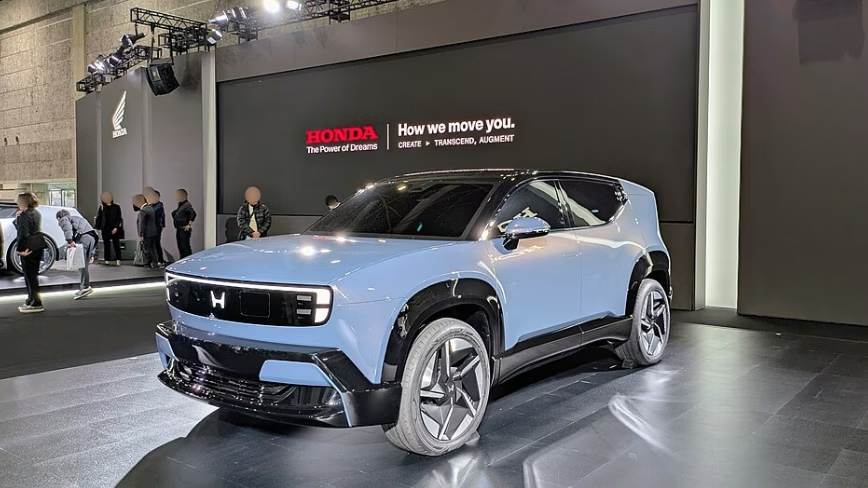
The timing is notable because Honda has been retreating from electric vehicles rather than advancing into them. Earlier this year, the company cancelled its entire 0 Series EV lineup in North America, including the Honda 0 Saloon, the Honda 0 SUV, and the Acura RSX, triggering up to 15 billion dollars in associated losses. Honda was among several automakers that pulled EVs from the US market in 2026 as tariffs and weakening demand reshaped the industry’s economics.
Honda has since pivoted toward hybrids, with new models planned from 2027, and lowered its 2030 global battery-electric sales target to roughly 20 percent of total volume. The QuantumScape partnership suggests the company has not abandoned EV battery research entirely, even as it scales back near-term electric vehicle production. Solid-state batteries could eventually underpin a second attempt at electrification if the technology reaches commercial viability.
QuantumScape’s other major automotive partner is Volkswagen, which licensed the technology through its battery subsidiary PowerCo SE. In September 2025, Volkswagen revealed the first test vehicle using QuantumScape cells, a modified Ducati V21L motorcycle. The QSE-5 cell that QuantumScape is currently producing in pilot volumes features an energy density of 844 watt-hours per litre and can fast charge from 10 to 80 percent in roughly 12 minutes.
Earlier this year, QuantumScape inaugurated its Eagle Line pilot production facility at its San Jose headquarters. The facility produces QSE-5 solid-state battery samples for partner evaluations and is designed to serve as a blueprint for large-scale manufacturing. The Eagle Line incorporates QuantumScape’s Cobra process, a fast separator production method that the company says enables manufacturing at gigawatt-hour scale.
QuantumScape CEO Siva Sivaram called Honda’s evaluation “one of the most rigorous assessments of our technology to date” and said the agreement reflects growing confidence in solid-state lithium-metal batteries. Honda is not licensing the technology for production yet, only committing to joint research. The gap between a research agreement and batteries in production vehicles remains substantial.
Honda has its own solid-state battery programme as well. In January 2025, the company began pilot production of solid-state cells at its Sakura plant in Japan. The QuantumScape deal suggests Honda is hedging its bets by pursuing multiple approaches to the technology rather than relying on a single internal programme.
QuantumScape shares rose 12 percent on the day of the announcement. The company remains pre-revenue and reported a loss of roughly 100 million dollars in the first quarter of 2026, a reminder that solid-state battery technology is still years from generating commercial returns despite the OEM partnerships.
The deal gives Honda access to what independent testing has validated as one of the more promising solid-state platforms, while giving QuantumScape a second major automaker to point to as evidence that its technology can survive rigorous evaluation. Whether either company can turn research collaboration into batteries that power production vehicles remains the question that the entire solid-state industry has been trying to answer for the better part of a decade.
View original source — The Next Web ↗
Related stories

RNZ
TechnologyJun 23, 2026 · 1 min
Fighting AI with AI - the only way to keep up on new frenetic frontier
RNZ

The Hindu
TechnologyJun 23, 2026 · 1 min
Watch: HL: Lucknow building fire: FIR cites illegal commercial use | Above the Fold | 23.06.2026
The Hindu
TechRadar
TechnologyJun 23, 2026 · 1 min
Ukraine open sources Russian military hardware secrets to 'protect the entire civilized world'
TechRadar

ZDNet
TechnologyJun 23, 2026 · 1 min
The iPad Pro M5 is $100 off on Amazon, and it's worth it for the battery life alone
ZDNet