Indian Express
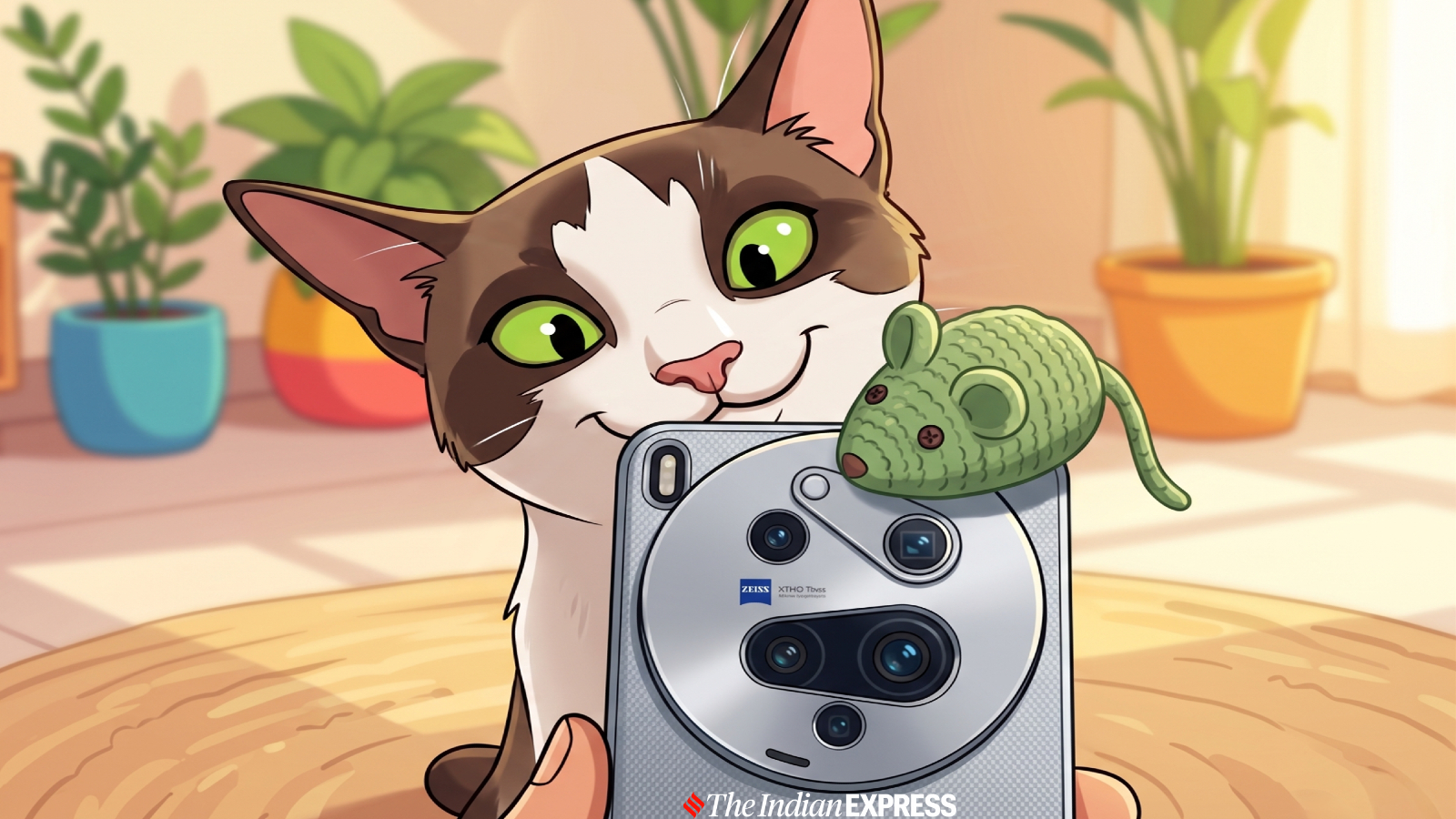
Cats, Vivo X300 Ultra, and the serenity of a pocket camera
It’s peak summer in Delhi, and the sun already feels like fire in the morning. I water the plants in a small terrace garden I have made for myself, and there comes Faraday, gleaming and looking at me. Faraday is a seven-month-old male cat who was born on my terrace. While his mother is gone, Faraday spends a lot of time here.
I spend a lot of time with Faraday, which means I often end up as his photographer. And let me tell you, when he’s in a good mood, he’s a total poser.
A few days ago, I posted a photo of Faraday on LinkedIn, and many people asked what camera I used to capture it. I have been using the Vivo X300 Ultra (and not a traditional camera) for some time now, and it has quickly become my go-to pocket camera.
It’s easily one of the best cameras I have ever used for everyday photography. It’s an exceptional camera system with versatile lenses and optional zoom accessories. At the same time, it’s a reminder that the device also doubles as a smartphone.
I will walk you through the pros and cons of the Vivo X300 Ultra and help you decide whether this camera phone is worth buying.
Premium build and huge camera bump
From the moment you pick it up, it’s clear that the Vivo X300 Ultra isn’t trying to be a slim smartphone. Don’t expect it to be as thin as the iPhone Air. Instead, Vivo has designed the device to resemble a dedicated camera, and it shows.
The X300 Ultra is a hefty device, dominated by a large camera island on the back. It’s undeniably thick, but that’s largely due to the camera hardware packed inside. The phone has a premium finish and feels solid in the hand. As I mentioned at the beginning, the X300 Ultra is marketed as a camera, but at the end of the day, it’s still a smartphone. Whether you see it as a camera, a phone, or a phone with a pocket camera is entirely up to you.
Story continues below this ad
The Vivo X300 Ultra captures sharp details and natural depth, even in challenging outdoor lighting. (Image: The Indian Express/ Anuj Bhatia)
That said, while the overall size is manageable, the camera island is designed in a way that makes it difficult to slide the phone into a jeans pocket. A more tapered edge would help it easily slide into a tight pocket. I would also like to point out that Vivo has not included a dedicated camera button on the side, a feature that would have made perfect sense on a device like this.
The 6.82-inch AMOLED display (3168×1440) is vibrant and offers several colour modes. It also supports both Dolby Vision and HDR10+ content. A 144Hz refresh rate ensures smooth scrolling and responsive gameplay. The phone is rated IP68 and IP69 for dust and water resistance, giving it durability in demanding conditions. That durability extends to battery life as well, thanks to the sizable 6,600 mAh silicon-carbon battery, with the phone supporting up to 100W wired and 40W wireless charging.
Unfortunately, there’s no built-in MagSafe support. Inside the device is Qualcomm’s flagship Snapdragon 8 Elite chipset, paired with 16 GB of RAM and 512 GB of storage.
Optional Zoom lens kit
For reviewers like us, Vivo has sent a special camera kit with the Vivo X300 Ultra. The kit is optional and not included with the standard retail package, but it can be purchased separately. Other brands are also trying to make smartphones into camera-first devices, and I appreciate their intent, but the Vivo experience is much more nuanced and thoughtful. Transforming the Vivo X300 Ultra into a compact camera is an experience in itself.
Story continues below this ad
The base of the case has a grippy texture on the back and a mount for external zoom lenses, although Vivo could have made it more robust. It feels a bit plasticy, I feel. Anyway, there is also a detachable camera grip that slides over the bottom end and connects via USB-C, featuring a red recording button, a shutter button with half-press focus, a flash control button, a function button, and a jog dial for zooming in and out. It even has a scroll wheel for quick exposure comp adjustments.
The Vivo X300 Ultra’s camera ecosystem includes external telephoto lenses designed for serious photography enthusiasts. (Image: The Indian Express/ Anuj Bhatia)
I really liked how the kit is designed with functionality in mind, as it doesn’t require any Bluetooth pairing. I tested both the second-generation 200mm lens and the new 400mm lens, and both teleconverter lenses feel more premium than the case they attach to, thanks to their solid metal construction and mounts. These lenses provide the equivalent of 8x or 16x optical zoom on a smartphone with a standard 24mm camera. However, since this phone doesn’t feature a conventional 24mm camera, the effective zoom is closer to 5.7x and 11.4x. In other words, they offer approximately 2.35x and 4.7x the magnification of the phone’s built-in telephoto lens.
The add-on external lenses work exactly as they should and feel incredible in use. Some of the shots I captured genuinely blew me away. When I showed the results to my friends, nobody believed they had been taken with a smartphone rather than a traditional camera. As I mentioned earlier, these are technically “add-on” lenses, but they feel more like a natural extension of the camera experience.
If you are into street photography or enjoy trekking or wildlife photography, this kit opens up a whole new range of creative possibilities. The lenses can be attached to the phone’s camera system using the special mount and removed just as easily when they are no longer needed. I could never imagine this kind of setup on my iPhone.
Story continues below this ad
However, the camera kit and Zeiss telephoto extenders come at a hefty cost. The Vivo X300 Ultra itself is priced at Rs 1,59,999, while the complete package, including the smartphone, camera kit, and telephoto extenders, costs Rs 2,09,999. That’s a lot of money for a smartphone that doubles as a pocket camera. At that price, you could easily buy a full-frame camera instead. There’s no denying that the cost of ownership is high, but the tech nerd in me, who also happens to love photography, can’t help but be tempted by the Vivo X300 Ultra.
Insane cameras (No AI B*S)
I like to believe that every photography journey begins at home, and over time, you develop a deeper emotional connection with photography. As a photographer, I wanted to review the Vivo X300 Ultra as if it were purely a camera. So, I took hundreds of photos and videos to see how it would hold up in real-world use. In fact, I spent a lot of time shooting both at home and outdoors, which gave me the opportunity to experience the camera system across a variety of scenarios.
At home, Faraday was my primary subject. Since he spent most of the day sleeping and remained relatively still when awake, I was able to get the camera so close to him that I could really test its capabilities. The camera hardware is so impressive that the X300 Ultra can capture spectacular photos that make you question whether they were taken on a smartphone or a traditional camera. If you look through the photos of Faraday, you can “trust” the images – and keep in mind, these shots were neither touched up nor enhanced using artificial intelligence.
The Vivo X300 Ultra paired with Zeiss telephoto extenders, expanding the camera system’s reach from everyday photography to long-range shooting. (Image: The Indian Express/ Anuj Bhatia)
The Vivo X300 Ultra takes a different approach to smartphone photography, using a 35mm main camera rather than the usual 23mm or 24mm lens. During my time with the device, I noticed that the 35mm focal length delivers more natural-looking shots with a pleasing perspective. While I may have some issues with Vivo’s clunky user interface, I can’t deny the impressive colour science, fast shutter response, and how tasteful the images look in the Zeiss Natural Colour mode (although Vivid is the default camera style).
Story continues below this ad
The main camera quality is impressive. Exposure is well-balanced, images are sharp, and details are captured well. However, at times, I felt Vivo’s processing was a little too aggressive, with images appearing slightly over-sharpened and HDR-heavy for my personal taste.
Night photography on the X300 Ultra is impressive, with accurate details and minimal reliance on long exposure modes. However, the processing can sometimes feel overly sharp and tends to brighten shadows more than preserve natural contrast.
I was once sceptical about Vivo’s cameras, but the X300 Ultra surprised me. The 14mm ultrawide is one of the best I have used on a smartphone, offering excellent quality and enough resolution for some cropping. However, the standout camera for me is the 85mm telephoto, which delivers exceptional detail, sharpness, colours, and stabilisation thanks to its large 200MP sensor and advanced optics.
Image shot on the Vivo X300 Ultra. (Image: The Indian Express/ Anuj Bhatia)
Shot on the Vivo X300 Ultra. (Image: The Indian Express/ Anuj Bhatia)
Image shot on the Vivo X300 Ultra. (Image: The Indian Express/ Anuj Bhatia)
Image shot on the Vivo X300 Ultra. (Image: The Indian Express/ Anuj Bhatia)
Image shot on the Vivo X300 Ultra. (Image: The Indian Express/ Anuj Bhatia)
Image shot on the Vivo X300 Ultra. (Image: The Indian Express/ Anuj Bhatia)
Image shot on the Vivo X300 Ultra. (Image: The Indian Express/ Anuj Bhatia)
Image shot on the Vivo X300 Ultra. (Image: The Indian Express/ Anuj Bhatia)
Image shot on the Vivo X300 Ultra. (Image: The Indian Express/ Anuj Bhatia)
Image shot on the Vivo X300 Ultra. (Image: The Indian Express/ Anuj Bhatia)
Shot on the Vivo X300 Ultra (Image: The Indian Express/ Anuj Bhatia)
The X300 Ultra’s macro photography is excellent, using the 3x telephoto lens instead of the ultrawide for a more natural perspective. The results feature realistic blur and a more camera-like look than the macro modes on smartphones. Portrait mode is also one of the best I have used on any smartphone, though the iPhone 17 Pro Max still wins me over for more natural-looking portrait shots.
Story continues below this ad
For video, the X300 Ultra has seen a significant improvement, and the results speak for themselves. I have always felt that high-end Android smartphones struggle with videography, and since I shoot a lot of product videos, I have noticed that they often don’t come close to the iPhone Pro series. Surprisingly, the X300 Ultra’s video performance challenges the iPhone’s dominance. The videos look professionally shot, with excellent dynamic range, smooth stabilisation, and a very cinematic feel.
A ‘communication’ tool
I take more pictures of cats than of humans, and I feel no guilt about it. There is some kind of cosmic connection with cats that is difficult to put into words. That’s why I take pictures of cats whenever I spot them. I have more photos of cats on my phone than I do of myself.
For me, a camera is a communication tool, a way to capture cats and share what I feel about them with the world, if that makes sense. I spent a lot of time photographing Faraday and other cats, and the Vivo X300 Ultra has changed my perspective on what’s possible for cat photographers.
As a test of the Vivo X300 Ultra’s camera performance, Faraday was my primary subject. Capturing the fine details of cats has always been a challenge, but the Vivo X300 Ultra handles it remarkably well. Not only can it capture cat photos with accurate details and excellent visual clarity, but it also performs impressively in low-light conditions.
Story continues below this ad
All in all, the Vivo X300 Ultra is a camera first. It may be one of the few smartphones that truly fits into that category. After using the X300 Ultra, I felt that the word “camera” might represent something entirely different from what we are used to: a phone that captures photos. The X300 Ultra feels like a glimpse into the future. Perhaps it is less about the stripped-down camera experience and more about seeing and processing the world through a lens.
View original source — Indian Express ↗
Related stories

Lovin Malta
TechnologyJun 25, 2026 · 1 min
Watch: Donal Skehan Says He’ll ‘Definitely’ Return To Malta After Food-Filled Getaway
Lovin Malta

Indian Express
TechnologyJun 25, 2026 · 1 min
Expert Explains | Why India’s buildings are vulnerable to fire, and what’s needed to fix them
Indian Express

ZDNet
TechnologyJun 25, 2026 · 1 min
A 64GB flash drive for $17? This SanDisk Prime Day deal is an absolute steal
ZDNet

The New York Times
TechnologyJun 25, 2026 · 1 min
Iran Threatens Ships in Strait of Hormuz as Marco Rubio Meets Gulf Leaders
The New York Times