Indian Express
Indian Express··7 min read
Union Minister gets Rs 99-lakh subsidy for his cucumber farm — from scheme under own ministry
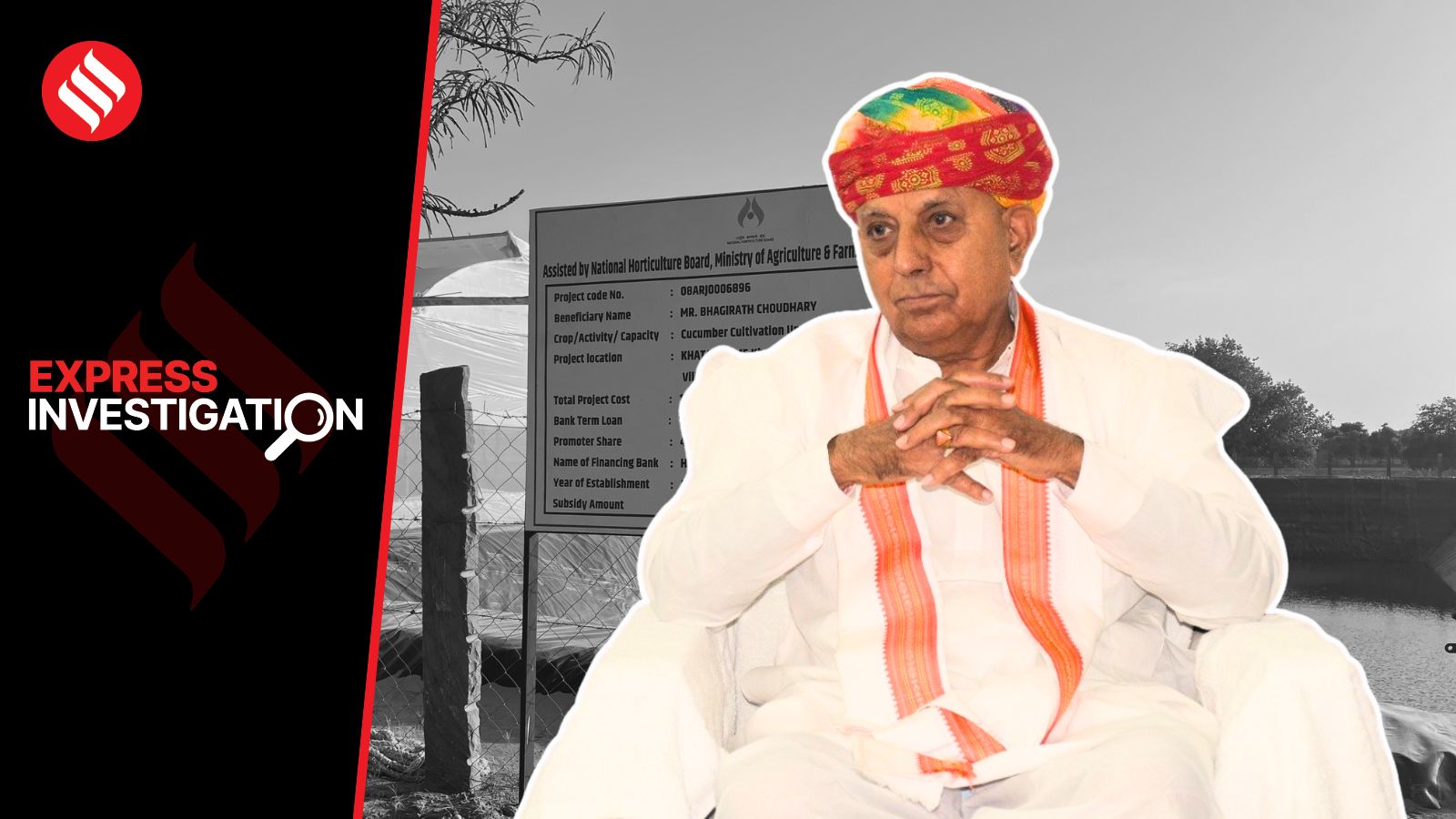
In a sprawling farm in central Rajasthan, where stone walls and barbed wire shield an orchard, artificial ponds and four large polyhouses, a white signboard spells it out: “Assisted by National Horticulture Board, Ministry of Agriculture & Farmers’ Welfare, Govt. of India”.
The beneficiary: “Mr. Bhagirath Choudhary”. The subsidy amount: “50% (99,60,000)”.
It’s what the signboard does not say that is most telling.
Choudhary is Minister of State in the Union Ministry of Agriculture and Farmers’ Welfare. An investigation by The Indian Express reveals that he received the subsidy three months ago through a scheme under his own ministry and approved by a board in which he is ex-officio Vice-President.
The scheme to promote “commercial farming” — on a large scale for profit — of select vegetables and flowers comes under Mission for Integrated Development of Horticulture (MIDH), which was launched in 2014-15 and is administered by the National Horticulture Board (NHB), an autonomous organisation under the administrative control of Choudhary’s Ministry.
The initiative offers a maximum subsidy of 50 per cent, capped at Rs 1 crore per family, of the project cost for farming capsicum, cucumber and tomato, and eight varieties of flowers, including rose, anthurium and orchids (see adjacent story).
Choudhary’s project for cucumber cultivation across 16,592 sq m is one of 467 approved by NHB in 2025 under the scheme titled “Development of Commercial Horticulture through Production and Post-Harvest Management of Horticulture Crops”.
According to NHB’s official website, its activities are managed by a Board of Directors headed by the Union Agriculture Minister as ex-officio President, with the Union MoS for Agriculture as ex-officio Vice-President.
Story continues below this ad
Signboard at Union Minister of State Bhagirath Choudhary’s farm at village Peeh in Parbatsar tehsil of Deedwana Kuchaman district in Rajasthan.
(Photo credit: Harikishan Sharma)
While the Board’s official website lists its ex-officio Vice-President as “Hon’ble Minister of State for Agriculture & Farmers Welfare”, the emails provided are [email protected]/ [email protected].
Other members include the Secretary, Department of Agriculture and Farmers’ Welfare; the Director General, Indian Council of Agricultural Research; and other officials and representatives of the horticulture industry.
On paper, the MoS has no direct role in approving projects for subsidy under the scheme. The final approval is granted by an NHB project approval committee that does not include the board’s president or vice-president.
The Indian Express sent a questionnaire to Choudhary, detailing its findings, and seeking his response on whether the subsidy constituted a case of conflict of interest. His office confirmed receipt of the email, but Choudhary was unavailable for comment.
Story continues below this ad
Official data shows that of the 467 projects, with a total cost of Rs 144 crore and covering an area of 677 acres, that were approved during the financial year 2025-26 under this scheme, there were 60 that received over Rs 50 lakh each as subsidy.
The Indian Express visited the project site at Choudhary’s farm in Peeh village of Rajasthan’s Deedwana-Kuchaman district. Apart from the subsidy amount, the signboard put up at the site — part of mandatory requirement under the scheme — shows the total cost of the project as “1,99,20,000” (Rs 1.99 crore).
It states that the promoter’s share was “49,80,000” (Rs 49.8 lakh) — and that the Minister took a loan of “1,49,40,000” (Rs 1.49 crore) from HDFC Bank for the project.
Records show that Choudhary, who is the BJP MP from Ajmer and has been MoS at the Agriculture Ministry since 2024, filed an application for clearance to start work on the project under the NHB scheme on April 15, 2025. The project was granted in-principle approval under the scheme 14 days later, on April 29, 2025.
Story continues below this ad
On March 11, 2026, records show, the project received final clearance from NHB. And, on March 30, “capital investment subsidy” of Rs 99.03 lakh was credited to Choudhary’s HDFC Bank loan account at Kishangarh in Rajasthan. The records reviewed by this newspaper on the transfer of subsidy do not mention the remaining Rs 57,000 from the amount of “99,60,000” shown on the signboard.
Records show that in Peeh, Choudhary owns 9.7 hectares of agricultural land under khata number 315 (khasra numbers 508, 509, 610, 611, 621) and 1.1332 hectares under khata number 991 (khasra numbers 2315/510).
Khasra is the number assigned to an agricultural plot or field, and acts as an identifier in land records. Khata is the record that provides details of all plots owned by an individual or family within a village.
Choudhary’s last available declaration to the Prime Minister’s Office (PMO), as on March 31, 2025, recorded Rs 4.41 crore worth of immovable and movable assets. The list includes agricultural land at 11 locations, including Khata/Khasra numbers 315, 1053, 1053/1 and 1058 at Peeh, valued at Rs 5.85 lakh. There is no specific mention of the NHB project, which received initial approval under the scheme a month later. An aide at the Minister’s office said details of the project “will be disclosed to the government”.
Story continues below this ad
It was not the first time Choudhary had applied for subsidy under the scheme. Records show he had submitted an application in September 2018, but that was rejected due to a delay in receiving the hard copy. That same year, his son Subhash Choudhary had applied for a mixed vegetable/ cucumber project in Peeh village, but the application was rejected because a “structure” used in the project was “not eligible under the scheme guidelines”.
Explained: 4 steps, Rs 1-crore cap: How the subsidy is cleared
What is the scheme?
“Development of Commercial Horticulture through Production and Post-Harvest Management of Horticulture Crops” is a sub-scheme under National Horticulture Board’s Mission for Integrated Development of Horticulture (MIDH).
Purpose: Promote commercial farming (for profit) of horticultural crops on a large scale. The crops under the scheme are three types of vegetables: capsicum, cucumber and tomato; and eight varieties of flowers: anthurium, orchid, rose, lilium, chrysanthemum, carnation, gypsophila and gerbera.
Subsidy: Upto 50 per cent of the project cost, capped at Rs 1 crore per family, is available as subsidy under the scheme.
Beneficiaries: Individuals, self-help groups, associations or groups of growers, trusts, cooperative societies, companies, farmer producer organisations, cooperative marketing federations, agricultural produce marketing committees, marketing boards, municipal corporations, agro-industries corporations, state agriculture universities and R&D organisations.
Story continues below this ad
What are the key conditions to avail subsidy?
The applicant must own, or hold, registered lease records for a minimum of 10 years on, at least 4,000 sq m (1,000 sq m in northeastern states).
The subsidy is linked to the “term loan” taken for the project. A term loan is a one-time amount (no top-up) with a fixed repayment period.
“The time limit for completion of the project would be a maximum of 18 months from the date of disbursement of first installment of the term loan,” the scheme’s guidelines state.
The subsidy is deposited in the loan account within three months of completion of the project (Note: The minimum loan taken should be more than the estimated subsidy being proposed).
How to obtain the subsidy?
Step 1: Apply online through the NHB portal for “In-Principle Approval cum Letter of Comfort” for the project, with all necessary documents, including PAN and land records, detailed project report, site layout plan, final loan sanction letter along with detailed appraisal note from lending bank.
Step 2: In-principle approval is followed by an on-site check by a Joint Inspection Team comprising NHB and bank representatives, state horticulture officials, and experts.
Step 3: The final approval is granted by an NHB project approval committee that does not include the board’s president or vice-president.
Step 4: Subsidy is deposited in the loan account of the applicant within three months of completion of the project.
Story continues below this ad
KEY TAKEAWAYS
Agriculture Minister of State Bhagirath Choudhary received a Rs 99 lakh government subsidy for his Rajasthan cucumber farm — from a scheme run by a board he heads as ex-officio Vice-President.
A signboard at his Peeh village farm proudly displays the NHB assistance, but omits that the beneficiary is the very minister overseeing the funding body.
Choudhary financed his Rs 1.99 crore project with a Rs 1.49 crore HDFC Bank loan, into which the subsidy was directly credited just weeks after final NHB clearance in March 2026.
In-principle approval arrived in just 14 days after application — though the scheme requires on-site joint inspections before any clearance is granted.
Story continues below this ad
His PMO asset declaration, filed a month before approval, lists his Peeh farmland but makes no mention of the pending NHB project; an aide says it “will be disclosed.”
Choudhary did not respond to The Indian Express questionnaire on whether the subsidy constituted a conflict of interest.
View original source — Indian Express ↗
Related stories

ESPN
SportsJun 27, 2026 · 1 min
Uruguay out of WC after GK blunder against Spain
ESPN

ESPN
SportsJun 27, 2026 · 1 min
Ducks send McTavish to Blues for 2 1st-rounders
ESPN

Philippine Daily Inquirer
NewsJun 27, 2026 · 1 min
Baterbonia family receives Davao City condo unit from NHA
Philippine Daily Inquirer
CNA
SportsJun 27, 2026 · 1 min
Spain seal Group H, knock out Uruguay with 1-0 win
CNA