Indian Express
UPSC Mains Answer Practice — GS 1: traditional knowledge systems and ancient Indian society (Week 160)
UPSC Essentials brings to you its initiative for the practice of Mains answer writing. It covers essential topics from both the static and dynamic portions of the UPSC Civil Services syllabus across various GS papers. The questions are carefully selected on the basis of their relevance to the UPSC examination and current developments, helping aspirants focus on themes that matter most for Mains. This answer-writing practice is designed as a value addition to your UPSC CSE Mains preparation. Attempt today’s GS-1 questions and check your progress.
🚨 Click Here to read the UPSC Essentials magazine for June 2026. Share your views and suggestions in the comment box or at [email protected]🚨
QUESTION 1
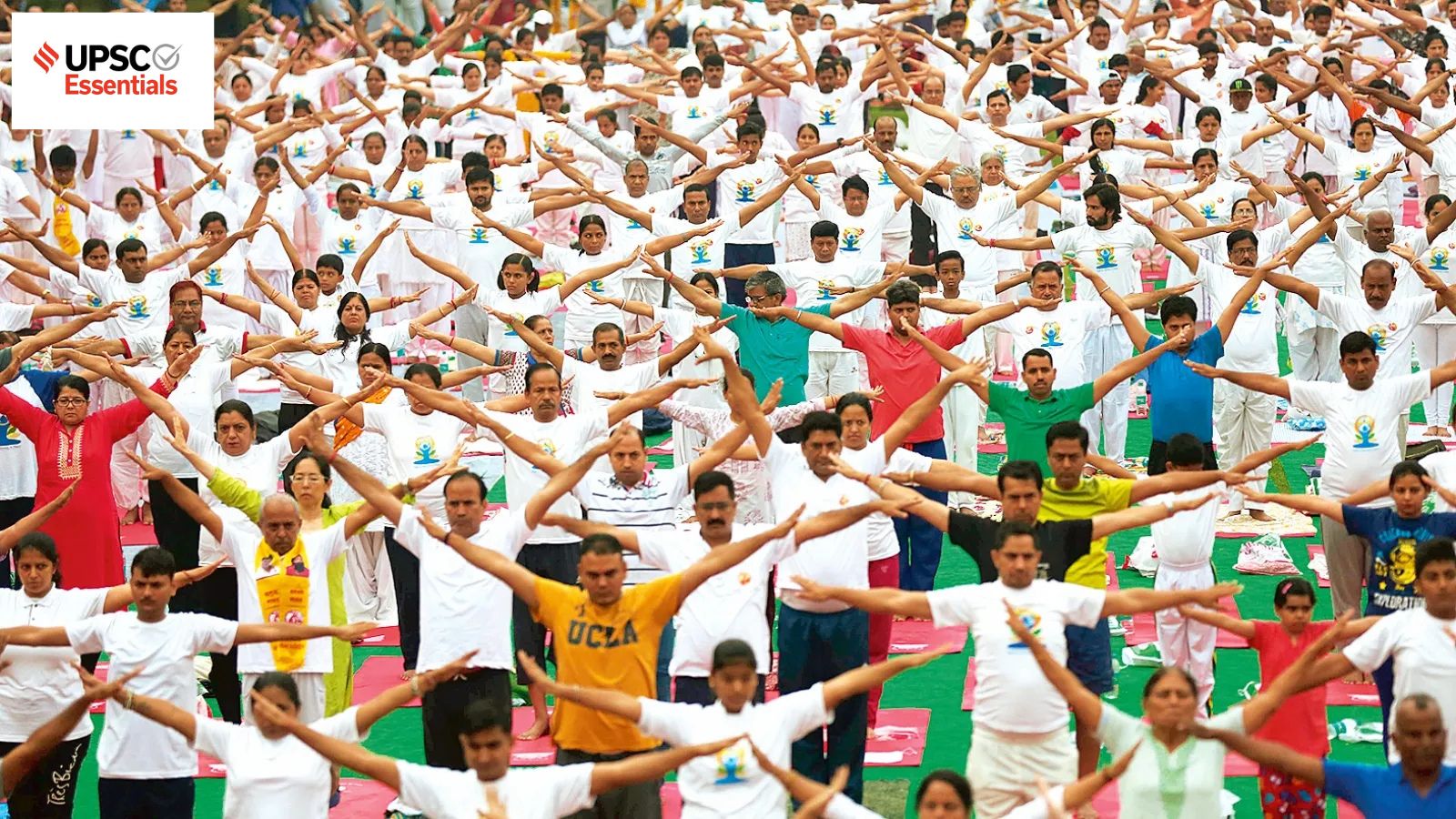
The traditional knowledge systems of India are increasingly finding relevance in addressing modern public health and societal challenges. Discuss this statement with reference to yoga and healthy ageing.
QUESTION 2
Discuss the significance of Rakhigarhi in the study of the Harappan Civilisation. How can multidisciplinary scientific investigations deepen our understanding of ancient Indian society?
QUESTION 1: The traditional knowledge systems of India are increasingly finding relevance in addressing modern public health and societal challenges. Discuss this statement with reference to yoga and healthy ageing.
Relevance: The question links Indian culture with contemporary societal issues, a recurring theme in GS Paper 1. It also reflects UPSC’s trend of examining the relevance of traditional knowledge systems in addressing modern challenges.
Note: This is not a model UPSC answer. It only provides you with a thought process which you may incorporate into the answers.
Introduction:
Story continues below this ad
— Traditional knowledge systems in India are becoming regarded as effective frameworks for tackling contemporary public health and societal concerns, rather than just cultural inheritances.
— The theme of the 2026 International Day of Yoga, “Yoga for Healthy Ageing,” demonstrates the growing importance of ancient Indian knowledge in supporting holistic well-being in an ageing world.
Body:
You may incorporate some of the following points in your answer:
— Yoga has grown in importance as life expectancy has increased and the population has aged. According to the India Ageing Report 2023, by 2050, approximately one in every five Indians will be above the age of 60, making healthy ageing a vital societal goal. As a result, the aim is not only to add years to life, but also to make those years more alive.
Story continues below this ad
— Yoga, which is based in India’s spiritual and philosophical traditions, provides a holistic approach by balancing the body, mind, and spirit. Unlike strictly curative medical therapies, it focuses on prevention, resilience, and general wellness.
— Recent academic and clinical studies included in the article show that regular yoga practice can enhance balance, flexibility, mobility, respiratory efficiency, bone health, and blood pressure regulation in older persons, lowering their risk of falls and age-related disability.
— Its benefits go beyond physical health. Meditative and breathing methods have been demonstrated to increase sleep quality, emotional resilience, cognitive functioning, and mental well-being in the aged population. Importantly, yoga addresses one of the most serious socioeconomic concerns connected with ageing: social isolation, by encouraging a sense of collective belonging and community participation. Furthermore, customised and gentle yoga protocols make the practice more accessible to seniors while also providing emotional support to carers.
Conclusion:
— The National Education Policy 2020 accords yoga a significant place as an integral component of health, wellness, and value-based education. This is a positive step in the direction of initiating the young into yoga.
Story continues below this ad
— Beyond physical rehabilitation, yoga nurtures emotional balance and social connectedness. Yoga gently transforms this inward loneliness into a broader sense of collective belonging.
(Source: Yoga for healthy ageing: Adding life to years)
Points to Ponder
Why is healthy ageing emerging as a major societal challenge in India?
How can traditional practices be integrated with evidence-based modern medicine?
Related Previous Year Question
How does Indian society maintain continuity in traditional social values? Enumerate the changes taking place in it. (2021)
Story continues below this ad
QUESTION 2: Discuss the significance of Rakhigarhi in the study of the Harappan Civilisation. How can multidisciplinary scientific investigations deepen our understanding of ancient Indian society?
Relevance: The question is relevant due to recent archaeological and scientific studies at Rakhigarhi, one of the largest Harappan sites. It also highlights the importance of scientific evidence in reconstructing ancient Indian history, especially where literary sources are absent.
Note: This is not a model UPSC answer. It only provides you with a thought process which you may incorporate into the answers.
Introduction:
— As the Harappan script has yet to be translated, researchers rely mainly on archaeological and material evidence. In this backdrop, recent scientific research into skeleton remains recovered from Rakhigarhi, one of India’s major Harappan sites, have underlined the growing importance of multidisciplinary techniques to reconstructing India’s ancient past.
Story continues below this ad
— Rakhigarhi, located in modern-day Haryana, is notable because it is one of the most massive urban sites of the Harappan Civilisation, spanning nearly 550 hectares and demonstrating occupation from the Early to Mature Harappan stages.
Body:
You may incorporate some of the following points in your answer:
— Excavations have found evidence of organised urban communities, including as mud-brick fortifications, roadways, drainage systems, craft production, bead-making workshops, ceramics, terracotta figurines, and bone and ivory carving. Importantly, Rakhigarhi is one of the few Harappan sites where cemeteries and human burials have been methodically excavated, offering invaluable information about the lives of its residents.
— Multidisciplinary scientific study can greatly contribute to our understanding of ancient Indian society. Palaeoanthropological studies, molecular biology, and ancient DNA analysis can aid in the reconstruction of ancestry, migration, and biological history. Palaeopathological research can disclose diseases, health problems, and the general health of Harappan populations. Similarly, the analysis of teeth and mandibles can reveal information about dietary habits, subsistence patterns, and food preparation procedures.
Story continues below this ad
— Scientific examination of skeletal remains can also reveal inequalities in nutrition and health among different social groups, revealing light on societal stratification.
— Furthermore, research of burial patterns and grave artefacts can aid in reconstructing cultural behaviours, social rank, and belief systems. Current research on facial reconstruction, environmental reconstruction, and anthropological analysis aims to gain a more comprehensive understanding of Harappan communities’ appearance, mobility, lifestyle, and ecological adaptations.
Conclusion:
— Since patterns of food consumption and nutrition are related to social standing, assessing the nutritional inputs in the skeletal remains of men and women can provide insight into disparities in status between various social groups. Differences in burials and the study of grave goods can further be used to make interpretations about social status and cultural practices of the Indus Valley inhabitants.
(Source: Rakhigarhi remains sent for scientific study: What ancient human remains can tell us)
Points to Ponder
Story continues below this ad
Why is Rakhigarhi considered a landmark site in the study of the Harappan Civilisation?
What are the advantages and limitations of scientific investigations in understanding ancient societies?
Related Previous Year Questions
Discuss the salient features of the Harappan architecture. (2025)
To what extent has the urban planning and culture of the Indus Valley Civilisation provided inputs to the present day urbanisation? Discuss. (2014)
Previous Mains Answer Practice
UPSC Essentials: Mains answer practice — GS 3 (Week 160)
UPSC Essentials: Mains answer practice — GS 3 (Week 159)
UPSC Essentials: Mains answer practice — GS 2 (Week 160)
UPSC Essentials: Mains answer practice — GS 2 (Week 159)
UPSC Essentials: Mains answer practice — GS 1 (Week 158)
UPSC Essentials: Mains answer practice — GS 1 (Week 159)
Subscribe to our UPSC newsletter and stay updated with the news cues from the past week.
Stay updated with the latest UPSC articles by joining our Telegram channel – IndianExpress UPSC Hub, and follow us on Instagram and X.
View original source — Indian Express ↗
Related stories

NPR
TechnologyJun 27, 2026 · 1 min
Inside a secretive Ukrainian team launching deep drone strikes at Russia
NPR
Indian Express
TechnologyJun 27, 2026 · 1 min
Knowledge Nugget | What is Netra, India’s indigenous ‘eye in the sky’?
Indian Express

The New York Times
TechnologyJun 27, 2026 · 1 min
This Trap Wants Ants to Take a Bite
The New York Times

TechRadar
TechnologyJun 27, 2026 · 1 min
Octopus Energy just announced 30kWh home batteries to compete with Tesla Powerwall — but they won't go on sale till 2027
TechRadar