Times of Israel
Trump threatens to ‘complete the job’ in Iran as US military launches fresh strikes
WASHINGTON — US President Donald Trump said Saturday that the Islamic Republic of Iran would “no longer exist” if the United States is “forced” to resume the war, as he accused Tehran of violating a ceasefire by striking ships in the Strait of Hormuz.
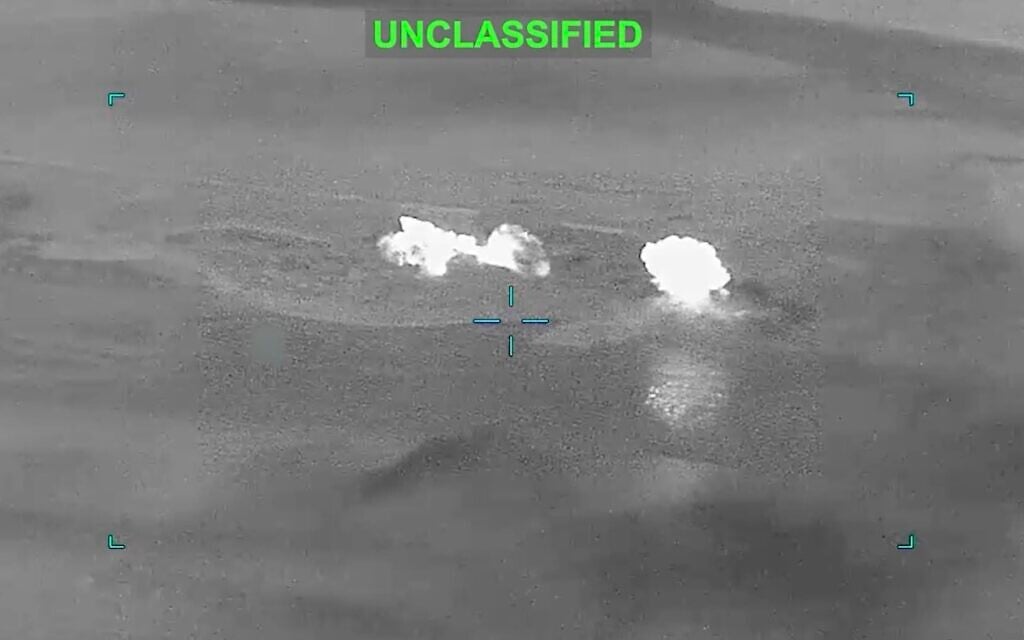
The threat came after US forces said they struck “multiple” Iranian targets Saturday in another tit-for-tat response to attacks on shipping in the vital Strait of Hormuz.
“United States aircraft just struck Iranian missile and drone storage locations, and coastal radar sites, for violating the Cease Fire Agreement, AGAIN!” Trump wrote on Truth Social.
“There may come a point when we are no longer able to be reasonable, and will be forced to militarily complete the job that we very successfully started. If that happens, the Islamic Republic of Iran will no longer exist!” Trump wrote.
US Central Command said the strikes were in response to an Iranian drone attack on the Panama-flagged oil tanker “Kiku,” which was carrying some two million barrels of crude.
Get The Times of Israel's Daily Edition
by email and never miss our top stories
By signing up, you agree to the terms
The US military said the latest response targeted “surveillance infrastructure, communication systems, air defense sites, drone storage facilities, and minelayer capabilities.”
In total, it said it hit 10 Iranian military targets “at multiple locations in and near the Strait of Hormuz.”
Iranian media reported several explosions in the Sirik and Qeshm areas of southern Iran.
U.S. Navy and Air Force fighter jets conducted strikes tonight on 10 Iranian military targets at multiple locations in and near the Strait of Hormuz for Iran's drone attack on M/T Kiku. pic.twitter.com/Z0TLZRqmF6
— U.S. Central Command (@CENTCOM) June 28, 2026
In the wake of the strikes, Iran’s Islamic Revolutionary Guard Corps also accused the US of violating the terms of the ceasefire, announcing that its navy and aerospace forces had launched joint missile and drone attacks targeting US military sites in Kuwait and Bahrain in retaliation.
“Violating the ceasefire is contrary to Clause 1 of the Islamabad Memorandum of Understanding and will result in the complete halt of all diplomatic processes,” the IRGC said in a statement carried by Iran’s Press TV.
In a statement, Kuwait’s military said that its air defenses were “engaging hostile missile and drone attacks.”
In Bahrain, which hosts a major US naval base, the interior ministry said air raid sirens had been activated, and urged residents to “remain calm and head to the nearest safe place.”
A US official speaking on condition of anonymity told Reuters that there were no reported US casualties or major impacts or damage to US facilities in the Middle East in the immediate aftermath of the Iranian attacks.
The IRGC warned that any further US action would be met with a “crushing response.”
In a statement, the IRGC said it “destroyed eight important US military facilities at the Ali al-Salem base in Kuwait and at the Fifth Fleet naval base in Port Salman in Bahrain.
“Any enemy aggression, whatever the pretext, even against insignificant targets… will have a crushing response,” the IRGC added.
The clashes brought new tension to the negotiating process meant to end a war launched by the United States and Israel at the end of February.
They also underlined the risks still facing one of the world’s most important sea lanes for oil and other commodities.
On Friday, the United States also conducted strikes that it said were in response to another Iranian attack on a ship, the “Ever Lovely.”
Iran said Saturday it had hit US targets in the Gulf in its own retaliation. Bahrain said it was targeted by several Iranian drones early on Saturday and accused Tehran of “sabotaging peace efforts.”
Iran’s Revolutionary Guards said “if the aggression is repeated, our response will be broader.”
Shipping lanes under fire
The flare-ups in violence highlighted ongoing wrangling over control of the Strait of Hormuz.
Iran imposed a blockade in the strait soon after the US and Israel, on February 28, launched a bombing campaign on the Islamic Republic in a bid to destabilize its regime and destroy its ballistic missile and nuclear programs. The blockade has triggered a global spike in energy prices.
Traffic through the Strait has increased since the US and Iran signed a memorandum of understanding earlier this month, but is still well below prewar levels.
Iran has warned vessels not to enter or leave the Gulf through the Strait without permission, but ships have continued to move, some using a route not authorized by Tehran.
The US and Iran are still debating the terms of the interim peace deal, including issues such as getting ships through the narrow mouth of the Persian Gulf and addressing the future of Iran’s stockpile of highly enriched uranium.
Under the memorandum of understanding, the US and Iran have 60 days to iron out the details. As talks are held behind closed doors, Trump and Iranian leaders have seemed to negotiate in public, trading threats and claiming concessions the other side denies.
Israel is not a party to the agreement or negotiations between the US and Iran, and Israeli officials have criticized the memorandum of understanding for its lack of a concrete concession from Iran on its nuclear program.
Despite the latest flare-up, oil prices have fallen sharply on hopes that traffic through Hormuz would recover. In peacetime, it carries about a fifth of the world’s oil and liquefied natural gas exports.
The economic impact on Iran remains unclear, but on Saturday, the country’s statistics agency said that year-on-year inflation had hit 88.6 percent, up from 68 percent in February.
View original source — Times of Israel ↗
Related stories

Antara News
PoliticsJun 28, 2026 · 1 min
Prabowo urges vigilance over nuclear and AI developments
Antara News

France 24
PoliticsJun 28, 2026 · 1 min
Middle East live: Iran threatens a 'completely halt' in talks with US following exchange of fire
France 24

Euronews
PoliticsJun 28, 2026 · 1 min
A ‘strategic mistake of colossal proportions’: Why Trump is losing the war on renewables
Euronews
The Guardian
PoliticsJun 28, 2026 · 1 min
Labour has abandoned the missions that brought it to power. Here's how Burnham could revive them. | Mariana Mazzucato
The Guardian