Times of Israel
Golan’s Democrats party unveils 51 primary candidates, touts 85,000 members
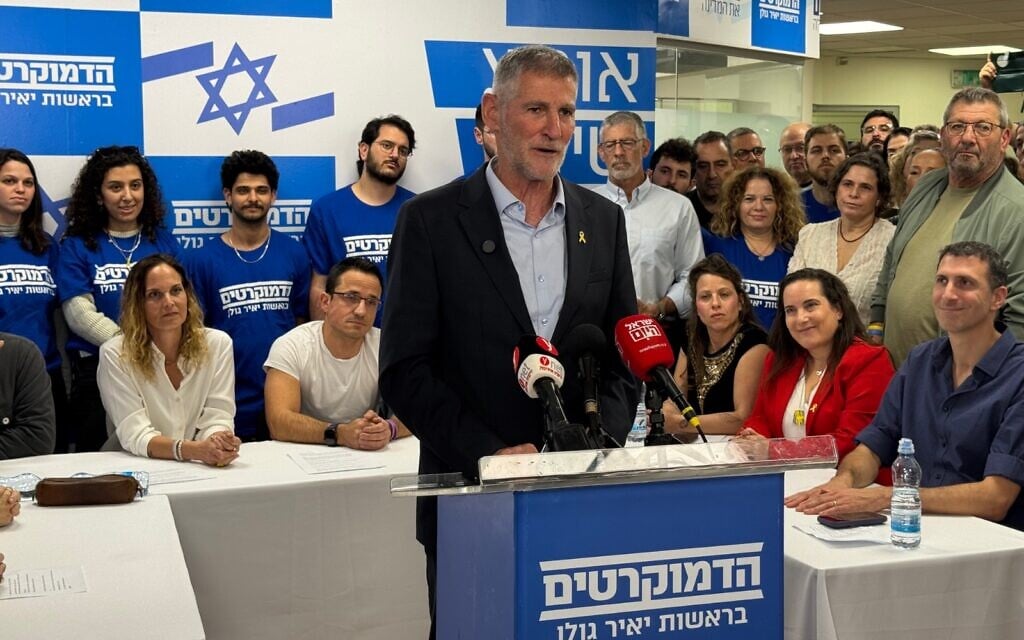
Yair Golan’s Democrats on Sunday unveiled the 51 candidates who will compete in a July 20 primary for the votes of what the left-wing party said were 85,000 dues-paying members.
The list features current and former lawmakers as well as anti-government protest leaders, including the outspoken brother of a slain hostage.
The candidates represent a “diverse range of communities from Beit Jann in the north to Sde Boker in the south” and include 19 women, with candidates coming from the Jewish, Druze, Arab and LGBTQ communities, the party said in a statement.
Membership in The Democrats remains open until July 12, with only registered members eligible to vote in the primary, which will determine the order of the electoral slate under Golan.
The party was formed in 2024 as an alliance of the Labor and Meretz parties under Golan’s leadership. The outspoken ex-deputy chief of the IDF, who briefly served as a lawmaker for Meretz, had assumed Labor’s mantle on the heels of the public acclaim he received for his heroism during the Hamas-led onslaught of October 7, 2023.
Get The Times of Israel's Daily Edition
by email and never miss our top stories
By signing up, you agree to the terms
Among the candidates in the Democrats primary are MKs Naama Lazimi, Gilad Kariv and Efrat Rayten, three of Labor’s four incumbent lawmakers.
MK Merav Michaeli, who led Labor in the previous election, will not run. Michaeli was lambasted on the left for failing at the time to unite with the further-left Meretz, which in turn fell short of the electoral threshold.
Former Meretz MKs Michal Rozin, Mossi Raz, Gaby Lasky and Ali Salalha — all of whom lost their seats in the 2022 election — were among the 51 candidates running in the Democrats primary.
Other former lawmakers in the running were Inbar Bezek, who served in the Knesset as part of Opposition Leader Yair Lapid’s Yesh Atid party, and Ram Shefa, who entered the Knesset with the centrist Blue and White party and later served as a lawmaker for Labor.
Other candidates include former Air Force general Nimrod Sheffer; former deputy national security adviser Eran Etzion; secularist activist Naor Narkis; Muslim Arab coexistence advocate Somaya Bashir; and Lt. Col. (res.) Ihab Shalyan, the first Christian Arab to reach that rank, who advocates for Christian Arabs to enlist in the IDF.
Also running are Rabbis for Human Rights CEO Avi Dabush, a survivor of the October 7 onslaught; investigative journalist Tomer Avital; Dani Elgarat, brother of slain hostage Itzik Elgarat, who regularly speaks at anti-government protests; and Moshe Radman, Ami Dror, Moran Michel and Nava Rozolyo, prominent organizers of the protests.
Candidates under Golan will be ranked according to the number of votes they receive, subject to party rules meant to guarantee gender parity and representation for candidates from moshavim, kibbutzim and the Arab and Druze minorities. The Labor-Meretz merger agreement that the Democrats approved in March also reserves spots for Meretz on the joint electoral slate.
Only a handful of Israeli parties, including Prime Minister Benjamin Netanyahu’s Likud and the Arab-majority Hadash, use primaries to select their Knesset slates. In other parties, including The Democrats’ allies in the Zionist opposition bloc, the order of the electoral slate is determined by the leadership.
“While the rest of the political map retreats into closed rooms, relying on arranging committees or a single leader, we are offering the public a transparent, open, principled and stable governing alternative,” Democrats Secretary-General Omer Lubaton said in a statement, asserting his was “the only democratic party” in the Zionist opposition.
Polls by Hebrew media, including The Times of Israel’s sister site Zman Yisrael, consistently award The Democrats about 10 of the Knesset’s 120 seats in the coming election, which is set to take place by October 27.
The party’s current representation in the Knesset comprises only Labor’s four lawmakers.
Labor and Meretz, the parties that make up The Democrats, were respectively the most recent iterations of Mapai and Mapam, the two main factions of the Labor Zionist movement that dominated early Israeli politics.
Times of Israel staff contributed to this report.
View original source — Times of Israel ↗
Related stories

The Punch
PoliticsJun 28, 2026 · 1 min
Kebbi declares war on’Yan vocal’ cybercrime syndicate
The Punch
The Punch
PoliticsJun 28, 2026 · 1 min
Fashola an outstanding governor, leader, Tinubu celebrates ex-minister at 62
The Punch
The Punch
PoliticsJun 28, 2026 · 1 min
Fashola an outstanding governor, leader, Tinubu celebrates ex-minister at 63
The Punch
The Punch
PoliticsJun 28, 2026 · 1 min
APC chieftain distances party from Osun pre-election violence
The Punch