Indian Express
From the Balkans to the World Cup: How a country that no longer exists shaped football
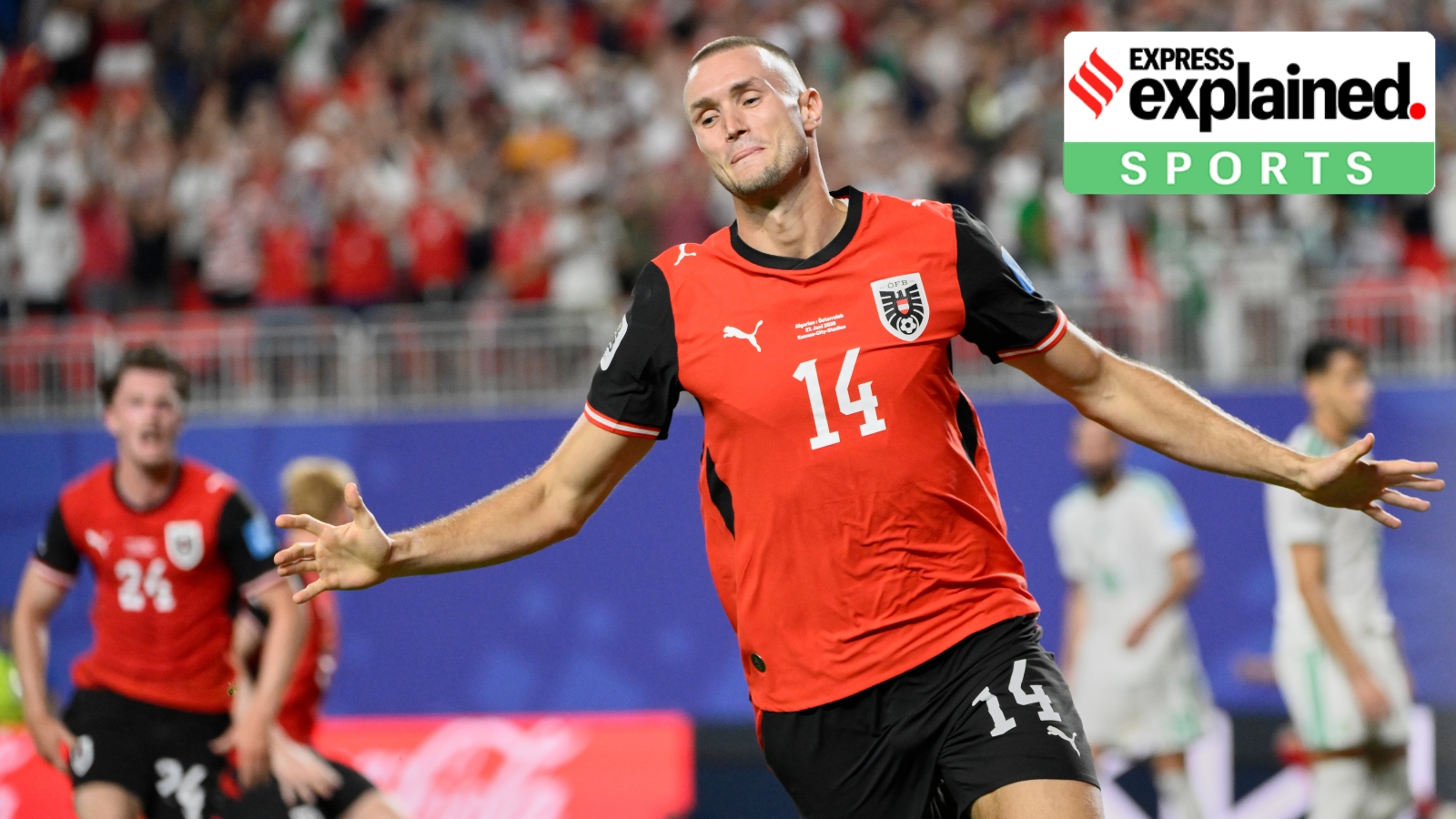
When Austria met Algeria at the 2026 FIFA World Cup, a tense finish took centre stage. Austria needed at least a draw to qualify for the round of 32, but up until the 96th minute it appeared Algeria had pulled off the victory. Instead, Austria turned the match into a dramatic 3-3 draw and secured qualification with a stoppage-time winner from substitute striker Saša Kalajdžić.
Kalajdžić’s story, however, stretches far beyond a decisive goal. Born in Austria to Bosnian Serb parents who fled Bosnia and Herzegovina during the Yugoslav wars of the 1990s, he is one of dozens of players at this World Cup whose lives have been shaped by the breakup of a country that no longer exists.
Breakup of Yugoslavia
At the start of the 1990s, Yugoslavia was a federation of six republics: Bosnia and Herzegovina, Croatia, Macedonia, Montenegro, Serbia and Slovenia. In addition to the six republics, the two separate regions of Kosovo and Vojvodina held the status of autonomous provinces within Serbia.
As communism collapsed across Eastern Europe, nationalist movements surged, especially after the death of President Josip Broz Tito. Slovenia and Croatia declared independence in 1991, triggering a chain of wars across the Balkans, including conflicts in Bosnia and Herzegovina, Kosovo, and later Macedonia. The violence redrew borders and created a major refugee crisis.
The Bosnian War alone killed more than 100,000 people and forced around two million people to flee their homes between 1992 and 1995, according to the United Nations.
Beyond displacement, the collapse of Yugoslavia reshaped football itself. The national team was suspended and barred from UEFA Euro 1992 due to UN sanctions. In their place, Denmark — late call-ups after finishing runners-up in qualifying — went on to win the tournament in one of international football’s most unlikely triumphs.
Story continues below this ad
Domestically, the Yugoslav First League dissolved into separate national competitions, permanently reshaping the footballing map of the Balkans. Diaspora communities formed across Germany, Austria, Switzerland, Sweden, Australia, New Zealand, and North America. Three decades later, those movements continue to shape international football.
Diaspora and nationhood
No squad better reflects that history than Bosnia and Herzegovina’s. Seventeen players in Bosnia’s World Cup squad were born outside the country they represent.
For Bosnia, the diaspora is not just a talent pool — it is central to its football identity. Nowhere is this more evident than in Esmir Bajraktarević, whose decisive penalty against Italy secured Bosnia’s qualification for the 2026 World Cup. Born in the United States to a Bosniak Muslim family connected to Srebrenica, he represents a generation shaped by the legacy of the July 1995 genocide, in which more than 8,000 Bosniak men and boys were killed.
Memorial stone at the Srebrenica-Potočari Memorial Centre. More than 8,000 Bosniak men and boys were killed in the July 1995 genocide. Photo: Wikimedia Commons
Few countries intertwine football and national identity as closely as Croatia. Months before war officially began, Dinamo Zagreb captain Zvonimir Boban kicked a police officer during riots involving Red Star Belgrade fans at Maksimir Stadium in May 1990. Many Croatians still view the moment as symbolic of the country’s path to independence.
Story continues below this ad
Croatia’s first president, Franjo Tuđman, once said: “Football victories shape a nation’s identity as much as wars do.” The war’s impact continues to be felt within the squad today.
Luka Modrić’s grandfather was killed near their home village, forcing the family to flee to Zadar. They spent years living in a hotel for refugees, where Modrić learned football in corridors while air-raid sirens sounded outside.
Midfielder Mateo Kovačić was born in Austria after his parents fled Bosnia, while defender Marin Pongračić was born in Germany to a Croatian family displaced by war.
History’s fault lines
The Yugoslav wars did not only reshape nations — they created political fault lines that still influence international football fixtures. This was most visible during Switzerland’s match against Serbia at the 2018 World Cup.
Story continues below this ad
Switzerland’s Granit Xhaka and Xherdan Shaqiri, both ethnic Albanians with roots in Kosovo, celebrated their goals by forming the double-headed eagle gesture from Albania’s flag. Serbia condemned the act as political, and FIFA later fined both players.
The symbolism traced back to the Kosovo War. In 1998, the Kosovo Liberation Army launched an armed rebellion against Serbian rule. Serbian forces responded with a conflict that escalated across the region, ending after NATO’s 78-day bombing campaign in 1999.
Matches involving Serbia, Albania, and Kosovo remain classified as high-risk fixtures. Kosovo and Serbia have never met in a senior competitive international match, and UEFA and FIFA ensure the two teams are kept apart in tournament draws for security reasons.
Reminders of a country lost
The consequences of the Yugoslav wars extend far beyond Europe, with players carrying fragments of that history across continents.
Story continues below this ad
Australia defender Miloš Degenek was born in Knin, Croatia, to a Serbian family. At 18 months old, he fled to Belgrade. During NATO’s bombing of Serbia in 1999, he grew up with air-raid sirens and nights in shelters before his family eventually emigrated to Australia. “But as a six-year-old,” he recalled during an interview, “I thought that was normal.”
The story stretches further still. New Zealand midfielder Marko Stamenić was born in Wellington to a Serbian father who fled Novi Sad during the Yugoslav wars. While he never experienced the conflict directly, his family’s journey reflects how the wars reshaped communities across continents.
The World Cup is often framed as a celebration of nations. But scattered across squads on multiple continents are reminders of a country that no longer exists. What remains is not just memory, but structure: new national teams, fractured leagues, and a diaspora that continues to define football talent across Europe and beyond.
View original source — Indian Express ↗
Related stories

BBC
TechnologyJun 29, 2026 · 1 min
Where can I see the Strawberry Moon tonight?
BBC
Indian Express
TechnologyJun 29, 2026 · 1 min
Sarla Bhat murder case: SIA names Yasin Malik, 4 JKLF operatives in chargesheet, 36 years on
Indian Express

TechRadar
TechnologyJun 29, 2026 · 1 min
How universities can better prepare graduates for the demands of the modern workplace
TechRadar
%20copy.jpg)
Wired
TechnologyJun 29, 2026 · 1 min
The Busy Bar Is a Gadget to Get People to Leave You Alone
Wired