CNA
CNA Explains: Why AI stocks are whipsawing markets from Wall Street to Seoul
Singapore
Are recent tech sell-offs a cause for concern, and is an AI bubble forming?
New: You can now listen to articles.
This audio is generated by an AI tool.
02 Jul 2026 06:00AM
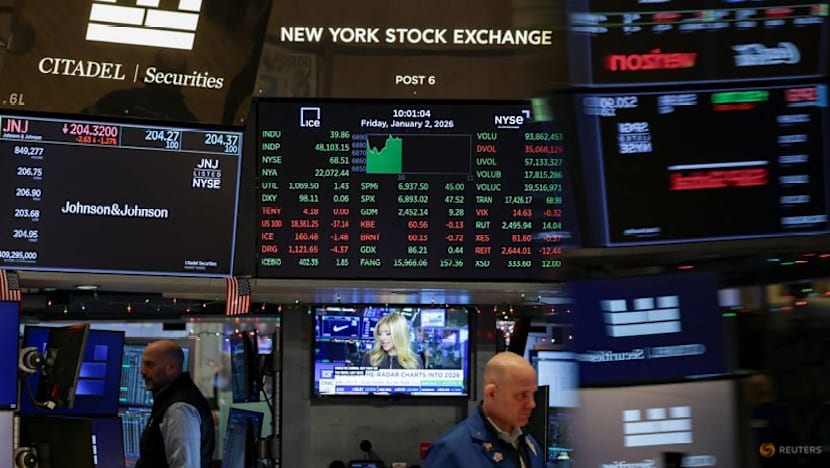
SINGAPORE: Tech stocks have been swinging sharply in recent weeks, as investors weigh the promise of artificial intelligence against concerns over lofty valuations and returns on massive spending.
The volatility has rippled across global markets - from Wall Street to Seoul - with sharp sell-offs in major tech names followed by equally swift rebounds.
In South Korea, for instance, stocks posted their strongest quarterly gain in nearly 30 years on Tuesday (Jun 30), powered by a rally in chipmakers - just a week after plummeting nearly 10 per cent.
Why are AI-linked stocks so volatile, and should investors be worried when markets pull back?
What's driving volatility in tech stocks?
Analysts said recent AI-fuelled sell-offs have been driven by uncertainty about the returns of massive AI investments, as well as overstretched valuations.
US technology giants are expected to collectively invest about US$650 billion in AI-related infrastructure this year, according to an analysis by Bridgewater Associates. That is a sharp increase from US$410 billion in 2025.
“AI stocks have been in focus and have done well due to their ability and capability to bring the new technology into the market, which will drive permanent and increased usage over the long term,” RHB Singapore’s research analyst Alfie Yeo told CNA.
“However, amid higher interest rates and inflation concerns in the US, the focus in recent days has now shifted to the clarity of future returns vs initial investment … in this space.”
Chris Beauchamp, chief market analyst at IG, noted that as with every trend, the AI sector will also face rocky patches. “The journey has become more volatile now that the initial rush of buying has slowed,” he added.
The tech-heavy Nasdaq Composite - often seen as a proxy for AI-linked stocks - has reflected these swings.
It fell into correction territory earlier this year amid broader market jitters tied to uncertainties around the US-Iran war. The index plunged nearly 11 per cent in March from its last record high in October last year, before rallying 15.3 per cent in April.
Such swings reflect both profit-taking and opportunistic buying.
“After their huge rally, many tech stocks face much pricier valuations, and as a result investors have become more skittish about possible weakness in earnings,” Beauchamp said.
“Having made such big gains of late, the temptation to book profits is becoming hard to resist.”
After the latest dip, investors have in turn rushed in to pick up bargains.
"After last week's record selling in big tech, buyers returned to the same names they were throwing overboard only days earlier," said SPI Asset Management's Stephen Innes.
"That does not mean the AI trade has suddenly been cured. It means the patient stopped bleeding long enough for the surgeons to begin bidding the stock back up."
Are recent sell-offs a cause for concern?
Despite the sharp moves, analysts said periodic corrections are not unusual - and may even be a healthy sign.
With companies pouring billions into AI, investors are naturally reassessing whether returns will justify the spending, HSBC Private Bank and Premier Wealth’s investment strategist Abhilash Narayan told CNA.
But he noted that underlying demand remains strong, particularly as companies increasingly embed AI in their operations.
“In fact, the periodic pull-backs and consolidations can be interpreted as positive signs that markets are acting rationally and not blindly chasing AI stocks,” Narayan said.
IG’s Beauchamp noted that the recent sell-offs have been dramatic but contained.
“Investors who want to be in tech stocks need to learn that the price for huge gains is plenty of volatility too,” he said.
“Chasing rallies and then selling at the first sign of trouble is a sure-fire way of missing out on the good days.”
Is an AI bubble forming?
The scale of spending has also raised concerns about a potential AI bubble, drawing comparisons with the dot-com boom of the late 1990s.
That period saw inflated valuations in internet stocks collapse, wiping out billions in market value and triggering widespread job losses.
For now, analysts said the comparison may be premature.
“Despite everything, it still doesn't look like a bubble. If it is a bubble, then we are only in the earliest stages,” said Beauchamp, noting that the current AI rally is built on earnings rather than speculative bets.
Narayan added that while valuations for some companies appear stretched, at an aggregate level, he sees strong revenue visibility for AI hardware manufacturers.
“Valuations for several large-cap stocks in the US have pulled back, which combined with their strong earnings growth, supports a favourable risk-reward in our opinion,” he said.
Similarly, OCBC head of equity research Carmen Lee said elevated valuations are less concerning if backed by earnings growth.
“However, if the selling is led by overinvestments or excessive valuations, then investors are likely to switch out into other stocks or sectors,” Lee told CNA.
AI-driven optimism has also lifted sectors tied to the buildout of data centres, including semiconductors, industrials and energy.
"The risk from the market's perspective is the technicals are so crowded within those trades that anything that starts to sow some seeds of doubt in the narrative and you are at a somewhat vulnerable position," said Garrett Melson, portfolio strategist with Natixis Investment Managers Solutions.
Still, OCBC’s Lee said that most AI-linked sub-segments are not trading at excessive valuations.
Why are North Asian markets more exposed?
The impact of AI-driven volatility has been particularly pronounced in North Asia, where markets are heavily weighted towards technology and semiconductor stocks.
South Korea’s KOSPI index, for instance, has nearly doubled its value since January, propelled by chipmakers Samsung Electronics and SK Hynix - both also now trillion-dollar companies.
Together, the two companies account for half of the KOSPI’s market capitalisation.
"The fact that two companies make up such a large portion of the market highlights just how concentrated that dependence is, and that is the biggest risk factor," said Kim Dae-jong, a professor at Sejong University.
Such concentration amplifies both gains and losses, analysts said.
Taiwan and Japan’s indices are also heavily exposed to AI trades.
In Taiwan, TSMC, a supplier to AI chip specialist Nvidia, accounts for roughly 40 per cent of the Taipei stock market. In Japan, tech investor Softbank has also surpassed Toyota as the country’s most valuable company.
How exposed is Singapore to tech swings?
Singapore’s market, by contrast, is less sensitive to tech-driven swings due to its composition.
The Straits Times Index is dominated by financials, with Singapore's three banks - DBS, OCBC and UOB – accounting for roughly half of the index’s weighting, said RHB Singapore’s head of equity research Shekhar Jaiswal.
“When global risk sentiment deteriorates, Singapore equities are not immune, but the impact tends to be modest relative to more AI-concentrated indices,” Jaiswal told CNA.
Yeo from RHB Singapore added that Singapore-listed tech firms tend to play supporting roles in the semiconductor and AI supply chain, rather than being primary drivers.
Still, analysts cautioned that Singapore is not entirely shielded.
“Given the importance of the tech sector for some of Singapore's key trading partners, a slowdown in these key sectors is bound to affect investor confidence in the outlook for the Singaporean economy,” IG's Beauchamp said.
Jaiswal said the bigger risk lies in indirect effects such as global risk aversion, weaker trade flows if the tech supply chain slows, or a pullback in semiconductor demand.
“In short, when AI sentiment turns negative, Singapore is more likely to catch a cold than pneumonia,” he said.
Want an issue or topic explained? Email us at digitalnews [at] mediacorp.com.sg. Your question might become a story on our site.
Source: CNA/co(gs)
Related stories

The Punch
BusinessJul 2, 2026 · 1 min
Tinubu approves N111bn for 700km northern superhighway construction
The Punch
The Punch
BusinessJul 2, 2026 · 1 min
Crude slips below $72, petrol stays above N1,000
The Punch
The Punch
BusinessJul 2, 2026 · 1 min
Nigeria, AfCFTA push Africa’s $180bn digital trade
The Punch
VnExpress
BusinessJul 1, 2026 · 1 min
Students of Southeast Asia's largest economy are choosing China over US
VnExpress