The Guardian
Germany are no longer a tournament team and must reconnect with our own identity
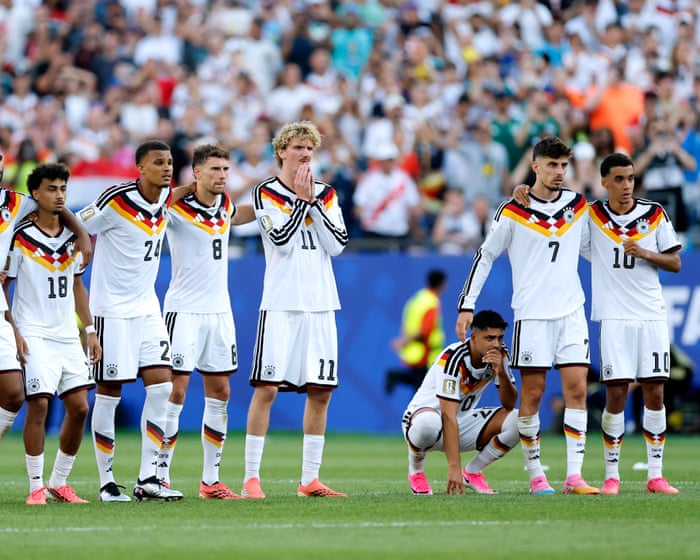
I am stunned. Germany have been eliminated early from a World Cup for the third time in a row. I need time to recover from this. The key word that needs to be discussed is continuity – something the national team have lacked for a decade. German football hasn’t decided how it wants to play. There are constantly new ideas, and time and again new players in new positions. Julian Nagelsmann has experimented too much, and not just during this tournament. Yet developing a team takes years.
Germany have always been successful when player roles were clearly defined, the hierarchy was established and the team had a clear concept of how to attack and defend. That conviction was completely missing. At this World Cup, the team didn’t look as if they had gone through the process that every team must undergo.
You could see it on the pitch in every game. There was a lack of control over the match in terms of building play confidently from the back through the midfield and into the attack, then keeping possession in the opponent’s half. Or, when the opponents have the ball, keeping them away from our own goal. I see that with other nations, but not with us.
We used to be known as a Turniermannschaft (“tournament team”). That meant finding our rhythm as the tournament progressed. Those days are gone. This time, the team got worse from game to game. That happened because promising approaches were abandoned, even when they were working well. The idea of using Deniz Undav as an impact substitute worked well, yet Nagelsmann deviated from that strategy against Paraguay.
Let me give two examples of what I would have done differently. First, Joshua Kimmich plays in midfield for Bayern Munich, so he should have played there for the national team as well. Second, Florian Wirtz and Kai Havertz are two of our best players, as evidenced by the goal against Paraguay. I would have liked to see Wirtz in the middle, playing centrally behind Havertz, where he is at his strongest. And I would have wanted that consistently – game after game, and day after day in training.
Nagelsmann likes to change systems and formations. That is his style, he says. Yet great teams such as Spain or France always play according to the same pattern. I recognise them immediately when I am watching. They simply execute it so well that others cannot stop them. You shouldn’t make things in football more complicated than they are.
Of course, a coach is allowed to vary things, but only the details, and only once there is order within the team. That is a general problem with German teams, including those in the Bundesliga. Most of them lack that clarity.
One also has to address Nagelsmann’s changes. Against Ecuador – in the final group match, which was of no consequence – he used a different formation from the one he used Paraguay in the last 16. Like many things, I didn’t understand that move. Every change sends a message to the team – a message that needs to be understood. Any rotation should serve a purpose that is ideally self-evident. That wasn’t the case here.
There was something about this World Cup that gives me hope, however. When faced with failure, the players didn’t turn on one another; the team protected their own. Antonio Rüdiger spoke highly of his rivals Jonathan Tah and Nico Schlotterbeck; Havertz raved about Undav; and Kimmich stood up for both Leroy Sané and Nagelsmann. I liked that. That is something to build on.
I also defend the players against accusations that they lack the right attitude. That was certainly the case in Russia in 2018, when the World Cup-winning generation put in a disastrous performance. But I do not accept that criticism regarding 2022 and 2026. It is not a question of the players’ character. I can see that the team are giving their all. Failure hits them hard. After the elimination in Qatar in 2022, Kimmich spoke of his fear of falling into a deep slump. He was devastated this time, too.
Today’s generation consists of “system players” who came through youth academies. They have viewed football as a profession since the age of 12 or 13 – a profession where everything has been growing dynamically for 15 years: salaries, digital presence and the excesses of individualisation. It is hard to keep pace with all that. That is where leadership is required.
And the generation after mine needs a fair chance. Yet, time and again, coaches fall back on the 2014 World Cup winners; at this tournament Manuel Neuer. Such a decision may provide short-term stability for the squad, but it always signals a lack of faith, an implication that the team cannot manage on their own.
Argentina and France – with Lionel Messi and Kylian Mbappé – prove that it is possible to build a team using established players. They operate under the same conditions as Germany. Didier Deschamps and Lionel Scaloni lead their squads; there is a sense of order and security there.
At three World Cups in a row the Germany coach – Joachim Löw, Hansi Flick and Nagelsmann – has failed. I do not see a problem with the players. We have individuals playing for top European clubs. Rüdiger has been at Real Madrid for years. Wirtz fired Leverkusen to their first league title before Liverpool spent a huge sum to sign him as a playmaker. Havertz won the Champions League with Chelsea and the Premier League with Arsenal. Jamal Musiala is considered to have world-class potential. Kimmich has been taking responsibility at Bayern for years. Only France possess more talent than Germany.
The World Cup is the most important sporting event in the world. A national team must represent its country. In Bosnia and Herzegovina, people celebrate their team because they see themselves reflected in it. But if you constantly disrupt the team’s development, no one can identify with the setup. That is why our fans are so disappointed. That is not good.
In our time – as in any team – not everyone got along perfectly. But when I meet up with former teammates from the 2006–14 era, we bask in fond memories together. That shared success gave us something that lasts a lifetime. It is an experience my successors likely won’t have. That is a great shame for them.
There is now talk about Nagelsmann and potential successors. But before we discuss names, we should clarify some fundamental issues. German football needs to decide how it wants to play. Are we Spain? Are we Argentina? Are we France? No, we are Germany. We have our own culture, our own brand of football. We should reconnect with our identity. We should do so with conviction.
Philipp Lahm’s column was produced in partnership with Oliver Fritsch at the German online magazine Die Zeit.
View original source — The Guardian ↗
Related stories

Philippine Daily Inquirer
SportsJul 2, 2026 · 1 min
Timeline of Taylor Swift and Travis Kelce's fairytale journey to the altar
Philippine Daily Inquirer

Daily Trust
SportsJul 2, 2026 · 1 min
Access Bank UK leverages Polo Day to rally global support for children’s education
Daily Trust
ABC News
SportsJul 2, 2026 · 1 min
Why F1's rumour mill is speculating futures of Piastri and Verstappen
ABC News

Daily Trust
SportsJul 2, 2026 · 1 min
Nigerian sprinter Oghenebrume sentenced to jail in US, faces deportation
Daily Trust