Times of Israel
Families marking 1,000 days since October 7 with memorials, protests, moment of silence
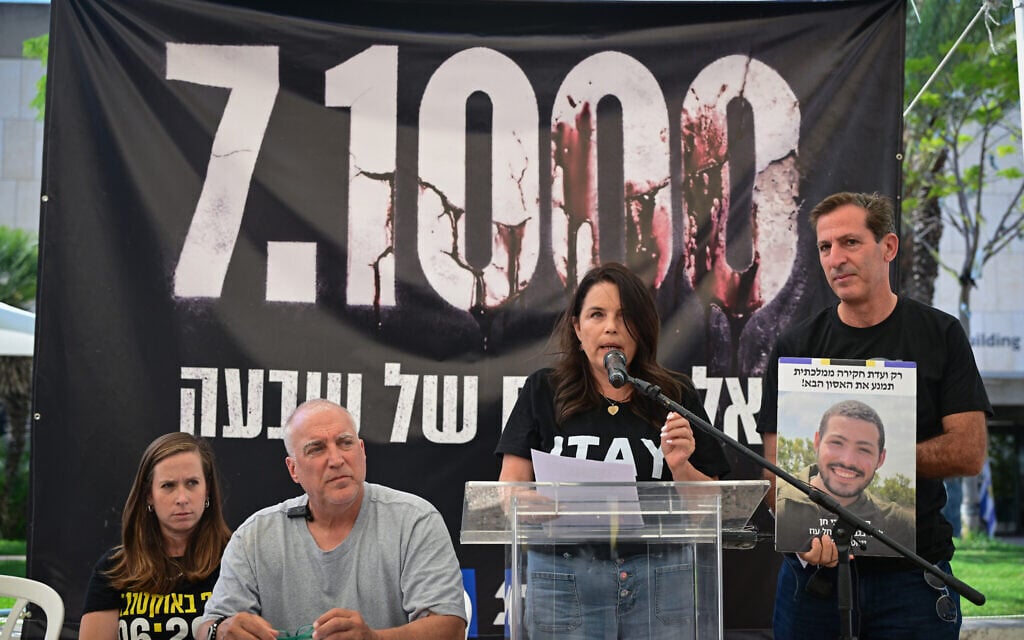
Israel was marking 1,000 days since the October 7, 2023, Hamas massacre on Thursday, with somber memorials, marches and protests planned across the country.
The October Council, a group of bereaved families, October 7 survivors and some former hostages, was organizing a full day of events to mark the occasion throughout the day.
The organization — which is sharply critical of the current government’s failure to prevent the Hamas invasion and its refusal to form a state commission of inquiry — opened the day’s events at 6:29 a.m., the exact time that the attack began 1,000 days earlier, with a series of protests.
The October Council was also organizing a convoy of vehicles that would tour the worst-hit sites of the attack, beginning at the site of the Nova festival near Kibbutz Re’im, continuing through Nir Oz, Kissufim, Be’eri, Nahal Oz, Kfar Aza and other locations, and ending at a memorial site next to Sderot.
The organization called for a nationwide moment of silence at 10 a.m. to remember the October 7 massacre. That time of day is also the time in which a siren rings out nationwide on Israel’s Holocaust Memorial Day each year. At 11 a.m., the organization was set to open an exhibit in Tel Aviv presenting 1,000 personal items that belonged to those killed or kidnapped that day.
Get The Times of Israel's Daily Edition
by email and never miss our top stories
By signing up, you agree to the terms
At 5 p.m., a protest will be held outside the Defense Ministry headquarters in Tel Aviv, and at 8 p.m. the main rally will be held at the former Hostages Square in Tel Aviv. A number of other events will be held throughout the day at locations nationwide.
Freed hostage Rom Braslavski, who was kidnapped from the Nova festival and held in captivity in Gaza for 737 days before being released in October 2025, said he would speak at the main gathering Thursday evening.
“Friends, I want to invite everyone to the 7.1000.2023 event,” he wrote on social media. “I invite everyone to come, to be moved and to pay respects to the fallen who are no longer with us.”
The October Council began the proceedings already on Wednesday evening, with a gathering at Sha’ar Hanegev, which included speeches from Yael Adar, the widow of slain hostage Tamir Adar, as well as Ali Ziyadne, whose brother Youssef and nephew Hamza were kidnapped and slain in captivity, while another nephew and niece, Bilal and Aisha, were taken captive and freed from Gaza in November 2023.
Ahead of the three-year anniversary of the massacre this fall, dueling ceremonies are once again being planned as the legacy of October 7 remains highly politicized.
On Wednesday, the Kumu (“Rise Up”) organization, a group of October 7 survivors and bereaved families, said it was planning a major memorial in Tel Aviv’s Yarkon Park, separate from the official state-sponsored ceremony.
“Three years after the failure and the disaster, with hearts that still ache, countless questions still awaiting answers, and a memory that must continue to resonate, we are once again taking our stand to present the failure as it unfolded, to give voice to the families, the murdered, the wounded, the survivors of captivity, and the communities that were destroyed — to remember, and to offer hope,” the organization said.
Speaking on Monday ahead of the 1,000-day mark, IDF Chief of Staff Lt. Gen. Eyal Zamir said that October 7 was “an attack on the very existence of the Jewish people.”
“That memory requires us to continue to change, to draw and assimilate lessons in the regional learning race,” he said.
The military event opened with a minute of silence in memory of those who fell on October 7 when Hamas led thousands of terrorists in an invasion of southern Israel, killing 1,200 people, mostly civilians, and abducting 251 as hostages to the Gaza Strip.
The Hamas attack triggered a war in Gaza that spilled over to several other fronts, after Israel came under attack from the Hezbollah terror group in Lebanon and Houthi rebels in Yemen, both of which are sponsored by Iran. Israel also went to war with Iran, alongside the US.
Though fighting has largely been halted on all fronts, none of the conflicts have ended with a permanent ceasefire, and sporadic clashes continue to threaten an outbreak of further fighting.
View original source — Times of Israel ↗
Related stories

Philippine Daily Inquirer
PoliticsJul 2, 2026 · 1 min
Japan female imperial succession far off despite legal change
Philippine Daily Inquirer
ABC News
PoliticsJul 2, 2026 · 1 min
MP's company fined $555k over worker's quad bike death
ABC News

Philippine Daily Inquirer
PoliticsJul 2, 2026 · 1 min
Japan pledges continued support for Ukraine, sanctions on Russia
Philippine Daily Inquirer
ABC News
PoliticsJul 2, 2026 · 1 min
NDIS fraud 'gaps remain open' as integrity report handed down
ABC News