Times of India
PM Modi lists 'five sankalps' for Amarnath Yatra pilgrims as second batch leaves Jammu
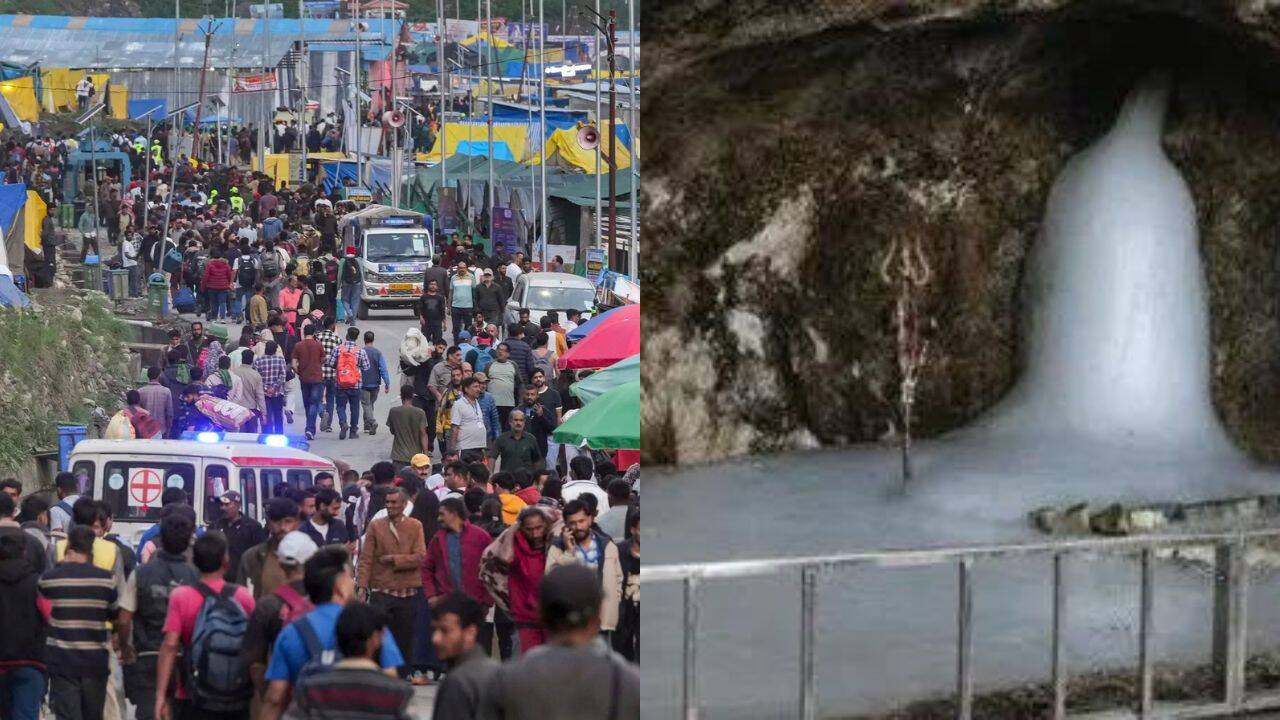
NEW DELHI: As the annual Shri Amarnath Yatra began on Friday, Prime Minister Narendra Modi extended his wishes to devotees undertaking the pilgrimage, describing the journey to the holy Amarnath cave as a "matter of great privilege" and urging pilgrims to follow five "Sankalps" (resolves) centred on cleanliness, safety, environmental conservation, support for the local economy and national service.His message came as the second batch of pilgrims departed from the Bhagwati Nagar Yatri Niwas in Jammu under multi-layered security arrangements. Meanwhile, the Shri Amarnath Shrine Board's Yatri Niwas at Chanderkote in Ramban district was illuminated with tricolour lights, adding to the festive atmosphere surrounding the pilgrimage.In a letter addressed to devotees of Lord Shiva, the PM Modi said, "Participating in the sacred Amarnath Yatra in Jammu and Kashmir is a matter of great privilege in itself.
Every year, this opportunity for a direct glimpse of Baba Barfani is a very auspicious and unforgettable experience for lakhs of Shiva devotees. On the occasion of this year's journey, I extend my heartiest wishes to all of you, the devotees of Shiva.
"
He described the Amarnath Yatra as one of the most enduring symbols of India's spiritual heritage and cultural unity."This pilgrimage to seek the blessings of Baba Amarnath is an eternal chapter in India's tradition of spiritual journeys.
Every year, lakhs of devotees from across the world who follow Sanatan culture reach Jammu and Kashmir to participate in this pilgrimage. People coming from different regions, speaking different languages, and practising diverse traditions complete this journey with a shared resolve to seek the blessings of Mahadev," he said.
PM thanks security forces, administration and volunteers
The Prime Minister also acknowledged the efforts of thousands of personnel working behind the scenes to ensure the smooth conduct of the pilgrimage.He thanked the Indian Army, Central Reserve Police Force (CRPF), Jammu and Kashmir Police, Indo-Tibetan Border Police (ITBP), Border Security Force (BSF), National Disaster Response Force (NDRF), healthcare workers, civil administration, sanitation workers and volunteers for their contribution."During these two months, a wonderful manifestation of 'Unity in Diversity' of India is witnessed at the sacred abode of Baba Barfani," he said.
Five 'Sankalps' for pilgrims
In his letter, PM Modi urged devotees to observe five resolutions during this year's pilgrimage.The first was maintaining cleanliness throughout the journey."First Resolve: Let us follow the rules of cleanliness during the Amarnath Yatra..."The second focused on following official instructions and safety guidelines."Second Resolve: Let us follow all orders of the administration, traffic rules, and safety directives with complete dedication."PM Modi also advised pilgrims to remain cautious while travelling through mountainous terrain, particularly in view of slippery paths and changing weather conditions.Another key appeal was to support the local economy under the Centre's "Vocal for Local" initiative."With the spirit of 'Vocal for Local', let us spend at least 10 percent of our travel expenses on purchasing local products. This will provide a boost to the livelihood of the families and youth of Jammu and Kashmir," he said.PM Modi also encouraged devotees to participate in the "Ek Ped Maa Ke Naam" campaign by gifting a sapling after completing the pilgrimage, which concludes on Raksha Bandhan.Concluding his message, the Prime Minister urged pilgrims to carry the values of the Yatra into their daily lives."With the sentiment of 'Nation First', let us honestly fulfill our duties throughout the year and make an active contribution toward building a 'Viksit Bharat'."He later reiterated the message on social media, saying the Amarnath Yatra remains an eternal symbol of India's spiritual traditions and cultural unity and expressed hope that the pilgrimage would be safe and auspicious for all devotees.
Second batch leaves Jammu under tight security
PM Modi's message coincided with the departure of the second batch of pilgrims from the Bhagwati Nagar base camp in Jammu on Friday morning.Authorities deployed a full security cover for the convoy as pilgrims began their journey towards the holy cave shrine.
The Shri Amarnath Shrine Board's Yatri Niwas at Chanderkote in Ramban district was illuminated with tricolour lights to welcome pilgrims.Several devotees praised the arrangements made by the administration."The arrangements here are very good. I am grateful for the arrangements of the Indian government. The Yatri Niwas, illuminated with tricolour lights, is grand and full of facilities. The pilgrims are not facing any difficulty," a pilgrim from Rajasthan said.
The Ramban district administration has also put in place round-the-clock sanitation and cleanliness measures to ensure hygienic conditions at transit facilities.A day earlier, Jammu and Kashmir lieutenant governor Manoj Sinha flagged off the first batch of over 4,800 pilgrims from Bhagwati Nagar in a convoy of 259 vehicles."Shri Amarnath Ji Yatra is a sacred path where devotion meets spiritual awakening. I wish all devotees a safe, comfortable, blissful and spiritually fulfilling journey.
May this holy pilgrimage bring immense joy and divine peace to all," Sinha had said.
Technology-driven security shield along pilgrimage routes
This year's Yatra is taking place under one of the most extensive security deployments in recent years.The Indian Army, working alongside the CRPF, Jammu and Kashmir Police and other security agencies, has established a technology-driven aerial security network across both the Pahalgam and Baltal routes.The security grid includes the Integrated Drone Detection and Interceptor System (IDDIS), deployed again after its successful use during last year's pilgrimage.
The system combines electronic jamming capabilities with laser-based interception to detect and neutralise hostile drones.The Army has also deployed the Low Level Lightweight Radar (LLLR) for the first time during the Amarnath Yatra. Designed to detect low-flying aerial threats, including drones, the radar can identify targets at distances ranging from 20 to 50 kilometres.L-70 and ZU anti-aircraft guns have been positioned at key locations to provide close-range air defence, while surveillance drones operated by various security agencies are conducting regular sorties over nearly 100 transit camps established along the pilgrimage routes.The enhanced deployment follows a comprehensive review of security arrangements after last year's terror attack on tourists in the Pahalgam region and reflects heightened efforts to safeguard one of India's largest annual religious pilgrimages.The 2026 Amarnath Yatra will continue until August 28, with devotees travelling to the holy cave shrine through the traditional 48-km Pahalgam route in Anantnag district and the shorter 14-km Baltal route in Ganderbal district.
View original source — Times of India ↗
Related stories

The Punch
PoliticsJul 3, 2026 · 1 min
‘My wife, Iya Alakara,’ Tinubu playfully nicknames First Lady
The Punch

The Guardian
PoliticsJul 3, 2026 · 1 min
‘Ridiculous’ for US to maintain current Nato support, Trump warns ahead of alliance summit
The Guardian

Philippine Daily Inquirer
PoliticsJul 3, 2026 · 1 min
LOOK: Senators hold caucus for Duterte impeachment trial
Philippine Daily Inquirer
ABC News
PoliticsJul 3, 2026 · 1 min
Australian in Israeli Defence Force committed war crimes, report alleges
ABC News