Indian Express
UPSC Key: Tiger reserves restoration, FDC drugs, and US turns 250
Preliminary Examination: Current events of national importance.
Mains Examination: General Studies-II, III: Government policies and interventions, Conservation, environmental pollution and degradation, environmental impact assessment.
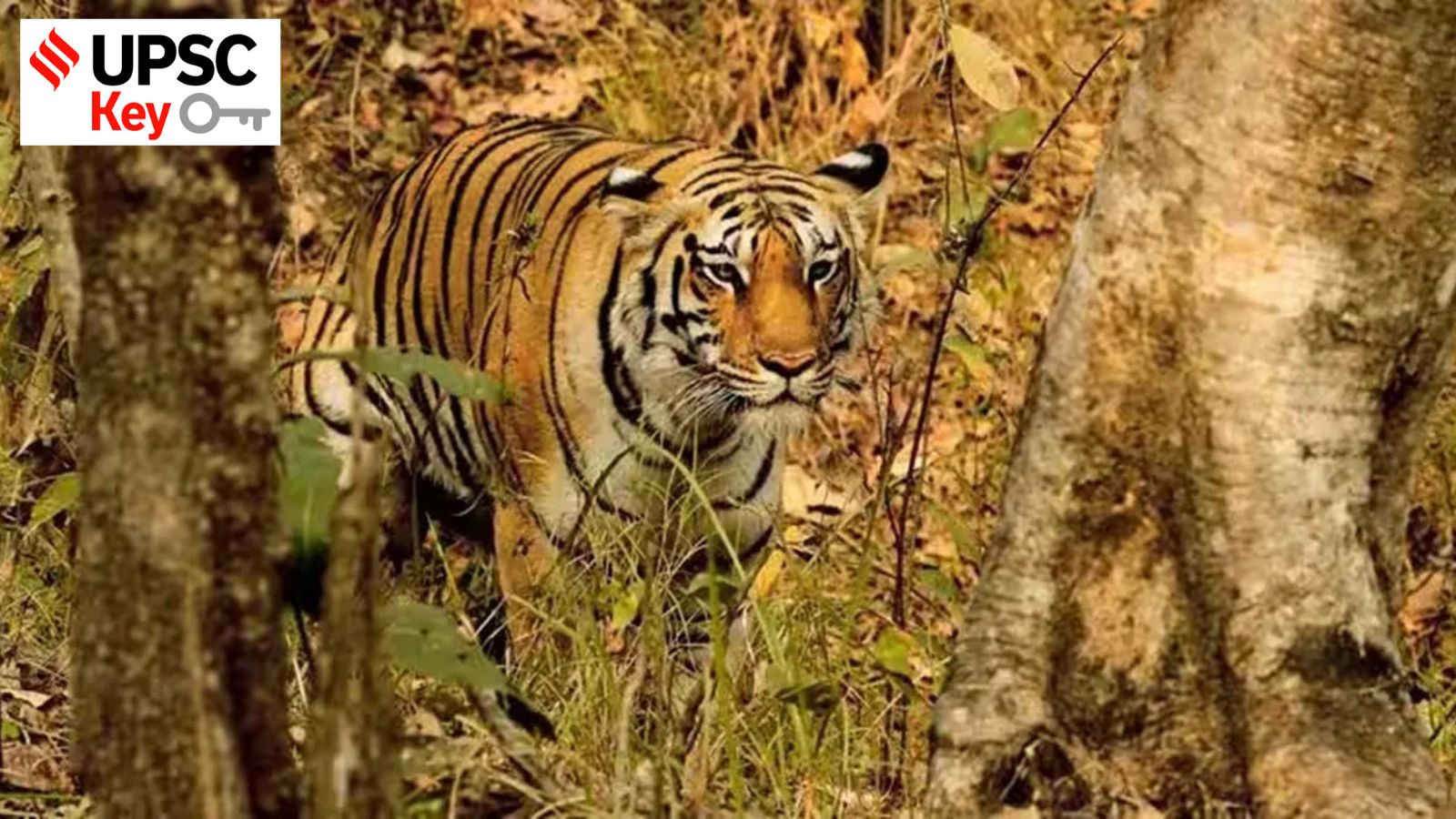
What’s the ongoing story: Last week, the Environment Ministry and Rajasthan Forest Department marked the 18th anniversary of tiger reintroductions at the Sariska Tiger Reserve in Alwar. Nestled in the lap of the Aravalli ranges, the tiger reserve had previously lost all its tigers.
Key Points to Ponder:
— How do tigers function as an umbrella species and why is their conservation critical for biodiversity?
— What is the conservation status of Tiger?
— What is India’s tiger population? How many tiger reserves are in India?
— Read about the ‘Project Tiger’?
( Thought Process: What is Project Tiger? In which year did it begin? Where was it launched? How successful has it been, and what have been the setbacks? )
— What are the major causes of local extinction of tigers in protected areas?
— What is tiger reintroduction? What is its significance for wildlife conservation in India?
— What are the challenges of tiger reintroduction programmes?
— What are the initiatives taken by the government for tiger conservation?
— Know about the Sariska Tiger Reserve.
Key Takeaways:
— This triggered not just a response on the reintroduction of tigers but sparked a nationwide overhaul of tiger conservation, population estimation methods, and management practices
— The Centre released two new assessments to mark this event. The first is a roadmap to manage tigers in the years ahead while the second dictates the lessons learnt from 12 re-introduction initiatives in the country. It has been argued that national parks and reserves with low tigers should be in focus beyond simply counting tiger numbers.
— To aid the recovery of big cats, parks with poor habitats and prey availability have also been included. This, the Centre said, will also aid the dispersal of tigers from places which have reached peak carrying capacity towards newer habitats.
— India’s tiger population has risen steadily. From 1,411 in 2006, there are now 3,682 tigers in 2022 across 58 tiger reserves, spread across 85,000 square kilometers (sq km). The numbers, however, do not reveal the full story.
— Of the 58 tiger reserves, 10-12 tiger reserves alone account for about 36 per cent of the population. Importantly, there are 12 tiger reserves with less than three tigers inside. Three of these reserves — Kawal, Kamlang and Dampa — have zero tigers. As the density of tigers increases, they disperse to buffer areas, territorial divisions and mixed-use land.
— Parks with low tigers however, may have intact forests but are also low on prey. Neither situation is ideal.
— In reserves housing a high density of tigers, their dispersal to forest edges or agricultural landscapes puts them in conflict with humans while increasing their dependency on livestock on these fringes. It also elevates the risk of mortality while crossing railways, roadways, canals.
— The unevenness between ‘source populations’ (where habitat, prey and tiger numbers are high) and ‘sink populations (where there are no breeding tigers or connectivity with healthier forest) poses a challenge for the long-term conservation of tigers.
— The Centre’s latest assessment calls for consolidating ‘source populations’ in 13 tiger reserves such as Corbett, Bandipur and Kaziranga. It has also suggested the need for priority interventions in at least 25 tiger reserves — including reintroductions where less than five tigers remain.
— Notably, Sariska was the first tiger reserve where tiger reintroduction was undertaken, in 2008, and the first litter through reintroduced tigers was born in 2012.
— After Sariska, tigers were also reintroduced in Panna, Madhya Pradesh, which had also faced local wipeout of the big cats. However, in the case of Panna, the reintroductions bore fruit earlier and the first litter was born in 2010. Since Panna’s reintroduction project in 2009, ten such translocations have been carried out with mixed success and some outright failures.
Do You Know:
— The National Tiger Conservation Authority and Wildlife Institute of India have created a framework or an index of assessment based on the status of habitat, prey and tiger population across each of the 58 reserves.
Facts about Tigers
📍Scientific Name: Panthera tigris
📍Wildlife Protection Act (WPA), 1972 status: Schedule I.
📍IUCN Red List status: Endangered.
📍CITES status: Appendix I.
📍Habitats: Tropical rainforests, evergreen forests, temperate forests, mangrove swamps, grasslands, and savannas.
📍Major Tiger Landscapes in India: Shivalik-Gangetic plains, Central India and Eastern Ghats, Western Ghats, North Eastern Hills & Brahmaputra Flood Plains and Sundarbans.
— It accounts for the constraints they have faced such as poor habitat quality, prey abundance and poor connectivity with other landscapes. Based on this assessment, 25 tiger reserves have been identified where at least one of them – prey availability, habitat quality and tiger occupancy – is under stress.
— The Central Indian and Eastern Ghats landscape has the largest number of tiger reserves that have been identified for priority interventions.
— The aim is to recover tiger populations and assist their dispersal from other regions. In contrast, the North Eastern Hills and Brahmaputra floodplains are home to extensive forested habitats with good potential for population recovery, if prey recovery, protection and landscape connectivity is improved, it noted.
Other Important Articles Covering the same topic:
📍UPSC Issue at a Glance | Why Tigers Matter: Environmental, cultural, and economic significance of India’s apex predator
📍Government flags priority intervention need in 25 of 58 tiger reserves with low, absent tigers
Previous year UPSC Prelims Questions Covering similar theme:
(1) Among the following Tiger Reserves, which one has the largest area under “Critical Tiger Habitat”? (UPSC CSE 2020)
(a) Corbett
(b) Ranthambore
(c) Nagarjunasagar-Srisailam
(d) Sundarbans
(2) The term ‘M-STrIPES’ is sometimes seen in the news in the context of (UPSC CSE 2017)
(a) Captive breeding of Wild Fauna
(b) Maintenance of Tiger Reserves
(c) Indigenous Satellite Navigation System
(d) Security of National Highways
Antibiotics to creams: The perils of combination meds
Syllabus:
Preliminary Examination: Current events of national importance.
Mains Examination: General Studies-II, III: Government policies and interventions, Issues relating to development and management of Social Sector/Services relating to Health.
What’s the ongoing story: The government has banned 16 fixed-dose combination (FDC) drugs, including certain antibiotic combinations and a range of dermatological products containing aloe vera and other herbal ingredients, because their amplified benefits lack scientific justification.
Key Points to Ponder:
— What are fixed-dose combination drugs?
— What is an ‘irrational’ fixed-dose combination?
— What is antimicrobial resistance?
— Can antibiotic combinations contribute to antimicrobial resistance?
— What are the risks associated with the irrational fixed-dose combination usage?
Key Takeaways:
— Fixed-dose combinations contain two or more active ingredients in a single formulation and are commonly prescribed for conditions ranging from infections to pain and skin ailments. While some combinations are evidence-based and improve patient outcomes, others are considered “irrational” because there is little or no scientific evidence that the ingredients work better together than when used separately.
— A fixed-dose combination is considered irrational when the ingredients do not have a scientifically established rationale for being combined in a single product. For a combination to be considered rational, each component should contribute meaningfully to the intended therapeutic effect, have compatible pharmacological properties and demonstrate additional clinical benefit compared to using the individual medicines separately. In many cases, there is little or no evidence from robust clinical trials to support the combination.
— When combinations are marketed as being more effective without sufficient evidence, they may encourage unnecessary or prolonged antibiotic use. This increases antibiotic exposure in the community and creates selective pressure on bacteria, allowing resistant organisms to survive and multiply. From a public health perspective, antibiotic use should be as targeted and evidence-based as possible.
— Patients may be exposed to unnecessary drugs, increasing the possibility of adverse effects, drug interactions and allergic reactions. Fixed combinations can also make it difficult for doctors to adjust the dose of individual ingredients according to a patient’s needs. If a doctor wants to increase the dose of one medication, they cannot do so without overdosing on the other. Besides, such drugs may mask an underlying complication, reducing precision treatment.
Other Important Articles Covering the same topic:
📍Centre bans 16 Fixed-Dose Combination drugs over safety concerns
UPSC Prelims Practice Question Covering similar theme:
(3) With reference to the fixed-dose combinations (FDCs), consider the statements:
1. FDCs contain two or more active ingredients in a single formulation.
2. All fixed-dose combinations approved for sale in India are considered rational and therapeutically superior to single-drug formulations.
3. FDCs do not require separate regulatory approval if each individual drug component has already been approved.
How many of the statements given above are correct?
(a) Only one
(b) Only two
(c) All three
(d) None
THE EDITORIAL PAGE
Europe must rethink how it will live with heat
Syllabus:
Preliminary Examination: Current events of national and international importance.
Main Examination: General Studies-I: Important Geophysical phenomena such as earthquakes, Tsunami, Volcanic activity, cyclone etc., geographical features and their location-changes in critical geographical features (including water-bodies and ice-caps) and in flora and fauna and the effects of such changes.
What’s the ongoing story: Pooja Ramamurthi writes- “In 2003, when a record-breaking heatwave hit Europe, several countries rushed to create national and city-level action plans. These were meant to be emergency responses to “once-in-a-generation” extreme weather events. Two decades later, high summer temperatures are no longer an anomaly in Europe.”
Key Points to Ponder:
— What are heatwaves?
— What are the causes behind the increasing frequency and intensity of heat waves across Europe?
— What is the relationship between global warming and record-breaking heat events in Europe?
— How does climate change influence the occurrence of compound extreme weather events?
— How does extreme heat affect agricultural productivity, food security, public health and infrastructure?
— What is the Omega Block?
— What is the Coalition for Disaster Resilient Infrastructure?
— What lessons can European countries learn from the Global South in adapting to heat stress?
Key Takeaways:
— “Over the past five years, all summers but one have seen severe heatwaves. The science is clear: Increasing carbon emissions are causing weather patterns to change, with Europe being the fastest-warming region. Heat stress has had repercussions for health, infrastructure and labour productivity.”
— “Estimates predict an excess of 2,000 deaths in Europe this summer. Railways have been disrupted and roads have melted. Germany and the UK have issued advisories to avoid non-essential travel. European heat action plans remain largely geared towards protecting people rather than ensuring that society continues functioning. Will Europe move towards seeing heatwaves as a broader infrastructure, productivity and agricultural issue?”
— “Espoused by far-right politicians like Marine Le Pen, there are calls for Europe to become an “air-conditioned” society. AC penetration remains low, with only one in five households owning one. There has been opposition from environmentalists, saying ACs will lead to higher carbon emissions that cause more global heating. Yet portraying ACs as environmentally irresponsible ignores the reality that Europe has long accepted the carbon costs of winter heating.”
A map of Europe’s heatwave hotspots, prepared by World Weather Attribution.
— “ACs also come with problems of equity, as seen in many Global South countries. The rich can adopt them while the poor cannot. Europe has some of the highest electricity costs, with 10 per cent of the population facing “energy poverty”. While vulnerable populations should be protected through ACs, this is not a universal solution. Issues of grid capacity to meet peak demand from space cooling must also be considered. As long as cheaper, sustainable alternatives exist, air conditioning need not be the only answer.”
— “In the Global South, disruptions and failings in infrastructure are often criticised as resulting from a lack of adequate planning. In Europe, when similar systems fail, governments tend to argue that they have not been built for high temperatures.”
— “In the Global South, initiatives like the Coalition for Disaster Resilient Infrastructure are working towards climate preparedness. Similar efforts will have to be made in Europe. This will not require a reinvention of the wheel. The technologies and materials needed exist in the Global South.”
— “A less-discussed aspect is agriculture. Unpredictable weather patterns make it difficult to plan crops, with France stating that it has lost up to one-third of its corn production. Farm animals are unable to adapt to heat stress. There are restrictions on farming activities during peak hours, and storing and transporting goods is a challenge. Farmers will need to start diversifying crop patterns. Given the strength of farmer lobbies in the EU, implementation of such plans may see pushback. For millions in the Global South, adapting to heat stress has become a way of life. As extreme heat becomes Europe’s new normal, it must also learn to build resilient societies.”
Do You Know:
— A heatwave is a period of abnormally high temperatures, more than the normal maximum temperature that occurs during the summer season in the North-Western parts of India.
— Heatwaves typically occur in India between March and June, and in some rare cases even extend till July. The extreme temperatures and resultant atmospheric conditions adversely affect people living in these regions as they cause physiological stress, sometimes resulting in death.
IMD Criteria for Declaring Heatwaves in India
— A heatwave is declared when the maximum temperature of a station reaches at least 40°C or more for plains, 37°C or more for coastal stations, and at least 30°C or more for hilly regions.
— Based on departure from normal temperatures, the following criteria are used to declare a heatwave:
(i) Heatwave: Departure from normal is 4.5°C to 6.4°C.
(ii) Severe Heatwave: Departure from normal is 6.4°C.
Learn through image: Criteria for Declaring Heatwaves in India.
— Based on the actual maximum temperature in plains, the following criteria is considered:
(i) Heatwave: When the actual maximum temperature ≥ 45°C
(ii) Severe Heatwave: When actual maximum temperature ≥47°C
— If the above criteria met at least in 2 stations in a Meteorological sub-division for at least two consecutive days and it was declared on the second day.
Other Important Articles Covering the same topic:
📍Europe’s worst heatwave would have been impossible without climate change
📍As Europe reels from record heatwave, why air-conditioning has become a political flashpoint
📍UPSC Issue at a Glance | Heatwaves: 5 Key Questions You Must Know for Prelims and Mains
UPSC Prelims Practice Question Covering similar theme:
(4) Which of the following is/are the favorable conditions for Heatwave?
1. Prevalence of hot dry air over a region
2. Absence of moisture in the upper atmosphere
3. Cloudless sky
4. Large amplitude anti-cyclonic flow over the area.
Select the correct answer using the codes given below:
(a) 1, 2 and 3 only
(b) 2, 3 and 4 only
(c) 1, 2 and 4 only
(d) 1, 2, 3 and 4
Previous year UPSC Mains Question Covering similar theme:
Bring out the causes for the formation of heat islands in the urban habitat of the world. (UPSC CSE 2013)
At 250, the US can still reinvent itself — and the world
Syllabus:
Preliminary Examination: Current events of international importance.
Mains Examination: General Studies-I, II: History of the world will include events from 18th century such as industrial revolution, world wars, redrawal of national boundaries, colonization, decolonization, capitalism, socialism etc.— their forms and effect on the society, Effect of policies and politics of developed and developing countries on India’s interests.
What’s the ongoing story: C. Raja Mohan writes- As America turns 250, much in Washington’s current politics distracts Indian attention…But major anniversaries demand a longer view. For Indians trying to understand the future of the US, the more important story lies beneath the unending political noise from Washington: The repeated reinvention of American capitalism. That process has shaped not only America’s domestic evolution but also the international order it has led for much of the past century.”
Key Points to Ponder:
— What is America’s 250th Independence Day?
— Why is the 250th anniversary significant?
— Know the history of the American War of Independence.
— Why is the American Declaration of Independence considered a landmark document in world history?
— How has the evolution of capitalism shaped the economic and political development of the United States?
— What do you understand by the term ‘techno-capitalism’?
— Read about the India-US bilateral relations.
Key Takeaways:
— “In reflecting on the American revolution, we must also consider the other, intellectual revolution that occurred in 1776. While Britain’s 13 North American colonies proclaimed their independence, Adam Smith published The Wealth of Nations, which laid the intellectual foundations of modern capitalism. Over the next 250 years, the two evolved together.”
— “America’s greatest contribution to the modern world has not only been its leadership of capitalist development, but also its extraordinary capacity to reinvent it. Every reinvention transformed the nature of production at home, reconfigured US politics, and restructured the international system.”
— “In the 19th century, factories, railroads and mechanised production transformed an agrarian republic into the world’s leading industrial economy. Capital, machines and labour were brought together on an unprecedented scale. Productivity soared, cities expanded, and American industry became the foundation of national power.”
— “The second reinvention arrived in the early 20th century with Frederick Winslow Taylor’s scientific management and Henry Ford’s moving assembly line reorganising work itself. Charlie Chaplin captured both the brilliance and the absurdity of this new industrial order in Modern Times…Fordism produced mass prosperity, but it also demanded that human beings adapt themselves to the rhythm of machines.”
— “The third reinvention took American capitalism beyond US shores…American firms increasingly specialised in technological innovation, finance, branding and design while manufacturing shifted to lower-cost locations across Asia. The resulting global value chains defined a new era of capitalism. They also transformed China into the world’s manufacturing powerhouse, even as American companies retained control over many of the technologies, finance and intellectual property that governed the system.”
— “Today, America is embarking on a fourth reinvention — techno-capitalism. AI, advanced semiconductors, cloud computing, biotechnology and humanoid robotics are converging to create a new production system. The ambition is no longer to make workers more productive. It is increasingly to reduce dependence on human labour itself.”
— “The new technologies change the very character of capitalism. Industrial capitalism depended on labour. Globalised capitalism depended on moving production to where labour was cheapest. Techno-capitalism depends increasingly on algorithms, computing power, data and intelligent machines. It also involves building massive new infrastructure within the US. Wealth now flows less from employing large and cheap workforces than from owning the technologies that can substitute for them.”
— “Every reinvention of capitalism has eventually produced a recasting of politics. The rise of giant industrial trusts produced the “progressive era” and antitrust legislation at the turn of the 20th century. The Great Depression produced the New Deal and a new social compact between capital and labour. The digital revolution has revived concerns over monopoly and market concentration.”
Other Important Articles Covering the same topic:
📍American declaration will remain universal, revolutionary. America may not
📍US turns 250: How India-US ties evolved from Cold War tensions to strategic partnership
THE IDEAS PAGE
AI’s upgraded the fraudster. Let’s upgrade our defence
Syllabus:
Preliminary Examination: Current events of national importance, Economic and Social Development.
Mains Examination: General Studies-III: Indian Economy and issues relating to planning, Awareness in the fields of IT.
What’s the ongoing story: Mihir Mehta writes- “The mule account has quietly become the load-bearing wall of digital fraud in India. As laundering channels multiply at machine speed, banks do not need louder alarms — they need a transaction-monitoring intelligence layer that cuts the noise and catches what matters. To understand why it has grown so dangerous, it helps to remember how much the ground beneath us has moved.”
Key Points to Ponder:
— What are mule accounts?
— What do you understand by the term “money mule”?
— How are mule accounts used for digital financial fraud?
— What are the challenges associated with the expansion of digital payments?
— What is MuleHunter.ai?
— Know about the Unified Payments Interface (UPI).
— How is artificial intelligence used for enabling digital financial crimes?
— How has artificial intelligence become a double-edged sword in digital finance?
— What is ‘alert fatigue’ in banking transaction monitoring systems?
— What measures have been taken to tackle mule accounts and digital payment frauds?
Key Takeaways:
— “Ten years ago, banking largely meant a branch, a queue, and a passbook. Today it lives entirely on the phone, with the Unified Payments Interface (UPI) alone processing nearly Rs 30 trillion in a single month across more than 800 million digital users. Here lies the uncomfortable corollary: Every new rail we build for legitimate money is also a new lane for illicit money.”
— “Artificial intelligence (AI) has mechanised the entire craft. No longer is a forged signature the extent of fraud. A few seconds of audio is now enough to manufacture voice instructions from a “CFO”. Stolen data is being used to walk synthetic identities through onboarding checks. Deepfake scams are being run at a scale that has touched nearly half of all Indian adults.”
— “The damage shows up on three fronts. Identity fraud, where the customer never truly existed. Monetary fraud, where the victim is socially engineered into pressing “send” themselves, defeating every authentication factor we built. And beneath both — the core — the mule account.”
— “The mule is the getaway vehicle of digital crime. In a single year, agencies froze close to 4,50,000 mule accounts through which more than Rs 17,000 crore had already been routed.
— “The regulator has clearly heard it. The Reserve Bank of India’s (RBI) MuleHunter.ai, the digital payments intelligence platform being built with the National Payments Corporation of India (NPCI), and the recent discussion paper proposing deliberate “frictions” on suspicious transfers all point the same way. But here is the sobering part: A rule we write on Monday is played upon by Friday.”
— “Almost every bank and NBFC already runs a transaction monitoring system. The problem is not that these systems flag too little. It is that they flag far, far too much. Such a system does not strengthen a bank’s defences but slowly erodes its own analysts’ trust in the alert itself, until the one signal that genuinely matters is lost in the static.”
— “The answer is not a louder alarm, or a larger team. It is an intelligence layer that sits on top of the monitoring system — one that stops handing the money laundering reporting officer a flat list of 48,000 alerts and starts answering the questions that matter.”
— “For those running banks and non-banking financial companies (NBFCs), the instruction is not the tired “adopt AI”. It is sharper. Deploy intelligence at the two points where it changes the odds. First, cut the noise so your best analysts spend their scarce hours on the 5 per cent that is real rather than the 95 that is not. Second, surface the mule networks early, while money is still recoverable.”
— “AI is now on both sides of the table. The fraudster has also picked it up.The only open question is whether our defences have. In banking, trust has always been the real moat. Protecting it is how we build a digitally inclusive and secure Bharat.”
Do You Know:
— A mule account is a bank account that is used by criminals for illegal activities, including the laundering of illicit funds. A mule account is typically bought over by the criminals from their original users, individuals who are often from lower income groups, or have low levels of technical literacy.
— The term “money mule” is used to describe the innocent victims who are used by the criminals to launder stolen or illegal money via their bank accounts. When such incidents are reported, the money mule becomes the target of police investigations, because it is their accounts that are involved, while the actual criminals remain undetectable.
— On 6th December last year, RBI announced that it has created an AI-powered model called MuleHunter.AI, which could reduce digital fraud by helping banks deal with the increasing problem of “mule” bank accounts. It has been developed by the Reserve Bank Innovation Hub.
— MuleHunter.AI enables the detection of mule bank accounts in an efficient manner. The RBI release said that a pilot with two large public sector banks had yielded encouraging results and asked banks to collaborate with RBIH to further develop the MuleHunter.AI model “to deal with the issue of mule bank accounts being used for committing financial frauds.”
Other Important Articles Covering the same topic:
📍Knowledge nugget of the day: MuleHunter.AI
📍How RBI is leveraging AI to crack down on ‘mule bank accounts’
Previous year UPSC Prelims/Mains Question Covering similar theme:
(5) In India, it is legally mandatory for which of the following to report on cyber security incidents? (UPSC CSE 2017)
1. Service providers
2. Data centres
3. Body corporate
Select the correct answer using the code given below:
(a) 1 only
(b) 1 and 2 only
(c) 3 only
(d) 1, 2 and 3
Previous year UPSC Mains Question Covering similar theme:
What are the different elements of cyber security ? Keeping in view the challenges in cyber security, examine the extent to which India has successfully developed a comprehensive National Cyber Security Strategy. (UPSC CSE 2022)
ALSO IN NEWS
• Defence acquisition proposals worth Rs 52,000 crore cleared
— The Defence Acquisition Council (DAC) on Friday cleared a range of acquisition proposals worth about Rs 52,000 crore for the Armed Forces.
— The proposals include Anti-Unmanned Aerial Vehicles (Anti-UAV) Electronic Warfare System named ‘Akash Tarang’, Medium Range Surface-to-Air Missile (MRSAM) Weapon System, the latest Verba Very Short Range Air Defence System (VSHORADS) developed in Russia, Jet-Based Kamikaze Drone System for the Army, Naval Shipborne Unmanned Aerial System (NSUAS) for the Navy and Fixed-Wing Based High Altitude Pseudo Satellite (FW-HAPS) for the Indian Air Force, among others.
— The DAC is the key defence body that grants Acceptance of Necessity (AoN) on all big-ticket capital procurements. The AoN is the first step in the defence procurement process. However, obtaining an AoN does not always lead to a final order.
• 1991 Act doesn’t bar takeover of worship place for public use: Allahabad HC
— The Places of Worship (Special Provisions) Act, 1991 does not bar the government from acquiring places of worship for public purposes, the Allahabad High Court said Thursday while dismissing a writ challenging the acquisition of six mosques in Varanasi’s Dalmandi Street for expansion of the Kashi Vishwanath Dham Corridor.
— A bench of Justice J J Munir and Justice Arun Kumar said, “The Act of 1991 does not prohibit the Government from acquiring religious land for larger public purposes. Under the Act of 2013, the Government has the sovereign power to acquire any property, including religious property, for public purposes, such as building roads, highways or public infrastructure.”
• India and France to deepen cooperation in critical minerals
— India and France on Friday agreed to deepen cooperation in critical minerals, economic security, investment, financial services, and high-speed rail as Finance Minister Nirmala Sitharaman and French Economy Minister Roland Lescure co-chaired the India-France Economic and Financial Dialogue (EFD) in Aix-en-Provence.
— The meeting, held under the broader India-France strategic partnership, reviewed the global economic outlook and explored ways to strengthen bilateral economic engagement. The dialogue follows the commitment made by Emmanuel Macron and Narendra Modi during the French president’s visit to India earlier this year to convene the EFD in 2026.
• Disable 7 apps, Govt tells Apple, Google after e-rickshaw shutdown videos
— The government Friday directed Apple and Google to take down seven apps following reports that these were being misused to remotely switch off some e-rickshaws, triggering cybersecurity concerns and passenger safety risks.
— The move follows the circulation of video clips on social media showing individuals connecting to nearby e-rickshaws through Bluetooth and disabling their battery management systems or BMS while the vehicles were in motion.
— A battery management system essentially tracks the state of a battery, with the primary aim of eliminating variations in performance of individual battery cells to allow them to work uniformly inside a battery pack. This system is incorporated in an EV powered with a large-capacity lithium ion battery, and plays a key role in extending the service life of the battery and ensuring the safe use of the battery.
— The primary concern lies with the security configuration of some BMS used in low-cost electric vehicles. The apps in question could connect to the BMS within a limited range, and be used to cut battery power, bringing the vehicle to a sudden halt.
— The problem with some of the low-cost Chinese lithium battery packs used in most e-rickshaws is that they come with Bluetooth-enabled BMS units that have little or no password protection. If such a battery is not adequately secured, anyone standing within Bluetooth range can potentially connect to it and they manipulate the settings, including turning off the battery’s discharge function.
ANSWER KEY
1. (c) 2. (b) 3. (a) 4. (d) 5. (d)
Subscribe to our UPSC newsletter. Stay updated with the latest UPSC articles by joining our Telegram channel – IndianExpress UPSC Hub, and follow us on Instagram and X.
🚨 Click Here to read the UPSC Essentials magazine for June 2026. Share your views and suggestions in the comment box or at [email protected]🚨
View original source — Indian Express ↗
Related stories

Engadget
TechnologyJul 4, 2026 · 1 min
Only these iPhone models are getting the new Siri AI this fall
Engadget

Portugal Resident
TechnologyJul 4, 2026 · 1 min
Portuguese Air Force joins frontline wildfire fight for first time
Portugal Resident

Wired
TechnologyJul 4, 2026 · 1 min
Submit Your Questions: Inside The World of Online Romance Scams
Wired
Indian Express
TechnologyJul 4, 2026 · 1 min
I planned to set up semiconductor factory in India 2 decades ago, but government was shackled then: PM Modi
Indian Express