Times of Israel
Mother of hostage slain by IDF says workers using his home as a ‘public restroom’
Human feces also reportedly found in another home of Oct. 7 victims from Kfar Aza’s young families’ section, whose fate is subject of dispute between the kibbutz and the government
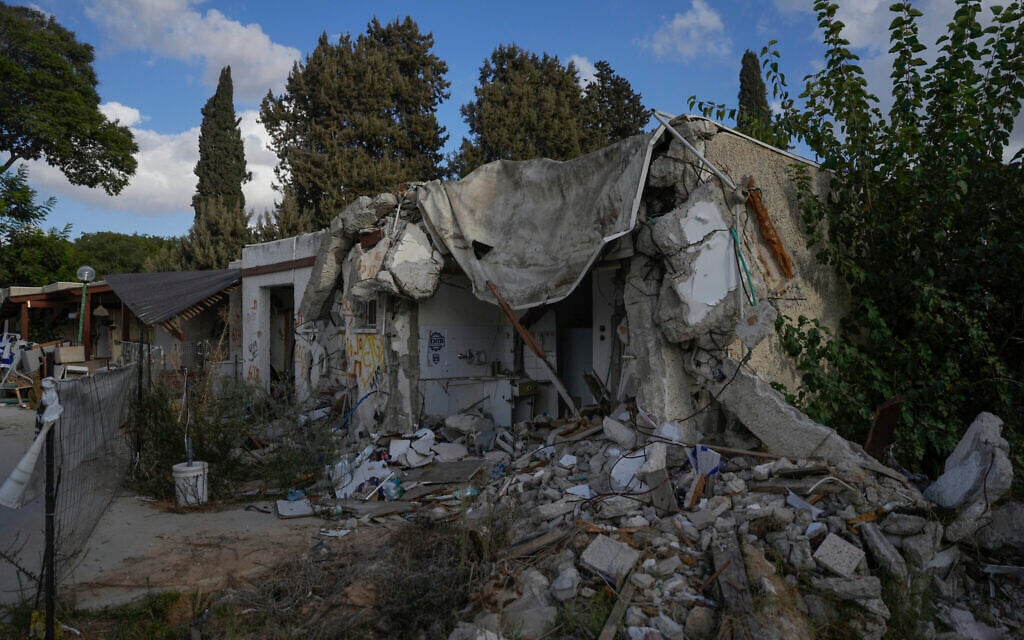
Iris Haim, whose hostage son Yotam was taken hostage by Hamas on October 7, 2023, and then accidentally killed by the IDF in Gaza, said Sunday that workers had made a “public restroom” of his abandoned home in Kibbutz Kfar Aza.
“When workers employed via a contractor (whose name I won’t reveal yet) work in the ‘young generation’ neighborhood, apparently too lazy to go to the bathroom on the kibbutz, they choose to have their daily bowel movement in Yotam’s room,” she wrote on Facebook.
Haim appended footage with incriminating evidence from the destroyed structure.
“How would you feel if you were sent a video where you see the home where your son lived, from which he was snatched on October 7, had become a public restroom?” she wrote, apologizing to her deceased son.
According to Haim, the kibbutz has put up security cameras but is “still unable to solve the problem.”
Get The Times of Israel's Daily Edition
by email and never miss our top stories
By signing up, you agree to the terms
The Ynet news site reported that human feces was also located three weeks ago in the same Kfar Aza neighborhood, in the home of Niv Raviv and Nirel Zini, among the 62 kibbutz residents who were murdered in the Hamas-led onslaught of October 7 that sparked the war in Gaza.
It was Zini’s brother Ori who discovered the couple’s home had been desecrated, Ynet said.
“We come almost every day to light a candle,” he told Ynet. “We’ve developed a deep connection to the ground here. We came into the house, we saw what we saw, and were horrified.”
It was not immediately clear what the workers were doing in Kfar Aza. Nor is it clear what is in store for Kfar Aza’s young families’ neighborhood, from where most the kibbutz’s hostages were taken.
Ynet reported in March that the kibbutz voted by a 70 percent majority to raze the “young generation” neighborhood and preserve part of it in a memorial outside the kibbutz itself.
Despite the vote, Heritage Minister Amichay Eliyahu informed the kibbutz that he intended to preserve the neighborhood for both remembrance and propaganda purposes, the news site reported later that month.
Meanwhile, some parents of slain “young generation” residents have petitioned the High Court to halt the destruction of the neighborhood. Among the petitioners are Zini’s parents and Haim, the Kan public broadcaster reported in May.
If you’d like to comment, join
The Times of Israel Community.
View original source — Times of Israel ↗
Related stories

TechRadar
TechnologyJul 5, 2026 · 1 min
Apolosign 32-inch Smart Portable TV review
TechRadar

Indian Express
TechnologyJul 5, 2026 · 1 min
Cape Verde: How a tiny African nation scripted 2026 World Cup’s underdog story
Indian Express

Nepali Telecom
TechnologyJul 5, 2026 · 1 min
Government’s 100 days work progress: 4G in 750 local levels, recurring plan, more
Nepali Telecom

TechRadar
TechnologyJul 5, 2026 · 1 min
The 5 best fitness trackers we've seen so far this year, from Google and Garmin to sleeper hits from Amazfit
TechRadar