The Guardian
Into the spider’s lair: how an Australian film-maker made an impossible documentary with AI
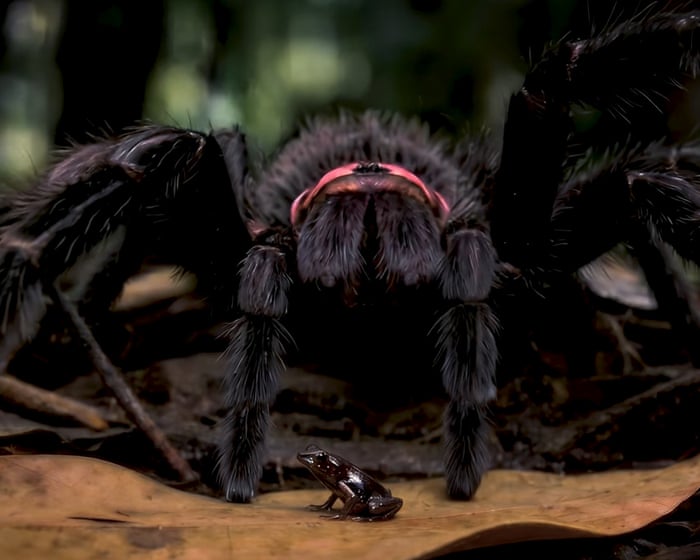
Scene: a dimly lit underground burrow. A giant Amazonian tarantula and a tiny dotted humming frog share the space, an unlikely duo captured in extraordinary detail.
Except, they haven’t been. Guardians of the Burrow, a short “wildlife documentary” by the Australian digital content designer Jodie Heenan, is entirely AI generated. At the weekend it won a prize in the Omni international AI film festival, adjudicated by a panel led by The Crow and Dark City director – and AI advocate – Alex Proyas.
The documentary doesn’t hide its origins: it says exactly how it was created on its YouTube page.
But AI is a controversial tool for creatives right now: the films use technology reportedly trained on stolen content. Last week musicians, authors and others roamed the halls of Australia’s parliament campaigning to protect their copyright, and communities across the country are mobilising against sprawling and power-hungry datacentres.
Heenan says she has weathered much criticism for her use of AI. She is part of an international team established by the California AI studio Fable (which has Amazon as one of its major investors) to reconstruct 44 minutes of Orson Welles’ The Magnificent Ambersons – giving it the ending Orson originally wanted, not the one Hollywood gave it in his absence.
The team’s use of AI to generate the digital likenesses and synthesised voices of the 1942 cast was criticised by the Orson Welles estate, which told Variety it was “a purely mechanical exercise without any of the uniquely innovative thinking or a creative force like Welles”.
But Heenan says AI has the capacity to show us the impossible – it’s a tool that can be used creatively, not just derivatively, as her documentary demonstrates.
She says even the likes of David Attenborough couldn’t have accurately conveyed how the fierce spider and tiny frog help and protect each other, because all the action takes place inside the spider’s lair. Lights and microscopic cameras would interfere with the natural behaviour.
“Nobody’s actually managed to capture [the spider and frog] on film in the wild, to my knowledge, so I thought that was a really great reason to use AI specifically,” she says.
“I can show the detail of the relationship, I can get into the spider’s burrow … and then recreate that in AI, but put it in a natural environment, so that it feels and looks like a real nature documentary.”
She researched how National Geographic, Animal Planet, and David Attenborough’s teams put their documentaries together, and steered clear of AI’s capacity for cheap special effects.
“No fancy camera tricks and morphs and warps, none of the fun stuff that AI can do that looks really cool,” she says. “I almost wanted it be: you’re in boring hotel room, you put on Nat Geo because there’s nothing else on the TV, and you get sucked in.”
AI film-makers from the US, the UK, Brazil, Ukraine, China and Australia were among the Omni category winners, with Canada’s Robert Gaudette, a self-confessed “middle age nobody” working in creative AI, taking out best picture award.
Last month his eight-minute film A Face Only a Mother Could Love was also awarded the $50,000 grand prix at the Runway AI film festival at New York’s Lincoln Center.
“I knew what type of story I wanted to tell, and I knew I wanted it to be different from what a lot of other people were doing in AI,” Gaudette tells the Guardian from his home in Toronto.
“AI is really great at creating spectacle … a lot of eye candy can be very visually stimulating, but I wanted to see if I could test the limits in terms of storytelling, trying to connect with an audience through a character … a character who had been treated very callously throughout his whole life, yet a character who just refused to meet the world the same way the world was meeting him.”
Gaudette’s poignant tale of Marcel Dupont, a physically disfigured man who perfects the waltz alone in his kitchen each night – convinced that one day someone will ask him to dance – is, he hopes, a counterpoint to criticisms that AI has no place in the crafting of emotionally resonant stories that come from uniquely human imagination.
AI did not create the story, Gaudette points out. He did. AI was merely one of the tools in the toolbox he used to bring his story to life.
Both Gaudette and Heenan say the industry and governments need to resolve the persistent teething issue of fair compensation for original creators, as AI hoovers up copyright works to train itself.
And, as AI replaces older special effects, some jobs will go, Gaudette concedes. But he believes new ones will emerge.
“In the Hitchcock era, there would be 30 to 50 people sitting on a sound stage, and then CGI came along, and there was a lot of fear, a lot of disruption, and a lot of people laid off from their traditional jobs and replaced by computers,” he says.
“But if you look at a Marvel film nowadays, there’s 300 to 400 people working on those projects, so there’s been a net addition in terms of the economy and employment.
“And I think AI, once we see it a little further down the pipeline, we’re going to see the same kind of thing – unanticipated and unexpected new roles … we will just be using creative teams in a new way.”
Heenan believes the accessibility of the new technology has brought a democratic revolution in visual storytelling.
“I don’t need to wait for Hollywood to allow me in as a PA, then get the gracious gift of being able to maybe be on a film set to maybe make something one day,” she said.
“It’s no longer a choice – do I spend my house deposit on making a short film? I can make a shot film for $500.
“The more stories that people can tell that don’t have the money and the resources behind them to tell their individual stories, that is just groundbreaking.
“It’s going to level the playing field … removing those gatekeepers stopping you from telling your story”
Gaudette agrees. “Nobody knew who I was three weeks ago,” he says. “I would have had zero potential of having my short film funded in any traditional way to shoot it live action”
View original source — The Guardian ↗
Related stories

E! Online
EntertainmentJul 6, 2026 · 1 min
Lena Dunham Pokes Fun at Taylor Swift, Travis Kelce Wedding Joke Rumor
E! Online

E! Online
EntertainmentJul 6, 2026 · 1 min
Penélope Cruz Says She’s Experienced “Many” Brain Aneurysm Scares
E! Online

Variety
EntertainmentJul 6, 2026 · 1 min
Harlan Coben’s Myron Bolitar Netflix Series Casts Colin Woodell, KJ Apa, Diane Guerrero in Lead Roles
Variety

Deadline
EntertainmentJul 6, 2026 · 1 min
Colin Woodell To Lead Netflix Series ‘Myron Bolitar,’ KJ Apa & Diane Guerrero Also Cast
Deadline