BBC
Treasury sees defence as a drain not a driver for growth, says Healey
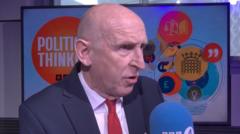
The Treasury has refused to see defence spending as an engine for growth, former defence secretary John Healey has told the BBC.
Healey quit his cabinet role after a battle over a long-delayed military spending plan, which proved to be one of the final blows for Sir Keir Starmer's leadership.
A slightly-increased Defence Investment Plan (DIP) of £15bn was unveiled last week - but £4.7bn will need to be found in the next budget.
Speaking to Nick Robinson's Political Thinking podcast, Healey blamed the Treasury for refusing to allow higher defence spending, adding he believed it was in denial about the UK's commitments to Nato.
At a Nato summit in the Hague in June 2025, the UK and other members committed to spend 5% of GDP on defence and security - with 3.5% going to Nato-qualifying "core defence" by 2035.
The original DIP committed to core defence spending of 2.68% by 2030, which led to Healey's resignation, because he said the government should be committing to 3% by 2030.
Although the latest version of the DIP added an extra 0.02% of GDP, the document suggests the government is still expecting to spend 2.7% by 2030 - still short of the figure Healey says is needed.
Asked whether it was a lack of political will or the Treasury blocking spending, Healey said: "The Treasury said no in the end.
"The Treasury's a paradox: you have some of the very best and brightest officials in the Treasury, but you have, too often, a Treasury orthodoxy that's a dead hand on dynamic government."
Healey, who was a Treasury minister in former Prime Minister Gordon Brown's Cabinet, said he saw the defence sector as an engine for growth and reindustrialisation, particularly in the defence technology sector.
He added: "The Treasury with defence really was in denial about the commitment that the UK has rightly made to Nato and to our people: it is still planning, was still planning on 3%, but not until 2034-35.
"The Treasury still often sees defence as a drain on public spending and not the driver of economic growth that we've demonstrated in two years."
The prime minister has frequently claimed the government is spending £270bn on defence over this parliament which he says is "the biggest sustained increase in defence spending since the 1980s", with Sir Keir saying the DIP increases this by "a further £15bn".
At Prime Minister's Questions last week, Conservative leader Kemi Badenoch criticised what she called a missing £5bn in the DIP, saying outgoing PM Sir Keir was leaving a mess for his successor, widely expected to be Andy Burnham.
Asked whether he thought Burnham would prioritise defence spending, Healey said he was surprised the DIP now included £5bn of unfunded pledges, but adding defence investment fitted with Burnham's vision of reindustrialisation.
"This means that it will be something for Andy Burnham as a short-term challenge," he said.
"I welcome the fact that he's committed to fully funding that.
"I know he's strong on defence - I've sat in Gordon Brown's cabinet alongside him and no one doubts his commitment to national security."
On Tuesday, Sir Keir will head to the Nato summit as one of his last appearances as prime minister on the world stage, following calls from US defence secretary Pete Hegseth for all Nato countries to set out credible plans for reaching the 3.5% target.
By 2030, more than half the Nato nations will have reached or exceeded 3%, Healey said, and the UK needed a credible path to do the same in order to maintain the leadership role re-established by the Labour government.
"It's important to Nato, it's important to Britain that we...demonstrate the sort of leadership that's required from within the European Nato as the US starts to scale back its contribution," he said.
"Anything that puts that at risk will, in the long run, count against us."
Related stories

The Punch
PoliticsJul 6, 2026 · 1 min
Tinubu backs FCTA’s TSA exit, commends Wike on Abuja projects
The Punch
The Punch
PoliticsJul 6, 2026 · 1 min
ADC dissolves Kano executives, constitutes caretaker committee
The Punch

Philippine Daily Inquirer
PoliticsJul 6, 2026 · 1 min
Telus, NQX to expand BPO operations in PH
Philippine Daily Inquirer
South China Morning Post
PoliticsJul 6, 2026 · 1 min
Nato can’t be ‘naive’ about China as it ramps up military might, Rutte claims
South China Morning Post