CNA
Body of Khamenei arrives in Qom ahead of procession
World
The funeral ceremonies will continue in Qom before moving to the Iraqi holy cities of Najaf and Karbala.
07 Jul 2026 04:32AM
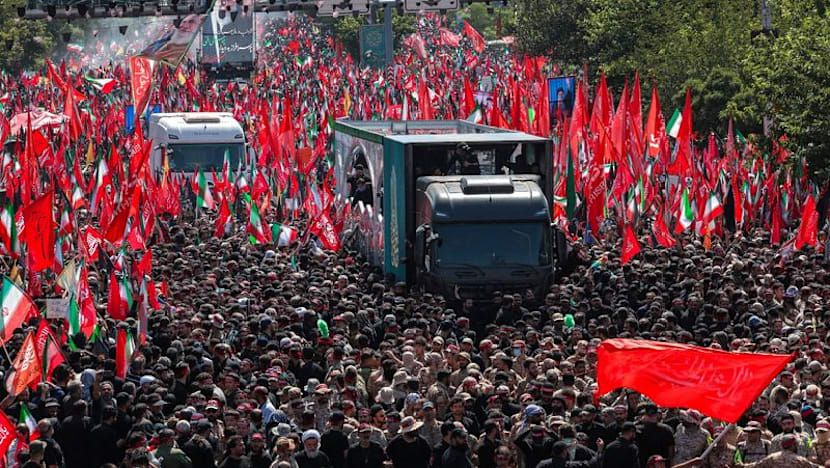
TEHRAN: The body of Iran's late supreme leader Ali Khamenei arrived in the holy city of Qom on Monday (Jul 6) evening, hours after a sea of people filled the streets of Tehran for his funeral procession in the capital.
Ordinary Iranians loyal to the Islamic republic joined top officials for the event, in which a truck carrying the bodies of Khamenei and four family members killed in a Feb 28 US-Israeli strike inched its way to Azadi Square in the west of the city.
Monday's procession will be followed by similar events in Qom on Tuesday and in Iraq's holy cities of Najaf and Karbala on Wednesday.
"The body of the martyred leader has arrived in Qom," south of the capital, state television said on social media, alongside footage showing a helicopter carrying Khamenei's body landing in the city.
Earlier Monday, AFP images showed huge numbers stretching along major boulevards in Tehran, while state television said millions turned out for an event comparable to the giant funeral of Khamenei's predecessor Ruhollah Khomeini in 1989.
But on the third day of a marathon six-day sequence of funeral ceremonies, there was still no sign of Khamenei's successor and son Mojtaba Khamenei, who has not been seen in public since before his appointment a week after his father's death.
Clad in black, people threw petals onto the coffins, including the tiny casket of Khamenei's granddaughter, who was only 14 months old when she was killed, according to state media.
"We will avenge the blood of the martyrs and our martyred imam from these criminals," said a man, 63, who gave his surname as Kazemi.
People carried blood-red flags - symbols of vengeance in Shia Islam - as well as slogans including "Kill Trump" and images of Mojtaba Khamenei.
"I came with honour and pride to show all the people of the world how much we loved him (Ali Khamenei) and how committed we are to the system, the people and the Islamic republic," said Melika Nourian, 22, a university student.
MESSAGE TO "ENEMIES"
Another truck was adorned with images of top Iranian and pro-Tehran officials killed in recent years, including the head of the overseas operations arm of the Revolutionary Guards, the Quds Force, Qassem Soleimani, who was killed in a US strike on Iraq in 2020.
In sweltering heat that nudged 40C, trucks sprayed mourners with water to cool them along a procession route that covered around 20 kilometres (12 miles).
"The leadership of the martyr taught everyone that Iran's greatest asset is its people and their unity," President Masoud Pezeshkian, who was among the mourners, wrote on X.
Other figures shown attending by state media included Foreign Minister Abbas Araghchi, judiciary chief Gholamhossein Mohseni Ejei and the current head of the Quds Force, Esmail Qaani.
The head of Iran's supreme national security council, Mohammad Bagher Zolghadr, whose predecessor Ali Larijani was killed in an airstrike in March, made his first appearance in public since being named at the procession, state television showed.
"The presence of millions of people with red flags and slogans, demanding bloodshed, is a clear message from the Iranian nation to its enemies," Iranian media quoted him as saying.
State media also showed images of Mahmood Ahmadinejad, Iran's president from 2005 to 2013, taking part. Ahmadinejad had fallen out with Khamenei in the latter part of his presidency and had not been seen since the war began.
FOCUS ON MOJTABA KHAMENEI
But as on previous days, there was still no sign of Mojtaba Khamenei, fuelling speculation over his whereabouts and condition. Iranian officials have said he was wounded in an airstrike and it remains uncertain if he will appear for the ceremonies.
Mojtaba Khamenei earlier reappointed Ejei as judiciary chief, according to his official social media.
The ceremonies culminate with Khamenei's burial in his hometown of Mashhad in northeastern Iran on Thursday which will be closely watched for signs of Mojtaba attending.
The government is eager to tout the mass mobilisation in the wake of the war but also after January mass protests, which rights groups say were quelled by a crackdown that killed thousands of people.
But authorities are also eager to avoid a repeat of the chaos that marred the 1989 funeral of Khomeini, which drew an estimated 10 million people, according to state media, but where crowd surges killed more than 10 people and injured over 10,000.
Jafar Miadfar, the head of emergency services, told state news agency no fatalities have been recorded so far.
Source: AFP/fs
Related stories

The Punch
WorldJul 6, 2026 · 1 min
State police calls stem from federal police failure — Okiro
The Punch
The Punch
WorldJul 6, 2026 · 1 min
Gunmen invade Rivers community, kill two
The Punch
The Punch
WorldJul 6, 2026 · 1 min
Northerners will never vote for Peter Obi – Ex-Borno gov Sheriff
The Punch
CNA
WorldJul 6, 2026 · 1 min
Lamborghini’s Temerario shows hybrid supercars can still have drama
CNA