CNA
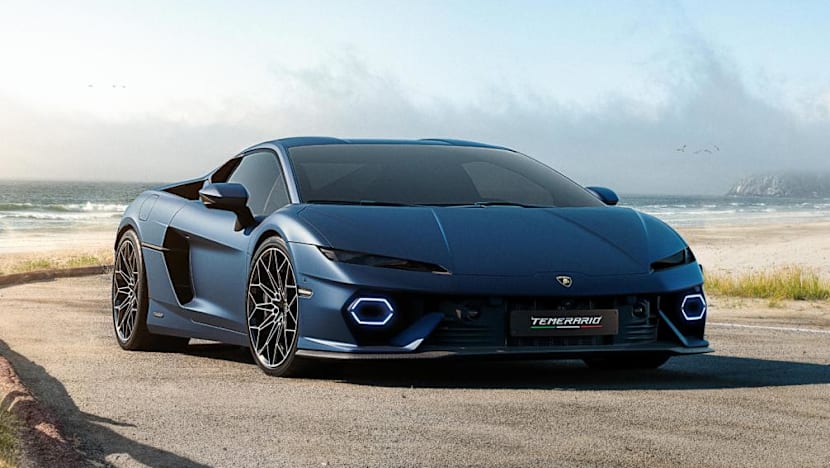
Lamborghini’s Temerario shows hybrid supercars can still have drama
Obsessions
Less intimidating than it looks, the Temerario pairs a 10,000 rpm V8 with hybrid power, sharper responses and a surprising degree of everyday usability.
New: You can now listen to articles.
This audio is generated by an AI tool.
07 Jul 2026 05:40AM
(Updated: 07 Jul 2026 05:50AM)
“Should I take the Temerario to the Futa Pass?” I wondered aloud, as Enrico handed me the keys to the V8 hybrid at Lamborghini’s headquarters in Sant’Agata Bolognese.
The answer was unanimous, especially with rain already pelting its sleek carbon-composite bodywork that grey Tuesday. After all, any petrolhead will tell you that bad weather is one way to test a supercar’s mettle.
It is worth noting here that “Temerario” means “reckless” or “daring” in Italian and Spanish – a fitting name for a car designed to make restraint feel optional.
And so, with the spirit of the Raging Bull in mind, I headed towards the famed mountain pass linking Emilia-Romagna and Tuscany.
LET’S GET TECHNICAL
The fact that I returned safely suggests one of two things: Either the Futa Pass is less treacherous than its reputation suggests, or the Temerario is as cleverly engineered as Lamborghini intended.
Positioned as the successor to the V10-powered Huracán, the plug-in hybrid Temerario completes Lamborghini’s current hybrid line-up.
The Temerario may be the “baby” of Lamborghini’s supercar range, but it is also the one that feels more suited to daily use than the Revuelto – apart from the Urus, of course.
For starters, this shark-nosed supercar is easier to drive than it looks.
To understand the Temerario’s uncomplicated drive experience, it helps to understand the complexity of its mechanical – and electrical – hybrid anatomy.
At the heart of its aluminium chassis is a new 4.0-litre twin-turbo V8 engine, built from the ground up and designed to rev to 10,000 rpm – something few supercars can claim.
The exposed engine, visible through a honeycomb-style cover, produces 730 Nm of torque and 789 hp. Together with the electric motors, total output rises to 907 hp.
Starting with a blank canvas allowed Lamborghini engineers to design what’s effectively a brand new mid-engined super sports car that combines a V8 internal combustion engine with three electric motors – a first for the company.
The engine uses racing-derived aluminium heads, titanium connecting rods and a flat-plane crankshaft. It also features a “hot-V” configuration, with the turbochargers mounted within the “V” of the engine block rather than along the outer edges. This is a reversal of the traditional setup and essentially flips the dynamic, with a direct impact on the car’s performance.
The advantage is a shorter path between the turbochargers and the engine intake, which helps reduce turbo lag – the delay between pressing the accelerator and feeling the turbocharged engine respond.
Meanwhile, three electric motors provide an extra helping of power. The two on the front axle provide all-wheel drive and torque vectoring. They’re also what enables the car to be driven up to about 10 km in pure-EV mode, powered by a 3.8 kWh battery.
The third motor sits between the V8 engine and the wet dual-clutch eight-speed transmission. It is a single 110 kW motor that acts as the starter motor and provides “torque-fill” helping smooth out response at lower engine speeds.
On the Futa Pass, that engineering makes itself felt immediately. The Temerario darts in and out of corners, cutting through the mist with more than 900 hp at your disposal.
The throttle response is delightfully immediate, with none of the sudden torque spikes that can unsettle a car mid-corner. Instead, the Temerario delivers its power in a clean, linear rush.
It also keeps the vehicle stable at high speeds, giving you the confidence to wring out every ounce of horsepower as you attack every twist and turn up and down the scenic mountain pass with the car wonderfully grunting for good measure, teasing between crescendo and downshifts.
AERODYNAMICS, DRIVE MODES AND SPEED
But the Temerario is not built only for mountain roads.
Lamborghini has also reworked the Temerario’s aerodynamics with a host of innovations and optimisations – from its very surface geometry shaped to reduce aerodynamic drag and a new rear spoiler to downforce generation, through-car air flow management and cooling efficiencies. Together these work out to an aero load increase of 103 per cent over the Huracan EVO. Which is impressive.
There are altogether 13 different drive modes including Citta (city), Strada (road), Sport (where you’ll feel more rear-wheel drive) and Corsa (Race; tighter, punchier, front e-axle-led sniper-sharp performance). These can be combined with the EV side of things to maximise the hybrid powertrain’s full potential to adapt to a variety of terrain scenarios and drive experiences.
The Temerario may be thrilling on mountain roads, but it is just as ferocious in a straight line, reaching 100 km/h in 2.7 seconds and a top speed of 343 km/h.
All in all, it’s a load of fun to drive; much less intimidating than one might imagine, and very, very quick on those Bridgestone Potenza Sport wheels.
As for that lack of turbo lag? It’ll have you blessing the Lamborghini engineers back in Sant'Agata Bolognese when you’re crawling in city traffic during peak hour.
MORE SPACE, MORE COMFORT
With a longer wheelbase than the outgoing Huracan, the Temerario is also more spacious inside. You get 34mm more headroom and 46mm more legroom, making it easier to get in and out of the vehicle – and more viable as a daily supercar. There’s even decent storage in the frunk for a small suitcase or two.
Lamborghini’s signature hexagonal motif features prominently on the exterior (headlamps, taillights, etc) and continues on the inside – from air vent frames to the digital tiles on the central 8.4-inch touchscreen that control all the multimedia functions and vehicle settings. Two more screens complete the digital experience: a 12.3-inch instrument panel behind the steering wheel and the 9.1-inch display on the passenger side.
The cockpit is designed to make the driver “feel like a pilot”, with visual cues such as the familiar fighter jet-style start button beneath a red flip-up cover on the centre console.
Instead of pushing the limits skywards, you can summon all 907 horses on land and see how you might possibly fare as a racecar driver in a future life. There’s a telemetry system built into the software that records and analyses your race times, should you take your Temerario to the circuit.
That said, one of the more fascinating developments in modern-day supercar design is how comfortable they’ve become. The interior is no longer as bare bones as before and the ride is no longer so rigid that it necessitates a visit to the chiropractor if you’ve been too overzealous for too long.
Instead, the Temerario offers modern conveniences such as wireless phone charging and new 18-way adjustable Comfort seats that are, yes, genuinely comfortable. Crucially, that added comfort does not come at the expense of performance.
So, will enthusiasts embrace the Temerario as a supercar that can double as a daily drive? Very likely. Just like the McLaren Artura, another exquisite hybrid example of the inevitable electric transition done right.
Source: CNA/bt
Related stories

The Punch
WorldJul 6, 2026 · 1 min
Police arrest woman for assaulting 12-year-old niece with knife in Abia
The Punch

TASS
WorldJul 6, 2026 · 1 min
Shooting incidents on US Independence Day claimed 100 lives
TASS
The Punch
WorldJul 6, 2026 · 1 min
Burial dates for late Oyo monarch set
The Punch

CBC
WorldJul 6, 2026 · 1 min
Repentigny, Que., residents shaken after train derailed just metres from their homes
CBC