Times of Israel
Knesset votes to split controversial bill to erode power of attorney general
The Times of Israel is liveblogging Tuesday’s events as they unfold.
Maine’s Democratic Party calls for Platner to drop out of Senate race after sex assault claim
Maine’s Democratic Party calls for Graham Platner, its nominee for a US Senate seat in the state, to withdraw his candidacy after a woman accused him of sexual assault.
“Over the past several weeks, multiple women have made serious, credible allegations against Graham Platner. Today’s statements take those allegations even further,” it says in a statement.
“Maine Democratic Party leadership is calling on Graham Platner to withdraw as the Democratic nominee for US Senate.”
Platner, a sharp critic of Israel, has faced numerous mounting scandals, including that he had a Nazi tattoo for several decades, something which did not stop him winning the primary last month.
Preliminary hearing begins in murder trial of Charlie Kirk
A former campus police officer testifies that he found an apparent “sniper pad” on a rooftop near where Charlie Kirk was assassinated, as prosecutors seek to convince a state judge they have enough evidence to put a Utah man on trial for murder.
Former Utah Valley University Officer Christopher Bagley says he witnessed Kirk’s shooting while the conservative activist was speaking to a crowd of thousands in September last year. Soon after, Bagley went to a nearby gravel rooftop, where it appeared someone had been lying prone with a clear sightline to Kirk’s location, he says.
“It looks like a sniper pad,” Bagley says, adding, “you’ve got markings of elbows, knees and feet.”
The testimony came as Kirk’s parents, Kathryn and Robert, and widow, Erika, were in the courtroom for the first time since the case began, along with Donald Trump Jr., US President Donald Trump’s son.
Prosecutors are seeking the death penalty for defendant Tyler Robinson. A five-day preliminary hearing that began today marks the most significant presentation of evidence to date in the case.
Knesset votes to split controversial bill to erode power of attorney general
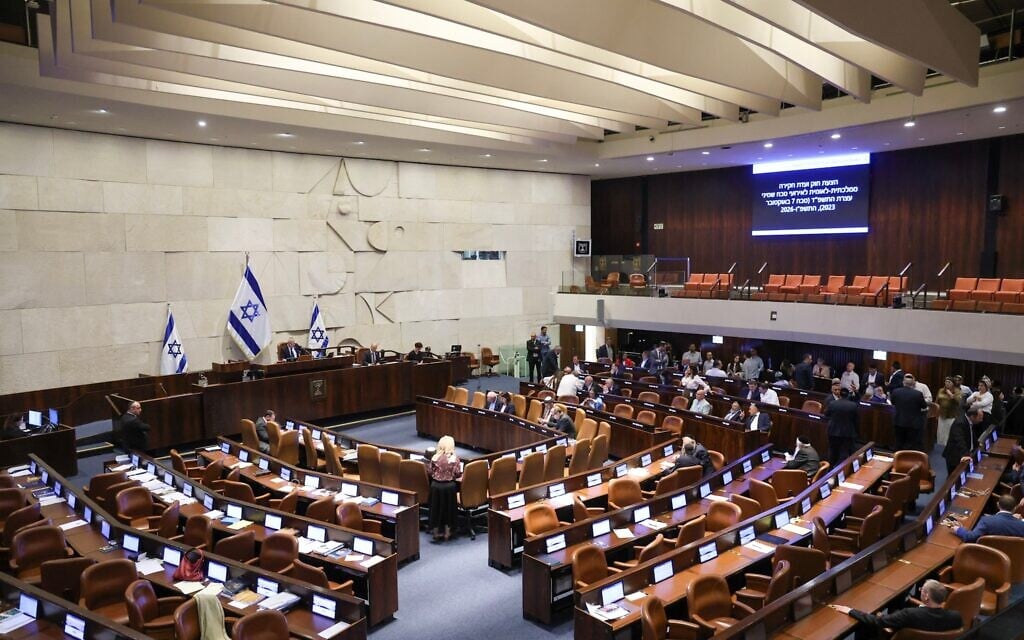
The Knesset votes 59-45 to split its highly controversial legislation gutting the powers of the attorney general.
The decision to split the bill arose seemingly because the Knesset Constitution, Law and Justice Committee no longer had time to prepare the original bill before the Knesset is set to dissolve next week ahead of October elections, due to the legislation’s size and potential impact.
As a result, the bill will no longer split the role into two separate offices — an attorney general and a prosecutor general — as the coalition had sought throughout the legislative process. Instead, criminal prosecution powers will remain with the attorney general for now.
The bill nevertheless preserves the most controversial aspect of the draft law: that the attorney general’s legal positions will no longer be binding for the government. Critics of this provision, including Attorney General Gali Baharav-Miara, say that allowing the government to decide for itself whether its actions are legal will severely violate the rule of law and remove a key check on government power.
The bill’s advancement follows a reported agreement between Netanyahu and the ultra-Orthodox parties ending their boycott of coalition legislation last month. Under the deal, the coalition agreed to advance key Haredi priorities, including legislation enshrining Torah study as a Basic Law and other related measures, in exchange for their support for the coalition’s own legislative agenda.
Constitution committee legal adviser Gur Bligh stated during today’s hearing that a key concern over the bill was the ability of the government to ignore the attorney general’s legal positions in “extreme” situations in which it tries to expand its authority beyond the boundaries of the law. Bligh said this was “especially dangerous” regarding criminal proceedings and election law for which the bill does not provide “adequate safeguards.”
The new version of the bill also removes the highly politicized method of hiring and firing the attorney general, which the previous version of the legislation stipulated, and which critics said would almost certainly undermine the independence of the attorney general. Instead, the new text of the bill says that the government will decide how the attorney general will be appointed and dismissed within 30 days of the law coming into effect after the upcoming elections.
The original version of the legislation passed its first reading in the Knesset plenum in June, but today’s plenum vote was required to approve the committee’s decision to split the bill.
Committee chairman MK Simcha Rothman intends to begin the process of approving the bill for its final readings in Knesset tomorrow night, meaning that votes in the plenum for the final passage of the legislation will likely be scheduled for next week.
Add ToI as a preferred source on Google
Maine Democrat Platner says he will ‘reflect’ on Senate campaign, denies report on sex allegations
Graham Platner, the Democratic nominee for a US Senate seat in Maine, says he is taking time to reflect on his campaign, but denies allegations in a Politico report that a woman he had dated accused him of forcing her to have sex with him nearly five years ago.
“We are taking the time to reflect on the best path forward,” Platner says in a statement.
Politico said the woman detailed the allegation in three interviews. It reported that it also reviewed documents, including emails between the woman and her therapist, and others.
Platner does not indicate whether he is considering suspending his campaign or dropping out of the race. It is also unclear whether Maine Governor Janet Mills, who had been running for the Senate seat but suspended her campaign earlier this year amid Platner’s surge in fundraising and polling, will rejoin if he leaves the race.
Platner is attempting to capture the Senate seat long held by Republican Senator Susan Collins. The race is one of the most closely watched contests in this year’s November 3 midterm elections.
Collins’ seat is a key target in Democrats’ drive to win majority control of the Senate. Republicans currently hold 53 Senate seats, while Democrats control 47. They would need a net gain of four seats to take over the 100-member chamber.
Group of army reservists accuse Channel 14 of regularly airing confidential info, harming national security
A lobby group of military reservists who served in the Gaza war has filed a complaint with police, the state attorney and the military censor against Channel 14, accusing the network of routinely harming national security by airing confidential information about military operations, and demanding an investigation.
The pro-government Channel 14 has become increasingly popular over the last five years. Critics say its pundits and anchors frequently engage in extreme, incendiary, and hyperbolic rhetoric against those perceived as hostile to the government.
The Swords of Iron Combatants Forum, led by Col. (res.) Hanoch Dauba, claims in its complaint that “for over two years, Channel 14 has been engaging in a systematic pattern of publishing sensitive security information, at times even before military operations are carried out, in violation of censorship regulations and criminal law.”
It alleges that this is “not a series of isolated errors, but an orderly system by which sensitive security information, at times highly classified, is used as a tool to generate ratings and public-political influence, while directly harming the national and security interests of the State of Israel.”
It further points to cases in which the military censorship asked for the removal of information, but said that in such instances, “Channel 14 and its employees employ methods of evasion, deliberate delay, and even re-publication of the information on the claim that it has become ‘public knowledge.’” It argues that “the cumulative consequences of this pattern are devastating. Exposure of security force locations in combat zones, exposure of classified intelligence systems, the leaking of operational plans based on the element of surprise — all of these are not only serious criminal offenses, but also harm the operational capabilities of the security forces.”
In a response, the network says: “The attempts by emissaries of Channel 12 to approach the state attorney in order to shut down Channel 14 will not succeed.
“The people of Israel remember well who harmed the fighters of Unit 100 and falsely accused them in the most serious blood libel in the history of the State of Israel,” it says, referring to Channel 12 being the first to air leaked footage of the alleged abuse of a Palestinian prisoner by guards at the Sde Teiman holding facility.
They also remember “who cooperated with the leak regarding the moment of the strike in Iran, thereby endangering our pilots and the state’s security,” it adds, referring to claims that Channel 12 was told of the strike ahead of time by unidentified figures, and therefore brought its anchors to the studio on the morning of February 28. The network did not broadcast any information on the attack prior to its start.
View original source — Times of Israel ↗
Related stories

The Punch
PoliticsJul 6, 2026 · 1 min
A’Court affirms Nenadi Usman’s LP leadership, Abure faction heads to Supreme Court
The Punch

South China Morning Post
PoliticsJul 6, 2026 · 1 min
Norway urges China to help bring Russia to Ukraine peace talks
South China Morning Post

The Guardian
PoliticsJul 6, 2026 · 1 min
UK abuse scandal ‘ignored because victims were working-class boys from north’, minister says
The Guardian
ABC News
PoliticsJul 6, 2026 · 1 min
Could the departure of a WA Labor stalwart give One Nation a boost?
ABC News