VnExpress
Storms, flooding kill 10 in China as east braces for Super Typhoon Bavi
Thunderstorms and strong winds have killed at least eight people in central China, state media said Tuesday, as heavy rains and flooding left two more dead in country's southern region.
Natural disasters are common across China, particularly in the summer, when some regions experience intense rainfall while others bake in scorching heat.
Multiple areas in the eastern part of Hubei Province in central China experienced "severe convective weather" on Monday, state broadcaster CCTV said.
"Thunderstorms and strong winds swept" through cities including Huangshi and Huanggang, killing eight people that evening, CCTV added.
Tornadoes were reported in some areas and one person is missing.
"The extent of the damage is currently being verified and rescue operations are fully underway," CCTV said.
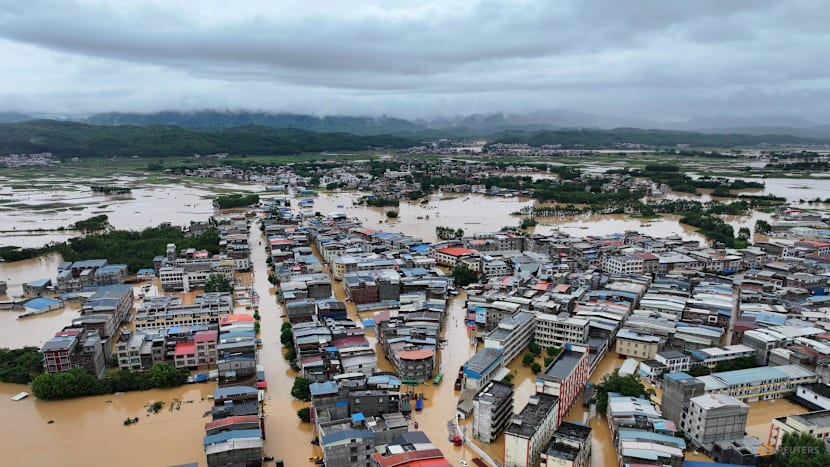
Heavy rains and severe flooding from Typhoon Maysak killed at least two people in the southern region of Guangxi, and prompted authorities to evacuate at least 48,000 people as of Monday evening.
Officials in Nanning, Guangxi's capital, also raised the city's flood control emergency response to the highest level after torrential rain breached dams.
Scientists warn the intensity and frequency of global extreme weather events will increase as the planet continues to heat up because of fossil fuel emissions.
China is the world's biggest emitter of greenhouse gases, but it is also a global renewable energy powerhouse that aims to make its massive economy carbon-neutral by 2060.
A drone view shows flooding in Pingshan village after heavy rainfall brought by Typhoon Maysak, in Hengzhou, China on July 6, 2026. Photo by cnsphoto via Reuters
Super typhoon Bavi approaching
About 170 miles (270 km) away in the city of Guigang, floodwaters turned a wide road into a lake, submerging cars and cascading in brown torrents down a hill into a building site, a video posted on the Chinese social media platform Douyin and verified by Reuters showed.
The water level at Guigang Hydrological Station had risen to 42 meters by 12:30 p.m. (0430 GMT), the Ministry of Water Resources said in a statement.
Further south in Fangchenggang, another verified video showed a small car being washed down a street. The water rose to the level of another car's steering wheel, and a man could be seen struggling to keep his electric scooter from being swept away.
China is also on alert for Super Typhoon Bavi, which is making its way across the Pacific Ocean towards Taiwan. The U.S. National Weather Service said it was packing winds of up to 180 miles per hour as it made its way across Guam, Tinian, Saipan and Rota on Monday.
Weather authorities warned that Bavi will bring strong winds and heavy rain to eastern China from Thursday, according to state agency Xinhua.
China, the world's second-largest economy, faces growing threats from extreme weather, which meteorologists link to climate change.
Analysts say weather-related risks each year stand to wipe out tens of billions of dollars' worth of commercial activity, as cities flood, industrial activity stalls and crops are submerged or washed away.
Turmoil in Hainan and Vietnam
Maysak made landfall in the southern island province of Hainan on Friday, the first tropical cyclone to reach the Chinese mainland this year. The storm made its second landfall on Sunday in Vietnam, which shares a border with Guangxi.
In the Vietnamese border town of Mong Cai, the storm brought down trees and ripped metal roofs from buildings, state media reported, as it made its way into China.
Heavy rainfall is expected across Guangxi, Guizhou, Hunan and other regions in the coming days, according to Chinese meteorologists. The three areas alone are home to over 150 million people — more than the population of Russia.
Following the disaster, China's state planner released 100 million yuan (US$14.72 million) for relief work in Guangxi, while the finance ministry and emergency management authorities provided 160 million yuan to support flood and typhoon response efforts across six provincial-level regions, including Guangxi.
View original source — VnExpress ↗
Related stories

Japan Times
WorldJul 7, 2026 · 1 min
Osaka trumps Tokyo as both ranked among world’s top 10 most livable cities
Japan Times

VnExpress
WorldJul 7, 2026 · 1 min
China dominates Asia university rankings, accounting for 8 of region's top 10
VnExpress

VnExpress
WorldJul 7, 2026 · 1 min
World's memory-chip superpower allows hiring foreign engineers without any language requirement
VnExpress

Japan Times
WorldJul 7, 2026 · 1 min
Australia vows stronger ties with Solomon Islands amid China concerns
Japan Times