Times of Israel
National security concerns threaten to capsize sale of Israeli shipping giant Zim
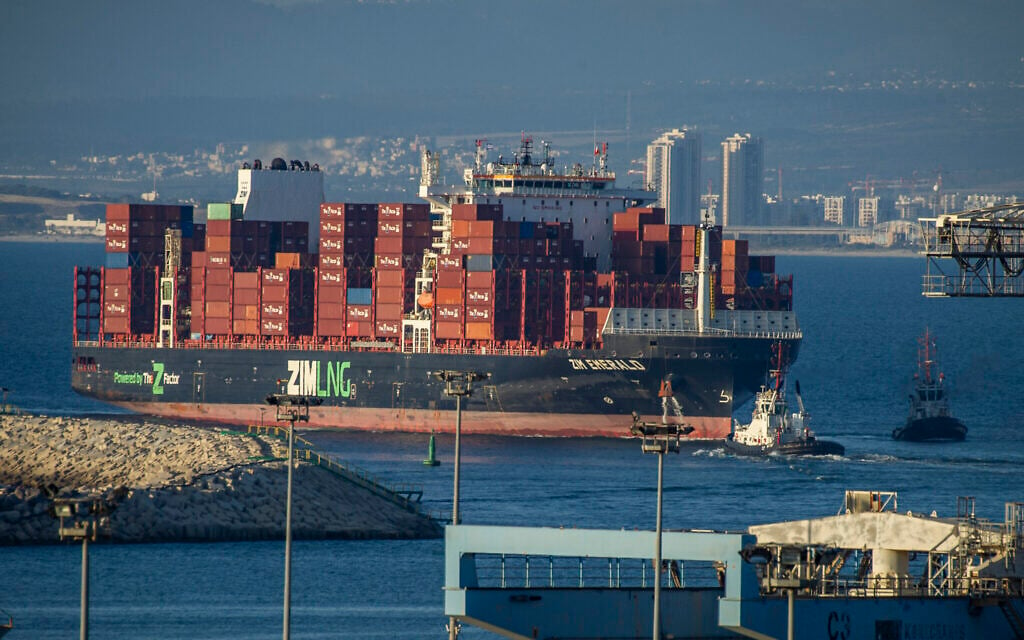
Jerusalem appears poised to torpedo a $4.2 billion deal for German shipping line Hapag-Lloyd to take control of Israel’s Zim freighter service, amid mounting concerns that the acquisition could put the country in dire strategic and national security straits.
This week, Defense Minister Israel Katz joined a list of political leaders objecting to the sale to the German shipping behemoth, siding with Defense Ministry officials reviewing the potential acquisition who concluded that the proposed sale doesn’t safeguard Israel’s national security interests, especially during emergencies, according to his office.
The purchase agreement as currently formulated would see a small slice of Zim Integrated Shipping Services spun off and kept in Israeli hands, meeting a requirement for the formerly state-owned enterprise to maintain maritime freight operations to and from Israel.
However, the lion’s share of Zim’s operations, including shipping routes between East Asia and the Americas, and between Asian ports, would come under the control of Hapag-Lloyd, whose shareholders include a subsidiary of Qatar’s sovereign wealth fund, which owns a 12.3 percent stake, and Saudi Arabia’s Public Investment Fund, which has a 10.2% stake.
Noting the “strategic danger” to Israel’s critical maritime trade routes, Deputy Minister Almog Cohen on Sunday warned Prime Minister Benjamin Netanyahu that it would be a “disaster to hand the key to Israel’s maritime gateway” to a buyer with Qatari-Saudi shareholders.
Sign up for the Tech Israel Daily
and never miss Israel's top tech stories
By signing up, you agree to the terms
Netanyahu said in response that “it is not on the agenda,” according to Hebrew press reports.
According to Katz, the “golden share” in the Haifa-based firm held by the state allows the government to block the sale if it concludes that it harms national security or threatens Israel’s vital maritime interests.
Hapag-Lloyd said it still expected the acquisition to go ahead.
“We continue to advance the deal and are seeking approvals of regulators both internationally and domestically, including the government, Israel Companies Authority and the Israel Competition Authority,” a spokesperson said in an emailed response. “We believe we will receive all approvals.”
The deal has been under discussion since February, when the German firm signed an agreement to purchase its rival for $4.2 billion, alongside Israeli private equity fund FIMI Opportunity Funds, which would hold the Israeli spin-off, to be known as “New Zim.”
The state’s golden share gives it special rights to require Zim to maintain a presence in Israel, including a certain number of vessels that must remain Israeli-owned so that the country’s shipping needs are served.
Under the proposed deal, the golden share would be transferred to New Zim. With a fleet of 12 to 16 vessels, the slimmed-down company will serve three global trade routes into Israel, mainly between the Eastern Mediterranean and the US.
The transaction, which is expected to close at the end of 2026, remains subject to customary closing conditions, including approvals by various regulatory authorities, among them the State of Israel.
In a statement Monday, Zim said it “continues to act in accordance with the agreement and in ongoing collaboration with the relevant state authorities as part of the regulatory review process.”
Founded in Israel in 1945, Zim is Israel’s largest shipping company, with operations in over 90 countries, serving more than 33,000 customers across 300 ports worldwide. Major trade routes including the Pacific, Latin America, the Atlantic, Cross-Suez, and Intra-Asia.
The firm, which has been wholly publicly owned since 2024, is listed on the New York Stock Exchange with a market value of $2.88 billion. It employs around 1,000 people, 160 of whom work out of its Haifa headquarters.
“Zim is the world’s ninth largest shipping company, controlling 40% of the Israeli export and import market,” said Zim labor union chief Oren Caspi, who has also come out against the deal.
With few significant commercial land crossings and a single large international airport, Israel is uniquely dependent on maritime shipping, which accounts for around 90% of imports.
There are concerns that the smaller New Zim, with limited geographic reach and capacity, will be unable to meet that demand to fulfill vital national and strategic interests, especially in times of geopolitical uncertainty that can keep non-Israeli shippers away.
Among government bodies that have expressed objections to the structure of the deal in recent weeks are the Transportation, Agriculture, and Economy ministries, due to concerns about dependence on foreign-owned shipping, particularly during emergencies and amid threats of trade embargoes.
At a Knesset Finance Committee meeting in June, an Economy Ministry representative said that there was no support for the firm to be sold to a buyer partially owned by nations that do not maintain diplomatic relations with Israel.
“From a maritime transport perspective, our understanding is that Zim Israel will not operate routes to the Far East; given that we are actively developing ties with the Far East, this could pose a problem,” said Economy Ministry’s Anael Maman, referring to New Zim.
The government has yet to publish an official position on whether it will approve or block the deal.
Help from Ashkenazi
In the face of the growing concerns in Israel over the country’s security and national maritime interests, Hapag-Lloyd has hired former IDF chief of staff Gabi Ashkenazi as a consultant to help advance necessary regulatory approvals.
“As the merger transaction was taking shape, it became clear to Hapag-Lloyd that it required professional advisors in two distinct areas: banking and business, and national security and defense,” Hapag-Lloyd said of the move.
The German shipping giant added that it had already engaged with Ashkenazi, a former foreign minister and Defense Ministry director general, before the purchase deal was signed.
It “formally retained him as a consultant shortly thereafter, in recognition of his exceptional expertise and extensive experience in national security and defense,” it said.
Joining government officials, Zim’s labor union has also come out against the deal, citing the importance of preserving Israel’s maritime independence and its ability to receive essential supplies from food to medicine in times of emergency.
Caspi told The Times of Israel that workers would support a competing bid from a local firm to purchase the company rather than breaking it up.
After Zim shareholders approved the Hapag-Lloyd merger, Israel’s Sakal Group in May submitted a competing bid offering $4.5 billion, alongside commitments to maintain its fleet and operations under Israeli control.
“Every Israeli player, who would offer to buy the whole of Zim is welcome — we would not object,” said Caspi.
He noted that when airspace was closed in June during the 12-day war with Iran, Zim vessels were used to bring dozens of doctors, reservists, and defense staff stranded overseas back to Israel.
“During recent wartime periods when missiles were flying here, all shipping companies either completely stopped or reduced their operations to Israel, while Zim’s vessels stayed and bore the burden, serving as a vital channel for supplying ammunition, food, and medicine to Israel.”
He noted that tensions were still high, particularly with rising anti-Israel rhetoric from Turkey, and warned a naval blockade on Israel could put it in a dangerous position should Zim be sold to buyers from potentially hostile countries.
“If the government approves the deal, Qatar-Saudi wealth funds will get a foothold here, which could have strategic consequences for Israel,” he said.
Caspi mentioned attempts by Qatar’s sovereign wealth fund, the third-largest investor in Volkswagen, to shoot down a deal between the Israeli state-owned defense firm Rafael and the German automotive giant to convert a struggling car manufacturing plant to produce parts for the Iron Dome missile defense system.
Qatar, which holds 17% of voting rights in Europe’s biggest carmaker via the Qatar Investment Authority, has reportedly raised issues over the talks between the two companies, due to its complicated relationship with Jerusalem.
“With the approval of this deal, the same could happen to Israel,” said Caspi. “Israel will give up a strategic asset: a large, independent, international shipping company with branches all over the world.”
Reuters contributed to this report.
View original source — Times of Israel ↗
Related stories

Philippine Daily Inquirer
TechnologyJul 8, 2026 · 1 min
Minor behind school shooting threat in Lapu-Lapu identified, held
Philippine Daily Inquirer

Indian Express
TechnologyJul 8, 2026 · 1 min
Rs 12.26 lakh crore infra projects, flood control projects: Maharashtra CM outlines MMR growth
Indian Express

Indian Express
TechnologyJul 8, 2026 · 1 min
Maharashtra rain: Why the Western Ghats received historically high rainfall this July
Indian Express

Engadget
TechnologyJul 8, 2026 · 1 min
Apple pledges to buy $30 billion of Broadcom's US-made chips
Engadget