Indian Express
Prambanan temple: Revisiting origins and history of Indonesia’s iconic heritage site
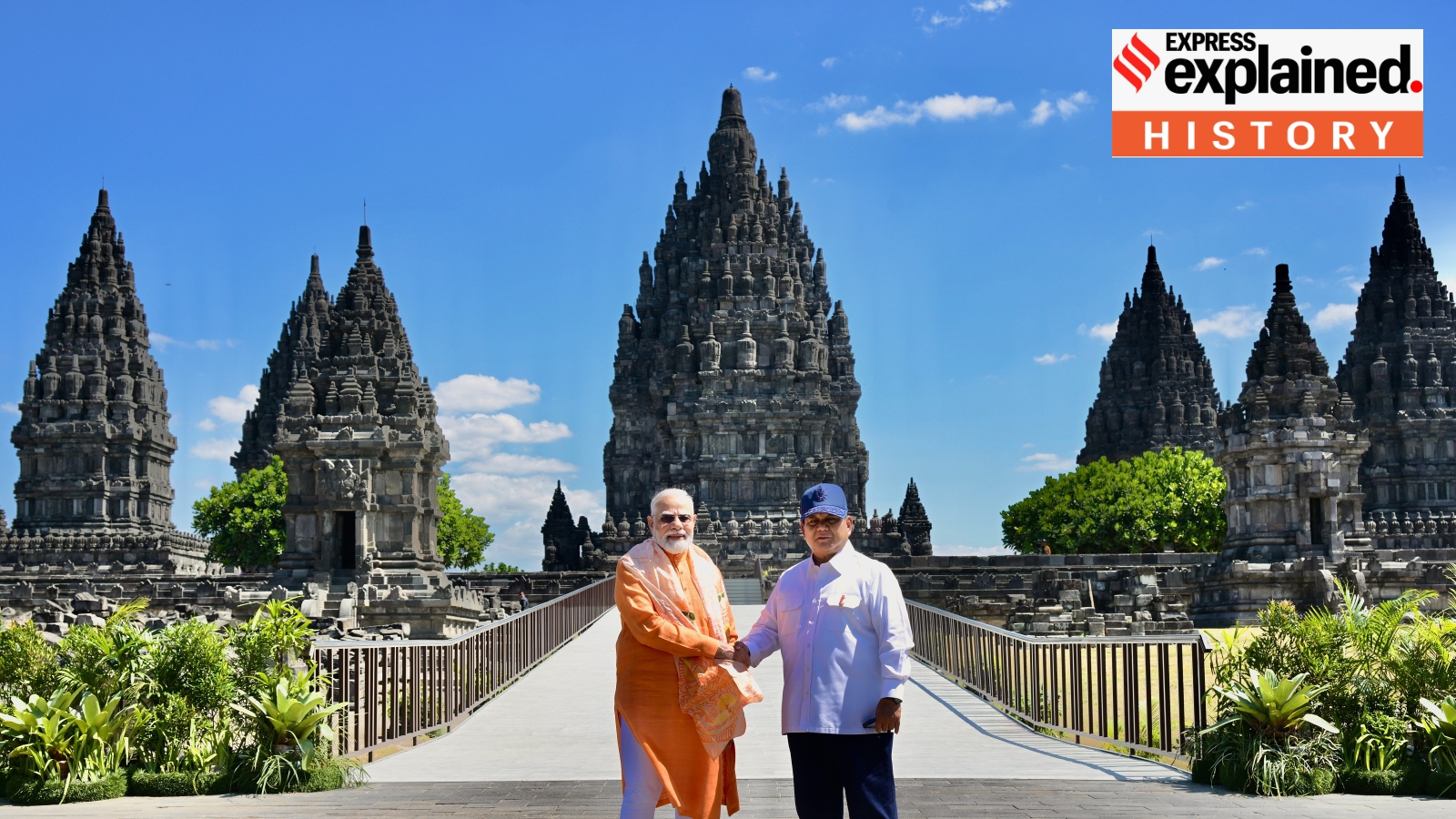
Prime Minister Narendra Modi’s visit to Yogyakarta, Indonesia, this week marked the beginning of India’s effort to help restore Indonesia’s iconic Prambanan Temple, a UNESCO World Heritage Site.
The Prambanan Temple Compounds, located on the border between Indonesia’s Yogyakarta Special Region and Central Java province on the island of Java, comprise Prambanan Temple (also known as Loro Jonggrang or Candi Prambanan), Sewu Temple, Bubrah Temple, and Lumbung Temple. At the heart of the complex is Prambanan Temple, which originally consisted of 240 large and small temples.
We revisit the long history of the temple’s origins.
The Sanjaya dynasty was a Javanese dynasty that ruled the Mataram Kingdom in Central Java during the eighth and ninth centuries, and is generally associated with the revival of Shaivite Hinduism on the island. Its dominance, however, was challenged by the Sailendra dynasty, a powerful Buddhist royal house. Under the Sailendras, Javanese art, architecture, and technology flourished, while religion and mythology found expression in the construction of numerous temples and shrines between 700 and 900 CE. Java also emerged as a major centre of Buddhist scholarship during this period.
Following the end of the reign of Samaratungga of the Sailendra dynasty, Rakai Pikatan of the Sanjaya dynasty is believed to have married Samaratungga’s daughter, Pramodhawardhani, and ruled between 842 and 856 CE. He is widely credited with commissioning Prambanan as a grand Hindu sanctuary.
In his journal article “Magnificent Prambanan and Borobudur Temples” (2026), researcher Hary Gunarto notes that the construction of Prambanan was intended to mark the return of the Hindu Sanjaya dynasty to power after nearly a century of Buddhist Sailendra dominance. Although the exact date construction began remains uncertain, inscriptions record the consecration of the temple in 856 CE.
For roughly the next century, Prambanan served as an important pilgrimage centre. But around 929-930 CE, the political centre of the Mataram Kingdom shifted to East Java. While this move is often linked to the eruption of Mount Merapi, historians have also suggested political and economic reasons.
Story continues below this ad
As Central Java was gradually abandoned, Prambanan fell into disuse and was eventually buried beneath vegetation and layers of volcanic debris. It remained largely forgotten until it was rediscovered by Europeans in the early 19th century.
Rediscovering Prambanan
Who first rediscovered Prambanan after centuries of abandonment remains a matter of debate. One possible early visitor was the 15th-century East Javanese court poet Mpu Tanakung. Describing a ruined temple complex, he wrote: “A great temple complex from ancient time rose near a mountain stream, and the path there was lonely.” Scholars have noted striking similarities between his account and Prambanan.
In modern Indonesian, candi means an ancient Hindu or Buddhist temple or shrine, while Prambanan is believed to derive its name from the village to which the temple complex once belonged. Photo: Wikimedia Commons
Another prominent figure associated with the site’s rediscovery is Thomas Stamford Raffles, Lieutenant-Governor of Java during the British interregnum (1811–16), who took a keen interest in documenting Central Java’s ancient monuments. Yet an even earlier European account comes from C A Lons, an official of the Dutch East India Company. As Roy E Jordaan notes in In Praise of Prambanan (1996): “Lons was an employee of the Dutch East Indies Company who in 1733, while staying at the court of the Javanese sultan as a member of an embassy made a sightseeing tour of a number of temple ruins and reported on these to his superiors.”
Prambanan has since undergone several phases of restoration, many of them interrupted by the Second World War and Indonesia’s struggle for independence. “Thus the reconstruction of the main temple, which had been in progress since 1918, was only completed in 1953, under a new national flag. The inauguration ceremonies were conducted by Soekarno, Indonesia’s first president,” writes Jordaan.
Symbol of religious harmony
Story continues below this ad
The marriage of the Hindu ruler Rakai Pikatan and a Buddhist princess is often seen as a symbol of religious harmony, also reflected in the architecture of Prambanan. The temple incorporates a Buddhist stupa-like element atop its superstructure, while Buddhist artistic influences are visible in several decorative sculptures across the complex.
Gunarto notes: “There are many Buddhist temples built around Candi Prambanan which were constructed at the same era, such as Candi Sewu, Candi Bubrah, Candi Lumbung, Candi Kalasan, Candi Plaosan, and Candi Sari.” This concentration of both Hindu and Buddhist monuments in the same landscape underscores the religious coexistence that characterised central Java during the 9th century.
In modern Indonesian, candi means an ancient Hindu or Buddhist temple or shrine, while Prambanan is believed to derive its name from the village to which the temple complex once belonged. At the heart of the complex are three temples dedicated to the Hindu trinity: Shiva, Vishnu, and Brahma decorated with relief panels depicting scenes from the Ramayana. Opposite them stand three temples dedicated to the animals who serve them.
Each of the four projecting sides of the temple has a stairway leading to a separate chamber, or cella. The eastern stairway opens into the main chamber, which houses the statue of Shiva. “In the western chamber stands the statue of Ganesa, Siva’s elephant-headed son. In the northern chamber we find the famous statue of Durga as Mahisasuramardini, showing the demon she has just extracted from the slain buffalo in which he had hidden. The local people call her Loro Jonggrang,” writes Jordaan.
Story continues below this ad
The Prambanan Temple Compounds was inscribed on the UNESCO World Heritage List in 1991. In 1998, it was designated as a National Cultural Property and the national law issued in 2010 also supports the protection and conservation of the property.
View original source — Indian Express ↗
Related stories

Philippine Daily Inquirer
TechnologyJul 9, 2026 · 1 min
Nadine Lustre reveals netizen she sued for harassment sentenced, undergoes rehab
Philippine Daily Inquirer

Philippine Daily Inquirer
TechnologyJul 9, 2026 · 1 min
When cybersecurity reminders are not enough
Philippine Daily Inquirer

France 24
TechnologyJul 9, 2026 · 1 min
Middle East live: Kuwait and Bahrain targeted by strikes after broken ceasefire
France 24

RNZ
TechnologyJul 9, 2026 · 1 min
Fresh drone shots show extent of weather damage to SH1 near Kaikōura
RNZ