Times of Israel
After ‘loyalty’ uproar, Shin Bet head says agency subordinate to Elections Committee on vote
Shin Bet chief David Zini said Thursday that the agency he leads is subordinate to the Central Elections Committee when it comes to the upcoming national vote, in the wake of a controversy in which he said he was loyal to the country’s “elected leadership.”
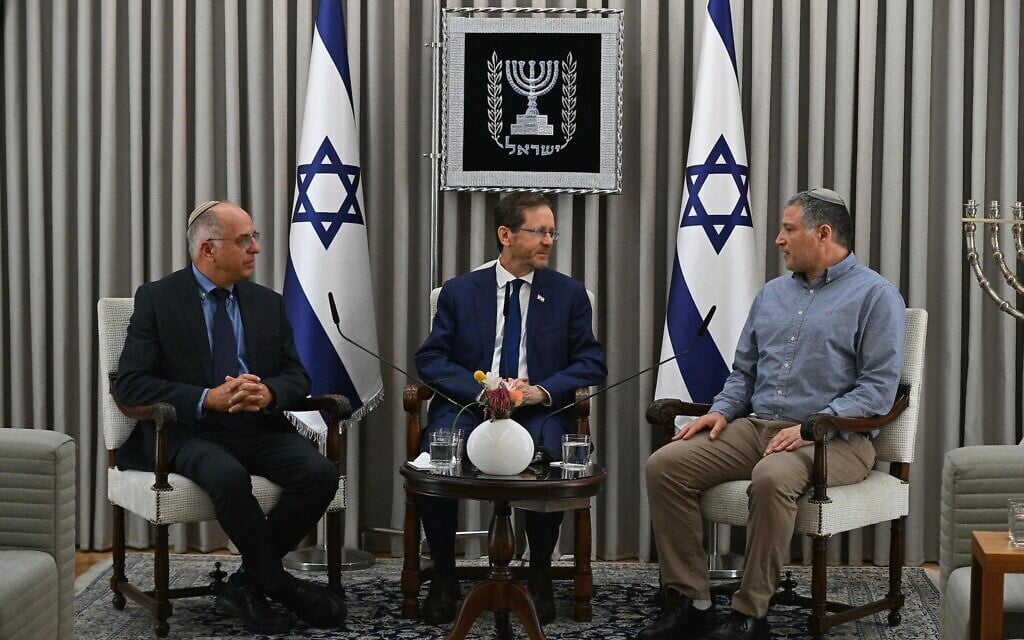
Zini held a meeting Thursday at the President’s Residence in Jerusalem with President Isaac Herzog and Central Elections Committee chairman Noam Sohlberg, in which the participants stressed their commitment to “ensuring the integrity of the election,” the president’s office said.
During the meeting, which came at Zini’s initiative, the three officials “emphasized their shared commitment to safeguarding the purity of the elections, strengthening public trust and upholding the status of the Central Elections Committee,” according to a readout from Herzog’s office.
The meeting came just days after comments from Zini drew sharp criticism from current and former officials. Speaking Tuesday, in audio that was first leaked and later published by the Shin Bet, Zini said that he had accepted the role of agency chief because of his ability to be “loyal to the elected leadership.” Under the law, the Shin Bet is subordinate to the government.
Opposition leaders reacted sharply to the comments at the time, saying the Shin Bet must be loyal to the country and its people rather than any political power. Herzog himself said in a speech Wednesday that Israel’s “security and law enforcement bodies are not loyal to any individual or political camp, but to the sovereign — the people of Israel, the laws of the State of Israel and the the values of the Jewish and democratic state.”
Get The Times of Israel's Daily Edition
by email and never miss our top stories
By signing up, you agree to the terms
In the readout from the meeting on Thursday, Zini said that “with regard to elections, the Shin Bet is directly subordinate to the chair of the Central Elections Committee, in order to do everything in our power to preserve the statesmanlike, nonpartisan character and integrity of the elections.”
Herzog added that “elections are not a civil war. Elections are a social, democratic and political process.”
“There are many hostile foreign digital influences, and there are many elements seeking to sabotage from within, and especially from the outside,” the president continued, without elaborating. he added: “We will do everything in our power, and I am confident that the Central Elections Committee and its personnel, with the backing and support of the Shin Bet, will prevent such disruptions.”
The upcoming national election is slated to be held no later than October 27.
Separately, a Haaretz newspaper report on Thursday said that Zini recently asked the Justice Ministry to seek Attorney General Gali Baharav-Miara’s approval for an investigation into an alleged leak to Channel 12 regarding the date on which the war with Iran would begin earlier this year.
The newspaper, citing a security source, said the request came after Prime Minister Benjamin Netanyahu and government ministers pressured Zini on the matter during a security cabinet meeting, despite the latter’s assessment that approval for such an investigation would not be granted.
According to the Ynet news site, Transportation Minister Miri Regev pressed Zini in the meeting on why the Shin Bet was not investigating the purported leak, and Zini responded that there was no point in doing so given the circumstances, telling ministers: “The incident happened a long time ago; they asked to investigate it several months later. More than 4,500 people were privy to the secret [war plans], and there is no lead. An investigation of this kind, involving media outlets, requires the attorney general’s approval, and she is not expected to grant such approval.”
Hebrew media outlets reported last month that Netanyahu had asked Zini to open an investigation into the matter, following similar efforts by Defense Minister Israel Katz.
Communications Minister Shlomo Karhi called in early March for a probe, after Channel 14 commentator Yaakov Bardugo, a close Netanyahu ally, alleged that Channel 12 appeared unusually prepared to go on air early Saturday on February 28 — the first day of the war — with anchor Yonit Levy and commentators already “in full makeup” minutes after the opening strikes were carried out.
Channel 14 previously quoted the premier as saying the alleged leak was a “criminal leak” that jeopardized the success of the operation, and Bardugo recently stated on a radio show that he met with Zini in the Shin Bet chief’s office to press for the investigation.
The Shin Bet declined to respond to Haaretz’s request for comment on the report.
Earlier this week, a group of IDF reservists urged police to open a criminal probe into Channel 14, alleging that the right-wing TV network regularly shares classified material that violated censorship rules, compromising operations and endangering security forces, including about the start of the 2025 Iran war.
Times of Israel staff contributed to this report.
View original source — Times of Israel ↗
Related stories

TASS
PoliticsJul 9, 2026 · 1 min
London, Stockholm courts issue unlawful rulings on Russian companies — Putin
TASS

AllAfrica
PoliticsJul 9, 2026 · 1 min
Nigeria: U.S. Publishes Names of 124 Nigerians to Be Deported
AllAfrica

Euronews
PoliticsJul 9, 2026 · 1 min
Santas fill Danish streets for annual congress
Euronews

Straits Times
PoliticsJul 9, 2026 · 1 min
Florida airport renamed ‘Trump’ in latest push to expand his brand
Straits Times