Indian Express
India, Australia ink defence pacts, fast-track trade deal
Signalling a significant deepening of bilateral ties, India and Australia on Thursday sealed a series of pacts across sectors, from defence and maritime security to energy, including one that paves the way to operationalise their 2014 Civil Nuclear Agreement that secures a stable corridor for uranium supplies to India for peaceful purposes.
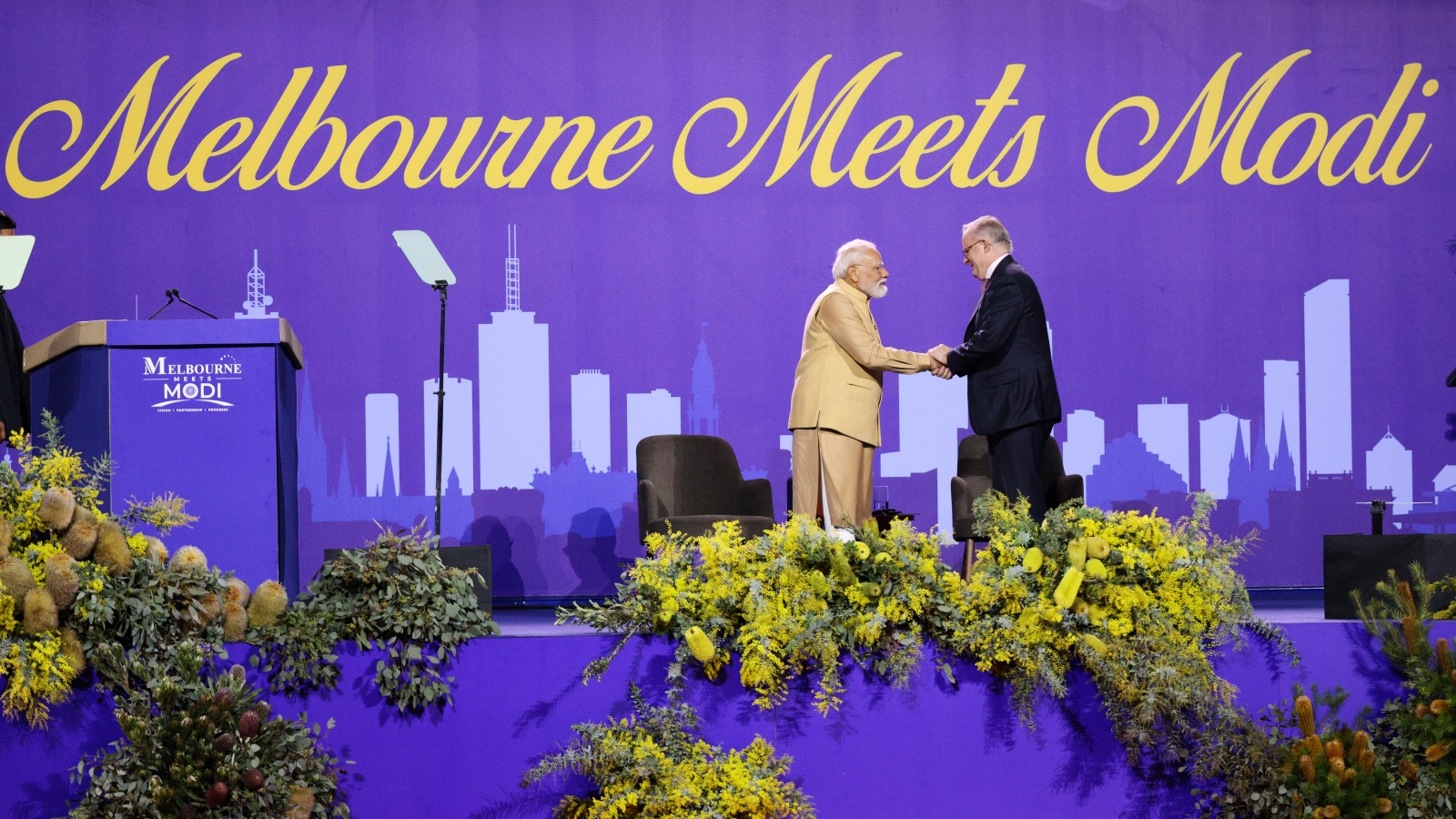
With these pacts forming the backdrop, Prime Minister Narendra Modi described both countries as “vibrant democracies”, “multicultural societies”, and “significant ocean powers”. Modi told Australian Prime Minister Anthony Albanese that they will together strengthen peace, stability, freedom of navigation, and a rules-based order across the Indo-Pacific region.
Albanese, in turn, said the two countries are focusing on deepening and diversifying their partnership. “Six years into our strategic partnership, Australia’s relationship with India has never been more consequential than it is today. Our partnership has never been stronger,” he said.
“We share a focus on deepening and diversifying the relationship between our countries so we can continue to grow from strength to strength. Today, we have done exactly that across the breadth of our relationship. With new landmark agreements, we are expanding our relationship across defence and security, education, science and technology, and energy security and critical minerals,” he said.
The strengthening of ties comes at a time when China’s assertive behaviour in the Indo-Pacific region has caused concern among like-minded Quad partners, while the ongoing conflict in West Asia between the US and Israel on one side and Iran on the other has affected maritime traffic in the Strait of Hormuz over the past four-and-a-half months.
Modi, who is in Melbourne for the third annual India-Australia Summit, said they have now decided to “fast-track work on the Comprehensive Economic Cooperation Agreement (CECA), which will be balanced, ambitious, and mutually beneficial for both nations”. “We will also accelerate progress on the Bilateral Investment Treaty,” he said after the bilateral talks.
Following the talks, the two sides signed a joint statement alongside separate statements covering defence and maritime security, energy security, and critical minerals. The statement noted tangible benefits already reaching businesses and consumers under the existing India-Australia Economic Cooperation and Trade Agreement (ECTA), while emphasising the need to dismantle non-tariff barriers further and coordinate institutional financing to drive private-sector investment.
Story continues below this ad
Another key outcome was the finalisation of the administrative arrangement to operationalise the Civil Nuclear Agreement signed in 2014 and enable supply of uranium from Australia to India. “The arrangement facilitates Australian uranium exports to India to help increase the share of non-fossil fuel power capacity, providing an additional market for the Australian resources sector,” Albanese said.
Also, to support India’s domestic renewable energy push, a joint ‘Rooftop Solar Training Academy’ will be established in Gujarat to build technical capacity among women and youth under the PM Surya Ghar Yojana.
On defence and security ties, Modi said, “The Indo-Pacific is not merely a confluence of two oceans; it is also a symbol of the shared aspirations of like-minded democracies like India and Australia. Today, we have issued an important Joint Declaration to enhance cooperation in defence and security. Through the India-Australia Defence Innovation Corridor, we will work on connecting defence start-ups and industries.”
“Our Maritime Security Collaboration Roadmap will lend new strength to our shared efforts in the Indo-Pacific. We will also move forward together in shipbuilding, ship repair, and maintenance,” he said.
Story continues below this ad
Albanese said the joint declaration on defence and security cooperation will provide for deepening “practical partnership”. “Australia values India as a top tier security partner and the declaration reflects our shared commitment to a peaceful, stable and prosperous Indo-Pacific region. We will boost strategic coordination, increase the complexity of our defence exercises and further build interoperability between our defence forces,” he said.
Reaffirming their commitment to a rules-based order, the joint statement noted that both prime ministers “strongly opposed any destabilising or unilateral action to change the status quo and undermine regional peace and stability,” and explicitly emphasised adherence to the United Nations Convention on the Law of the Sea (UNCLOS).
Addressing international issues, Modi reiterated India’s stance against cross-border terrorism. “India and Australia believe that terrorism is a serious challenge not just for any single country, but for humanity as a whole. Therefore, our fight against terrorism is shared, our resolve is unwavering, and our cooperation is continuously strengthening,” he said.
On global conflicts, he said, “We also believe that the tensions and conflicts prevailing in various parts of the world can only be resolved through dialogue and diplomacy.”
Story continues below this ad
The two leaders also launched the Australia-India Partnership on Cyber, Critical Technologies and Supply Chains (PACTS). The partnership targets supply chain diversification, cybersecurity, digital resilience, and joint semiconductor research.
“Our cooperation in critical minerals is vital for our strategic security and clean energy transition,” said Modi.
A separate trilateral Memorandum of Understanding (MoU) was also signed under the Australia-Canada-India Technology and Innovation (ACITI) umbrella, cementing a trusted technological alliance between the three Commonwealth nations.
Highlighting the deep cultural footprint of the Indian diaspora in Australia, the leaders welcomed significant advancements in educational ties.
Story continues below this ad
The University Grants Commission (UGC) issued a formal Letter of Intent to Flinders University to establish its foreign branch campus in Bengaluru. Simultaneously, a Letter of Approval was granted to Victoria University to operationalise its new campus in Gurgaon.
Furthering vocational training, the Western Australian Government signed an agreement with New Delhi to set up a National Centre of Excellence for Skilling in Mining at the National Skill Training Institute in Bhubaneswar.
Another key outcome from the bilateral talks was a pact for the repatriation of Indian artifacts, with Australia agreeing to return the sacred bull Nandi (11th–12th century, granite), a trident with Auspicious Kali (11th century, bronze), and a six-headed Skanda (12th century, basalt).
Concluding the summit, Modi turned to the two nations’ shared sporting passion to describe the evolving relationship. “Cricket serves as a diplomatic language for the relationship between India and Australia. That is why our meetings often feel like a cricket match: The agenda — focused like a one-day match, decisions — swift like a T20 game, and the partnership—long-lasting and deep, like a Test match,” he said.
Story continues below this ad
Modi, who is in Australia as part of a three-nation trip, will next head to New Zealand.
View original source — Indian Express ↗
Related stories
CNA
WorldJul 10, 2026 · 1 min
Suspect in Charlie Kirk killing expressed regret after shooting, roommate says
CNA

Stuff
WorldJul 10, 2026 · 1 min
Watch: Fighter jet crash lands, bursts into flames at Greek airport
Stuff

Philippine Daily Inquirer
WorldJul 10, 2026 · 1 min
Ashfall from Kanlaon, sulfuric smell reported in some NegOcc communities
Philippine Daily Inquirer

Philippine Daily Inquirer
WorldJul 10, 2026 · 1 min
Army recovers alleged NPA arms cache in Oriental Mindoro
Philippine Daily Inquirer