VnExpress
Ivy League professor traps students with in-person exam, exposes mass AI cheating
A Brown University economics professor says most of his class cheated with AI on a take-home midterm that averaged 96%, only for the in-person final to collapse to 48%.
Roberto Serrano, who has taught at Brown for 34 years, gave a take-home midterm in his advanced undergraduate welfare economics course for the first time, he told Inside Higher Ed in June.
He relaxed the format for students still shaken by the Dec. 13 mass shooting at Brown, where a gunman killed two students and wounded nine.
Two of the wounded were his students. One of those killed had asked him days earlier to be her academic adviser, he told Fortune.
Enrollment in a course that usually drew up to 30 students jumped to 86, which Serrano ties to the take-home promise.
The March 5 midterm came back with a 96% average and 40 perfect scores out of 86, Spanish daily El País reported. The course's midterm had historically averaged 65% to 80%, and he had written this version to be harder than usual.
Serrano and his graders ran the exam through ChatGPT.
Its answers matched many of the students', accurate in spots but "very off and with a very convoluted style," he told Inside Higher Ed. A question with a clean direct solution drew the same contrived, contradiction-based proof from the chatbot and from student after student.
Serrano told the class he would keep the midterm if the final's grade distribution roughly matched it and void it if not, then made the final an in-person exam.
Eighteen students dropped the course and nine more skipped the final. Of those 27, 22 had scored a perfect 100 on the midterm, El País reported.
The May final averaged 48.6%, the lowest in the course's history, with three zeros.
Serrano voided the midterm, made the final worth 80% of the grade, and lowered the passing mark from 50% to 40%. 19 students failed.
He gave the grade data to Brown's Standing Committee on the Academic Code in May and heard nothing, he said.
After he went public, the committee asked him through his department chair to file separate complaints against each suspected student, with copies of their exams.
He called the demand "appalling" and told Inside Higher Ed he expects the exams would be run through AI-detection tools he considers unreliable.
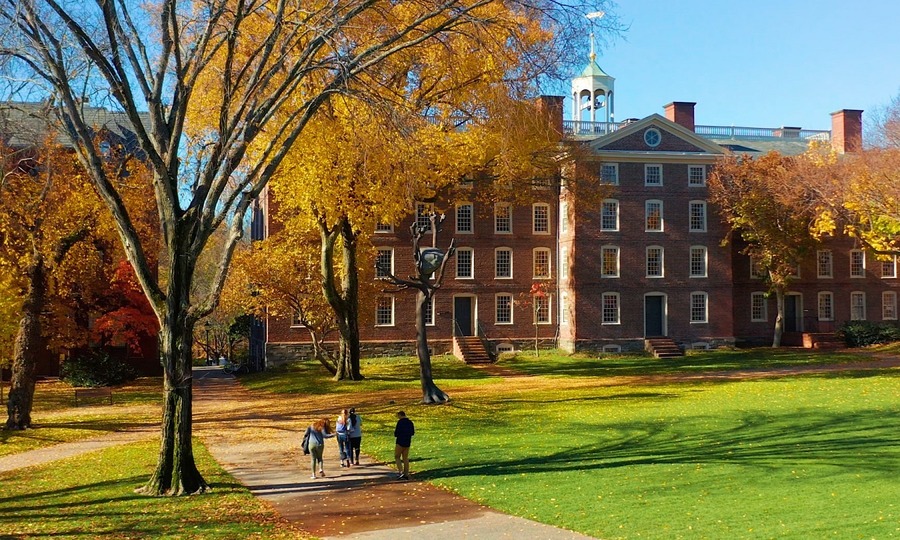
A view of Brown University. Photo courtesy of Brown University
Brown spokesperson Brian Clark told Inside Higher Ed the university takes every integrity allegation seriously and follows the same process whether one student or many are involved.
Academic leaders had been in touch with Serrano, Clark said, but the professor had not supplied the details the committee needs to act.
Faculty are neither rewarded nor paid to adjudicate a 60-person cheating case, said Tricia Bertram Gallant, director of the Academic Integrity Office and Triton Testing Center at the University of California, San Diego.
Institutions serious about integrity will fund dedicated staff, she told Inside Higher Ed, citing organizational theorist Edgar Schein's line that leaders reveal their values through what they spend money on.
A Brown committee on generative AI in teaching and learning released its first report on July 7.
Three-quarters of the 105 faculty members surveyed said they worry about students using AI to cheat, matching a 2025 national survey by the American Association of Colleges and Universities.
The committee urged Brown to update its academic codes while telling faculty to move beyond punishment, since no method catches AI use reliably.
Brown's cost of attendance reaches about $97,000 for 2026-27, with tuition up nearly 50% over the past decade, The Boston Globe reported.
Serrano has warned that if elite universities keep graduating students who let a chatbot do the work, employers will notice and the credential itself will lose value.
A society in which many of its brightest students think cheating is acceptable is a failing one, Serrano told Inside Higher Ed. "We cannot choose to become idiots."
View original source — VnExpress ↗
Related stories

South China Morning Post
WorldJul 10, 2026 · 1 min
Hong Kong, Macau central to China’s commercial space expansion, GalaxySpace says
South China Morning Post

TASS
WorldJul 10, 2026 · 1 min
SCO, Laos sign memorandum on Dialogue Partner status for Vientiane
TASS

Philippine Daily Inquirer
WorldJul 10, 2026 · 1 min
Classes suspended in half of Pangasinan towns due to Inday
Philippine Daily Inquirer

Philippine Daily Inquirer
WorldJul 10, 2026 · 1 min
IU, Lee Jong-suk break up after 4 years
Philippine Daily Inquirer