Indian Express
Expert Explains | How Turkey emerged as a winner from a fractious NATO summit
For months, President Donald Trump’s attendance at the NATO leaders’ summit in Ankara appeared unlikely amid the widening rift between the US and Europe. Trump did attend, in typically stormy fashion — ordering a cutoff in trade with one member, Spain, and renewing claims on Greenland before recommitting himself to the alliance.
Leaders of the 77-year-old transatlantic alliance, would count this as a successful outcome from the gathering that concluded this week with no breakthrough on its internal divisions.
The real winner of the summit, however, was the host, Turkey, which is looking to boost its stature within the bloc and overcome longstanding issues with the US.
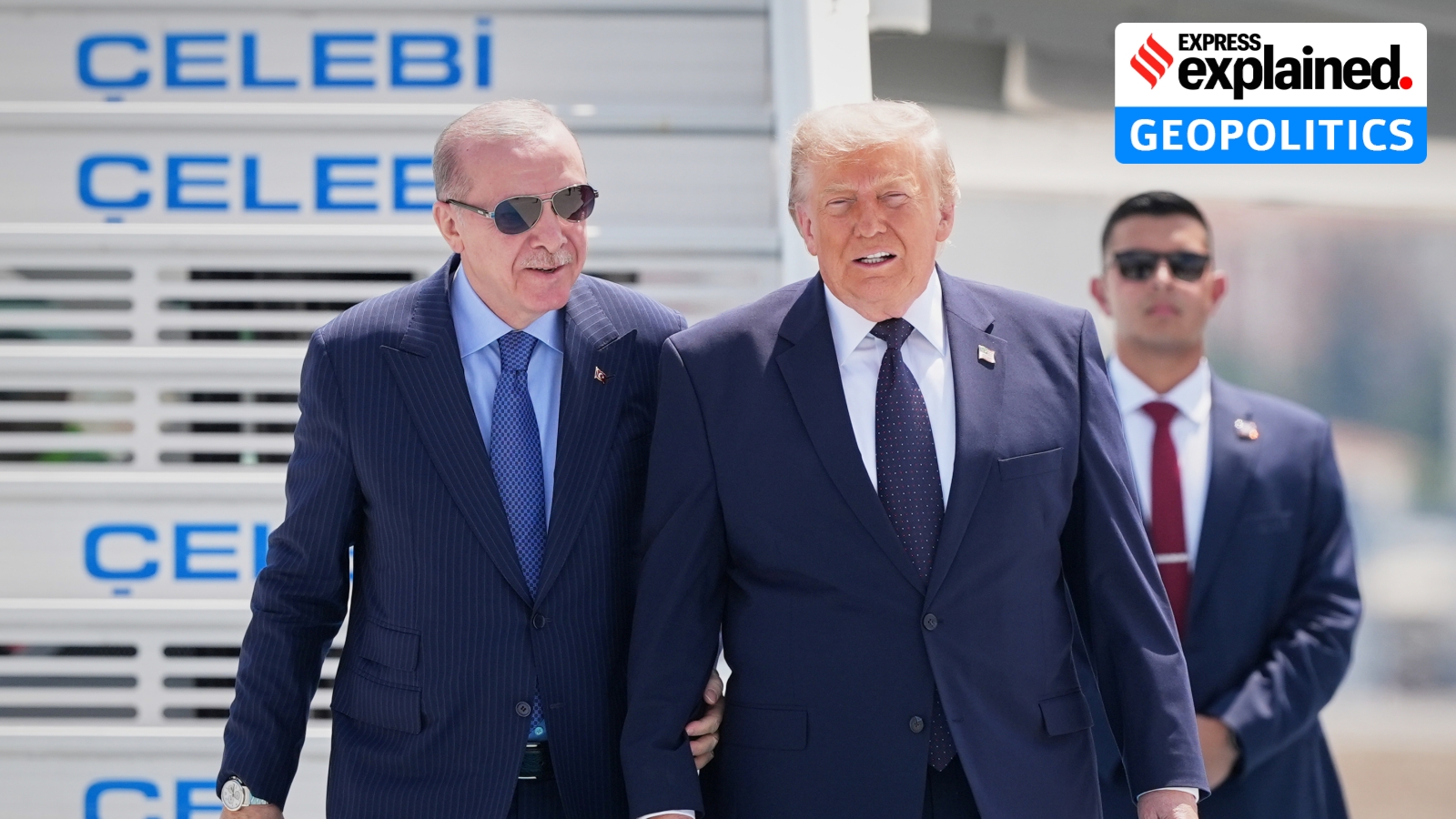
In fact, Trump, who has long railed against the defence spending disparities within NATO and the lack of support for his war against Iran, said he only attended because Turkish President Recep Tayyip Erdogan was the host.
The challenges for NATO
NATO summits are gradually becoming an annual ritual that many members would prefer to skip, at least as long as Trump is in the White House. NATO faces doctrinal, strategic and technological challenges.
President Trump is furiously vocal, at least on technological crises, and decries Europe’s reluctance to increase defence spending and invest in innovation. While Europe is willing to increase spending, Trump’s views on Ukraine and Greenland have created mistrust within the transatlantic solidarity.
Despite this turbulence in the relationship, European officials feel that the absence of their superpower ally from the alliance would leave them more vulnerable to an attack from Russia.
Story continues below this ad
At the summit, President Trump made little effort to restrain his anger over his European allies’ lukewarm support for his Iran war. He said he was joining the Ankara Summit only because of his relations with Erdogan.
Sitting alongside NATO head Mark Rutte, Trump also defended Erdogan against sharp criticism from US ally, Israeli Prime Minister Benjamin Netanyahu, who warned this week against selling F-35s to Ankara. He repeatedly praised the Turkish president during the course of the summit.
The divisions within the alliance
NATO in 2026 is a divided house. The US is driven by its America First policy, and the UK and Turkey remain outside the EU.
At the core of this divide is the burden-sharing dispute that has jeopardised US-Europe relations for months. Europe has also almost abstained from ceasefire forums in Gaza, Iran, Libya and Sudan.
Story continues below this ad
Now, for the first time, NATO has pledged €70 billion in military aid to Ukraine that will be fully financed by the EU. For American weapons, Ukraine must buy from the US in Trump’s buy-back plan. Trump has already asked the EU members to reimburse $350 billion that the US has spent on Ukraine so far because these funds have stabilised European security.
Meanwhile, non-EU NATO members accuse the EU of overregulation and lack of innovation. Turkey remains isolated for its staunchly pro-Palestine views in the pro-Israel military alliance.
The EU defence fund Security Action for Europe (SAFE) mandates at least 65% procurement in the $150 billion projects should be EU-origin, towards reducing EU’s dependency on the US and to expedite EU’s defence innovation.
In this, the non-EU NATO members — mainly the US, UK, Canada and Turkey — are effectively treated as “foreigners”. Italy has paused its SAFE borrowing to continue the Italy-Turkey defence venture. Similarly, after years of political rifts with Ankara over Syria and Armenia, France has decided to go ahead with Franco-Italian and Turkish cooperation for a long-range air defence system.
Story continues below this ad
The fate of Türkiye’s entry to SAFE depends on Greece and Cyprus’ veto, even though Germany and Italy want the two countries to soften their position on Türkiye.
Turkey and the West
There are no signs that the EU will show any flexibility over Türkiye’s EU accession application, something the US wants. But Ankara has built closer ties with the US, UK and West Asia. Turkish defence exports are reaching European capitals. Germany, Italy, France and Spain are rebuilding their defence relations with the country.
The US-Turkey relations under Trump have seen a full rebound as differences over Syria have been overcome.
Trump publicly said more than once that he favors the lifting of CAATSA sanctions on Turkey allowing Ankara’s return to the F35 production program and access to the US defence market. Given the Erdogan-Trump camaraderie, Erdogan might renounce the Russian S-400 air defence system in exchange for an assured return to the F-35 programme.
Story continues below this ad
If this happens, this will be a dramatic turnaround of US-Türkiye relations after years of disputes over the Russian air defence system.
Omair Anas teaches International Relations at Ankara Yildirim Beyazit University, Türkiye
View original source — Indian Express ↗
Related stories

Lovin Malta
TechnologyJul 10, 2026 · 1 min
Giselle Begins One-Year Countdown To Her Wedding
Lovin Malta

The New York Times
TechnologyJul 10, 2026 · 1 min
Mediators Trying to Pull U.S. and Iran Back From Brink, Officials Say
The New York Times

TechPana
TechnologyJul 10, 2026 · 1 min
RPP's Gyanendra Shahi Slams Home Minister Over Ganesh Nepali's Death: 'Are You a Minister or a Content Creator?'
TechPana

ZDNet
TechnologyJul 10, 2026 · 1 min
Best wireless chargers of 2026: Expert tested
ZDNet