The Next Web
China just caught a rocket in a net, and SpaceX should be watching
SpaceX lands its rockets on legs. Blue Origin uses a platform. China just caught one in a giant net.
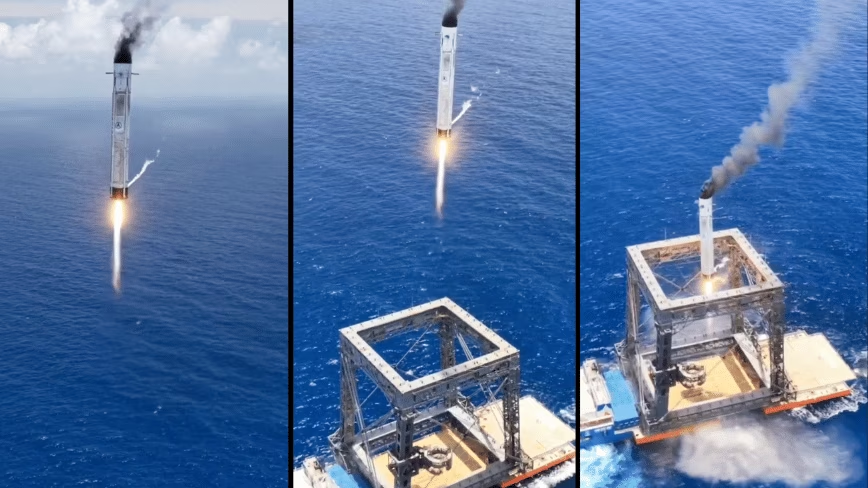
China has recovered the first stage of an orbital rocket for the first time. The milestone pulls it into a club with only two other members. On Friday, the booster of a Long March-10B lifted off from Hainan Island, separated, and flew back to a barge at sea, the Associated Press reports, citing state media.
The landing came with a twist. About six minutes after launch, the first stage settled onto the platform and was snared by a large net. Local media called it the world’s first “net-based recovery” of a rocket, according to Business Insider.
With it, China’s state-owned Aerospace Science and Technology Corp joins an exclusive club. Only SpaceX and Jeff Bezos’ Blue Origin had landed a rocket booster before. Mao Ning, a foreign ministry spokesperson, called it “a major leap toward reusable launch capabilities”.
Why catching a booster matters
The prize is cost. A rocket’s first stage is its most expensive part, and letting it burn up on re-entry means building a new one for every flight. Land it, refurbish it, and fly it again, and the price of reaching orbit falls sharply. That single idea is what made SpaceX the dominant launch company on Earth.
SpaceX landed its first booster in 2015 and has since done it hundreds of times. In 2024 it went further, catching a 120-metre Starship booster with the chopstick arms of its launch tower. Blue Origin managed its first landing only last November, and its New Glenn rocket then blew up on the pad in May.
Still a lap behind
China’s achievement is real, but the gap is wide. The reusable Long March-10B can lift about 16 tonnes to low Earth orbit. A Falcon 9 manages roughly 25, and SpaceX’s Starship is designed for more than 100. SpaceX also launches more mass into orbit than every other country and company combined.
The satellite race tells the same story. China is building its own answer to Starlink through a state-backed venture, SpaceSail, which has lofted around 200 satellites since 2024. Starlink already has more than 10,000. It is one of several would-be Starlink rivals, from Russia’s delayed constellation to Amazon’s, all chasing a network that keeps printing cash for SpaceX.
Why it matters
Even Musk has noticed. In an October post he said China’s engineers had grafted “aspects of Starship, such as use of stainless steel and methalox, to a Falcon 9 architecture”, enough to “beat Falcon 9”. Then came the caveat he always adds: “Starship is in another league.” Friday’s catch does not close that gap.
But it proves China can now do the hardest part of cheap spaceflight. A country that can reuse its rockets is a country that can launch far more, far more often. The net just changed the maths.
View original source — The Next Web ↗
Related stories
TechRadar
TechnologyJul 10, 2026 · 1 min
Proton VPN brings official one-click installs to the Linux Snap Store — but some features are still missing
TechRadar

Wired
TechnologyJul 10, 2026 · 1 min
What Watching a Soccer Final Does to Your Body, According to Science
Wired

The Verge
TechnologyJul 10, 2026 · 1 min
Disney Plus is reportedly looking into a free streaming tier
The Verge
Indian Express
TechnologyJul 10, 2026 · 1 min
UPSC Essentials daily subject quiz : Environment and Geography MCQs (Week 170)
Indian Express