Times of Israel
Ex-minister Chili Tropper says he will ‘absolutely not’ help Netanyahu form a government
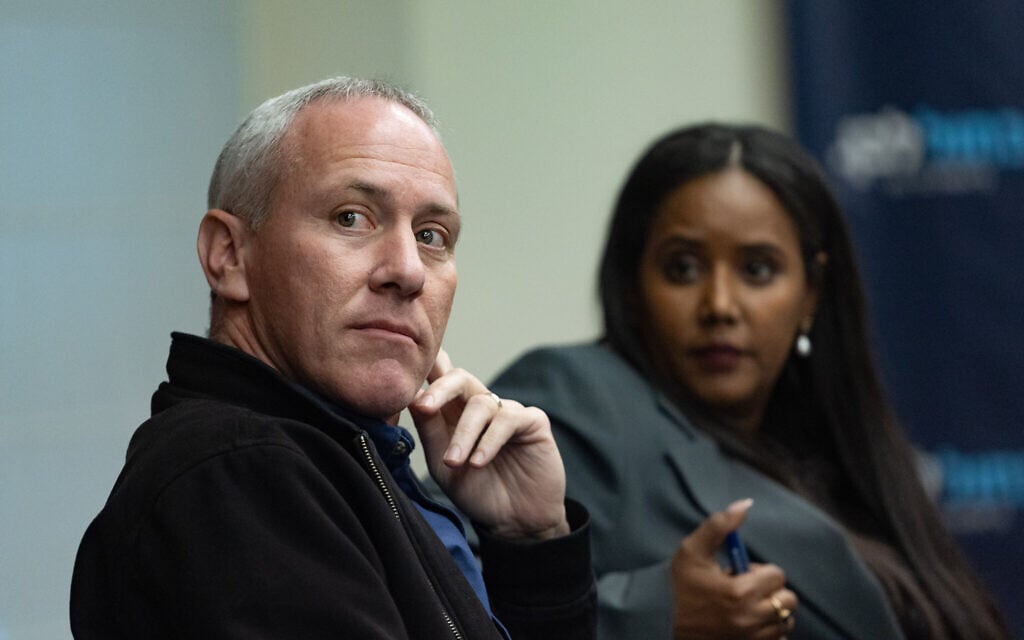
Former Blue and White minister Chili Tropper, who is running in the upcoming Knesset elections on a joint slate with Yoaz Hendel’s Reservists party, said in an interview aired Saturday that he would “absolutely not” help Prime Minister Benjamin Netanyahu form a government if it comes to it.
“I have a principled, moral statement: Everyone who was in a leadership position on October 7 should end their role,” he told Channel 12’s “Meet the Press” program, referring to the Hamas-led terror invasion in 2023.
He said he would also be unwilling to join a coalition with Arab-majority parties or ultra-Orthodox parties, saying he was “in favor of a Zionist-only government.”
He noted that this set him apart from Gadi Eisenkot, the leader of the Yashar party, who has emerged as a frontrunner in recent polls.
“I really like and appreciate him, and we’re on good terms,” Tropper said of Eisenkot, “but I’m in favor of a Zionist-only government”
Get The Times of Israel's Daily Edition
by email and never miss our top stories
By signing up, you agree to the terms
He clarified that he wasn’t questioning Eisenkot’s Zionism, “but I’m talking about my position.”
“The ultra-Orthodox and Arab parties chose not to be part of the Zionist story,” he said. “This is as far from hatred as there is, but Israel needs a Zionist government today.”
Hendel expressed similar sentiments earlier this week, telling the Ynet news outlet that under no circumstances would he join a governing coalition that depends on “non-Zionist” elements, including the existing Haredi and Arab parties.
According to Hendel, it would be preferable to trigger repeat elections if the only alternative would be to hand the pro-Netanyahu bloc a parliamentary majority to pass laws enshrining sweeping ultra-Orthodox military exemptions. But he said he would sit with Netanyahu under a broad government that includes both Likud and the parties running against him.
Tropper said the pair were hoping to win the votes of the “300,000 Israelis who say they have no political home.”
Prior to merging his party with Tropper, Hendel’s Reservists consistently polled below the electoral threshold, meaning the party would attract less than 3.25% of the total vote needed to enter the 120-seat Knesset.
A poll published by Maariv on Thursday suggested that the combined slate would still fall short with 2.9% of the vote, although a poll published by Israel Hayom showed it scraping by with the minimum four seats required to enter the Knesset.
Discontent over ultra-Orthodox military exemptions has not been contained to opposition parties. On Saturday night, freshman Likud MK Dan Illouz announced that he would not be standing for reelection in the Likud primaries later this year.
Illouz is one of the party’s most outspoken voices against the government’s bill exempting Haredi men from military service and has repeatedly clashed with coalition and Likud figures over its legislation, which he has said goes against Likud’s “national, liberal values.”
His resignation came a week after longtime member Yuli Edelstein announced that he would also be departing Likud to forge “a new political path,” as he could no longer campaign for a party seeking to uphold the practice of exempting ultra-Orthodox men from military service.
Also Saturday, Mansour Abbas told “Meet the Press” that his Islamist Ra’am party would not run jointly with the other Arab-majority parties in the upcoming elections.
Although Abbas had indicated earlier this year that he was open to a joint run with Hadash, Ta’al and Balad, he told Channel 12 that he ultimately decided against it.
The four Arab-majority parties signed an agreement in January, committing to work together to revive the Joint List ahead of this year’s election, but negotiations stalled for months, mainly due to Abbas’s insistence that it be a purely technical bloc that would preserve Ra’am’s ability to join a governing coalition, which the other three Arab-majority parties oppose — a demand that Hadash said the parties ultimately agreed to.
But a source with knowledge of the negotiations told The Times of Israel that the main obstacle that prevented a final agreement was Ra’am’s demand that the other parties also commit not to oppose or bring down any government that the Islamist party chooses to join.
Abbas appeared to confirm this rift in his remarks to Channel 12, telling the network that Hadash, Ta’al and Balad, “have a shared agenda; they constantly want to be the opposition, and not just that, but the opposition of the opposition.”
He described the aforementioned agenda as: “Dissolving every Knesset, bringing down every government.”
“I’m looking to do things another way — cooperation,” he said.
There is no guarantee, however, that any of the figures running to replace Netanyahu would be willing to sit in a coalition with Ra’am.
While Eisenkot has not ruled out relying on Ra’am to form a government, former prime minister Naftali Bennett has said that he will not form a coalition with Abbas, despite having done so in the past.
Ra’am joined the Bennett-Yair Lapid governing coalition in 2021, making Abbas the first Arab party leader to do so in half a century.
Ra’am’s base is among the traditional Bedouin communities in the Negev desert.
For decades, Arab Israeli parties have almost always remained on the outside of the decision-making process in Israeli politics. Jewish parties shunned them as extremists, while they themselves were often skeptical of joining an Israeli government that they believed treated them as second-class citizens and oppressed Palestinians.
Recent Zman Yisrael polls have shown both Ra’am and an alliance of Arab parties reaching the necessary 4 seats to enter the Knesset.
View original source — Times of Israel ↗
Related stories
ABC News
PoliticsJul 11, 2026 · 1 min
Australian veterans say government will 'delay, deny until we all die'
ABC News
Times of Israel
PoliticsJul 11, 2026 · 1 min
Coalition hopes to pass raft of contentious bills in final week before Knesset dissolution
Times of Israel

SBS News
PoliticsJul 11, 2026 · 1 min
Redrawn maps, proof of citizenship and ICE agents: How voting in the US is set to change
SBS News

The Hill
PoliticsJul 11, 2026 · 1 min
Sunday shows preview: US-Iran tensions flare; Democrats grapple with Platner fallout
The Hill