CNA
Bhutan beyond Tiger’s Nest: A slower journey through Paro, Thimphu and Punakha
Bhutan has long been a dream destination of mine. For years, I had admired photographs of the Tiger’s Nest monastery perched dramatically on a cliffside, colourful prayer flags fluttering against mountain backdrops and suspension bridges stretching across river valleys. They looked almost otherworldly, and I wondered if the country could really be as peaceful and picturesque as it seemed.
Like many travellers, I thought slowing down simply meant doing less. Spend a few days in Bhutan, however, and it quickly becomes apparent that the point is not to fill your itinerary with fewer things, but to make room to notice more.
Whether it’s sharing a home-cooked meal with a local family, learning centuries-old traditions or watching the mountains drift past during long drives, the country gently encourages visitors to be present rather than chase the next attraction. It was these quieter moments, beyond the postcard sights, that left the deepest impression on me.
Over six days travelling through Paro, Thimphu and Punakha, we visited monasteries, museums, villages and mountain passes, discovering how Bhutan's landscapes, traditions and even its approach to hospitality all reflected the same unhurried rhythm. Even the stray dogs seemed to have mastered it.
FIRST IMPRESSIONS: A LANDSCAPE SHAPED BY NATURE AND TRADITION
The mountains are the first thing travellers see when they step off the plane at Bhutan's international airport in Paro.
Our tour guide, Kuenley, greeted us and draped a white silk scarf, known as a khadar, over our shoulders, a traditional gesture of welcome. Many visitors book their trips through licensed Bhutanese tour operators, who can arrange everything from transport to accommodation, making for a seamless arrival.
As we drove out of the airport, mountains surrounded the valley, a river wound its way through the town and traditional Bhutanese houses sat against the scenery.
One of the first things I noticed was the absence of high-rise buildings and how cohesive the architecture felt. There were no familiar international fast-food chains or oversized commercial signboards competing for attention. I later learnt that houses and buildings are generally required to follow architectural guidelines, from traditional sloping roofs and timber-framed windows to restrictions on building height. These help preserve Bhutan’s cultural identity. As a result, the buildings seemed to sit naturally within the landscape rather than dominate it. Coming from a country filled with high-rises, it was a refreshing change.
The next thing that caught my attention was the colourful prayer flags scattered across hillsides, forests and roadsides. Looking back at the photographs I’d seen of Bhutan over the years, I had always assumed they were simply decorative. It wasn’t until our guide explained their significance that I understood how deeply they are woven into everyday life. Each colour represents one of the five Buddhist elements – space, air, fire, water and earth – while the flags are printed with sacred mantras and hung high so the wind can carry their blessings across the land. Families also raise them outside their homes to mark significant moments in life or to pray for protection, good health and the recovery of loved ones who are unwell.
Prayer wheels outside monasteries and chortens were another constant presence, quietly reinforcing Bhutan's deeply rooted spiritual traditions.
A STAY WHERE THE MOUNTAINS TAKE CENTRE STAGE
The first leg of our journey took us to Thimphu, just over an hour’s drive from Paro.
Our first stay was at Six Senses Thimphu, perched on a hillside at an elevation of 2,650m. The largest of the five Six Senses lodges in Bhutan, it is aptly nicknamed “The Palace in the Sky”. It didn’t take long to understand why.
Floor-to-ceiling windows in the lobby frame sweeping views of the mountains and Thimphu Valley. When mist drifts across the landscape, the lodge appears almost to float above it. On clear days, guests can even spot the towering Buddha Dordenma statue in the distance, while the reflective ponds outside the lobby mirror the ever-changing sky.
The property has 25 villas and suites. I stayed in the Lodge Suite, where stepping through the door revealed sweeping views of the valley. Whether relaxing in the living area, waking up in bed or sitting out on the patio, the landscape was always within sight. Designed with warm timber finishes, earthy tones and a fireplace for colder nights, the suite balanced contemporary luxury with a sense of warmth and comfort.
Beyond its accommodation, Six Senses Thimphu offers cultural experiences that introduce guests to Bhutanese traditions, including how suja, or salted butter tea, and khuley, or buckwheat pancakes, are traditionally prepared. As buckwheat thrives in Bhutan’s mountainous terrain, it has long been a local staple, reflecting how Bhutanese cuisine makes use of what the countryside provides.
We also learnt to make butter lamps and tsatsas, small clay offerings used in Buddhist practice. Later in the trip, we carried our handmade tsatsas with us and placed them along the trail to Tiger's Nest, as many Bhutanese do during pilgrimages.
A TRADITION THAT STILL GUIDES EVERYDAY LIFE
I'm not particularly superstitious, though I can't deny there's always a small part of me hoping for good news whenever someone offers to predict my future.
Astrology is one tradition that continues to shape everyday Bhutanese life. Our guide explained that many Bhutanese consult monks or astrologers before making major decisions, from choosing an auspicious date to start a business to scheduling medical appointments. Rather than being viewed as a novelty, it remains part of daily life.
At Pangri Zampa Monastery in Thimphu, we took part in a condensed five-minute session designed to introduce visitors to the practice. A standard reading typically lasts 20 to 30 minutes, while more detailed consultations can take considerably longer.
The session began with the monk asking for my birth year before consulting the Datho, a traditional Bhutanese astrological text. My reading touched on everything from my birth animal and element to auspicious colours, favourable days for work and health-related matters, and even predictions about my health and lifespan. Whether or not one believes in astrology, it was fascinating to witness how such an ancient practice continues to guide everyday decisions for many Bhutanese.
Visitors don't have to be Buddhist to experience an astrology reading. Donations are encouraged after the session as a gesture of appreciation to the monk.
THE EVER-CHANGING VIEWS OF DOCHULA PASS
The journey from Thimphu to Punakha takes visitors through Dochula Pass, which sits at an elevation of about 3,100m. As we climbed higher, the landscape gradually disappeared behind a blanket of mist before revealing one of Bhutan’s most recognisable landmarks: 108 white chortens arranged in concentric circles on a hillside.
The chortens represent the 108 defilements that Buddhists seek to overcome on the path to enlightenment. They were built to honour the bravery of the Fourth King and the Bhutanese soldiers who lost their lives during military operations against Assamese insurgents in 2003. Each one houses sacred relics and serves as a place for prayer and meditation.
Walking among the chortens as the mist drifted through the site gave it an almost cinematic quality. The clouds constantly shifted, revealing and concealing the mountains beyond. On a clear day, the pass offers unobstructed views of the snow-capped Himalayas.
A TASTE OF EVERYDAY BHUTANESE LIFE
I believe one of the best ways to experience and understand a new country is by stepping into a local’s home and sharing a meal with them.
We were invited to lunch at a homestay near Chimi Lhakhang in Punakha, where homeowner Tshering Penjor welcomed us with ara, a traditional Bhutanese spirit often served to guests before a meal.
A generous spread of home-cooked dishes prepared by Penjor’s wife, Dago Zam, and his mother-in-law was already waiting for us. Among them were ema datshi, Bhutan’s national dish of fresh chillies simmered in local cheese and butter, as well as red rice, seasonal vegetables, butter tea and hearty stir-fried dishes made with produce grown in the family’s fields just outside the house. Over lunch, Penjor shared stories about daily life, farming and hosting travellers, before showing us around his home.
Long after we had left Punakha, it was this meal that I found myself thinking about most. It wasn't just because of the food, but because of the warmth, generosity and glimpse into everyday Bhutanese life that came with it.
WHERE HISTORY MEETS THE LANDSCAPE
While traditional Bhutanese architecture can be seen in homes throughout the country, the dzongs remain its most impressive architectural landmarks.
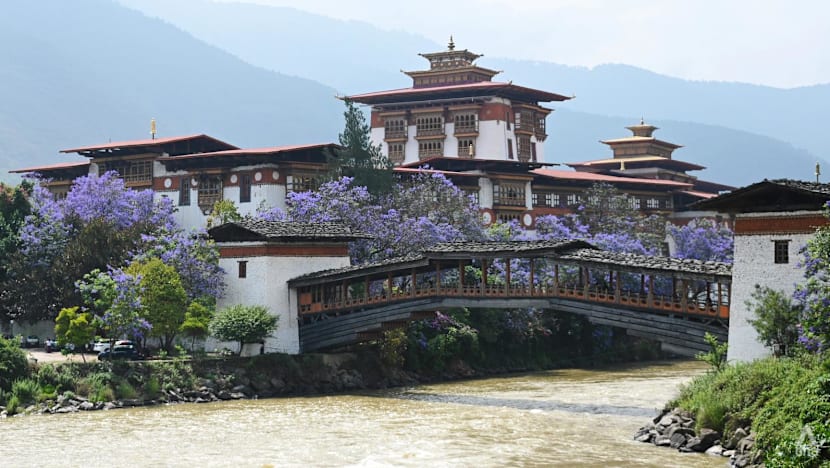
Originally built as fortresses to defend against invasions, dzongs today serve as centres of both religious and administrative life. Among the most spectacular is Punakha Dzong, which served as Bhutan’s capital until 1955. Today, it is the winter residence of Bhutan’s central monastic body and continues to host important royal and religious occasions.
The fortress sits at the confluence of the Pho Chhu and Mo Chhu rivers, with a traditional wooden cantilever bridge leading to its main entrance. During our visit, blooming jacaranda trees added splashes of purple to the setting. Like much of Bhutanese architecture, the entire structure was built without a single iron nail. Knowing this made me appreciate the remarkable craftsmanship even more, especially the intricate timber roofs, carved windows and elaborate doors.
Inside, the dzong is divided into three courtyards. The third houses Machen Lhakhang, one of Bhutan’s most sacred temples, where the remains of the country’s founding father, Zhabdrung Ngawang Namgyal, are kept alongside sacred relics associated with Pema Lingpa.
While the rest of our group photographed the fortress, I found myself watching a stray dog sitting on the bridge, gazing across the river as though it had mastered the art of slowing down. I ended up taking almost as many photos of him as I did of the dzong.
Just a 15-minute walk from Punakha Dzong is one of Bhutan’s longest suspension bridges.
Suspended high above the Pho Chhu River, the bridge swayed gently with every passing pedestrian and gust of wind. Prayer flags and the bright red robes of monks crossing the bridge stood out against the natural surroundings.
Somewhere in the middle of the bridge, away from the other visitors, I found myself pausing to look out at the river below, breathing in the fresh air and taking in the view as the bridge rocked gently beneath my feet. Before long, though, another stray dog caught my attention and I ended up following him to the other side of the river instead.
WHEN THE VIEW BECOMES THE LUXURY
Our second stay was at Six Senses Punakha, which offered a completely different side of Bhutan.
Every Six Senses property in Bhutan has its own nickname, and this one is known as “The Flying Farmhouse”, set amid rice paddies. While it shares the same understated design language as Six Senses Thimphu, the atmosphere felt warmer and more rustic. Instead of waking up to mist rolling over the mountains, we were greeted by birdsong, the sounds of insects and views of the surrounding rice fields.
One thoughtful design feature stood out in my suite: the television rose from a console and disappeared when not in use, ensuring it never interrupted the view from the bed.
The same philosophy extended to other luxury properties we explored, including Amankora Thimphu and &Beyond Punakha River Lodge. Although we stopped there only for meals, we toured the properties and some of their rooms, where televisions were deliberately absent. It became clear that luxury in Bhutan isn’t defined by filling every moment with entertainment, but by creating spaces where the scenery naturally takes centre stage.
THE FINAL PILGRIMAGE
Many itineraries in Bhutan end at Tiger’s Nest, its most iconic attraction. Guides often save it for the last day because it is near Paro Airport, making it a convenient stop before heading home.
By then, we’d already spent several days warming up our legs with shorter hikes, including the 45-minute trek to Khamsum Yulley Namgyal Chorten, where we were rewarded with panoramic views of the Punakha Valley. Even so, I wasn’t prepared for how arduous the climb to Tiger’s Nest, or Paro Taktsang, would be.
Although the route is only about 7km long, the elevation makes it challenging: The monastery sits 3,120m above sea level.
We set off at 7.30am. Visitors can choose to ride a mule for part of the ascent, but I decided to walk instead. I didn’t regret it after finding another stray dog who became my hiking companion – at least until he realised I was far too slow for him.
The hike usually takes four to five hours, and I found myself constantly checking the time while trying to catch my breath. At one point, our guide gently tapped me on the shoulder and reminded me that the timing didn’t matter. The point of the hike, he said, was to slow down and enjoy the surroundings.
About halfway up the trail is a cafeteria where many hikers stop to recharge while taking in their first distant view of Tiger's Nest. Against the towering, mist-shrouded mountainside, the monastery's whitewashed walls and gold-painted roofs offered subtle touches of colour. Beautiful as the view was, I couldn't help thinking how small the monastery looked, which only reminded me how much further we still had to climb.
As we continued on our hike, the monastery gradually came into full view. It was the sight I’d spent years admiring in photographs and postcards. Seeing it perched dramatically on the cliffside in person was surreal. We spent a long time photographing it from every angle, only to put our cameras away before the changing light tempted us to take them out again.
The final stretch was the toughest. By then, my legs were shaky, my breathing had become shorter, and every step demanded a little more effort. Reaching the entrance was a small celebration in itself, marked by a banana and a couple of snack bars.
By this point in the trip, we’d already visited several monasteries and temples across Bhutan, each beautifully decorated with colourful murals, intricate woodwork and striking Buddhist statues. But stepping inside Tiger’s Nest felt different. Built into the cliff face, parts of the natural rock remain visible within the monastery, contrasting with the ornate timber frames, colourful window details and flickering butter lamps. Visitors aren’t allowed to take photographs inside, so it becomes one of those places you have to carry in memory.
Sitting inside the monastery, listening to monks chant while visitors paused for prayer and meditation, it was hard to believe I was inside a cave perched 3,120m above sea level. As I soaked in the atmosphere, one thought kept creeping back into my mind: I still had to hike all the way down.
THE ART OF UNWINDING
After descending the mountain, we made our way to the final stay of our trip, Bhutan Spirit Sanctuary, where a traditional hot stone bath was exactly what our tired legs needed.
The wellness-focused retreat offers personalised programmes with an in-house doctor, alongside traditional therapies such as the Bhutanese hot stone bath, or dotsho. River stones are heated over an open fire before being placed into a wooden tub, slowly warming water infused with artemisia leaves, a local medicinal herb.
As I settled into the water, I could feel the warmth gradually easing its way through my tired muscles. A small window beside the bath let in a gentle breeze. After six days of travelling through Bhutan, it felt like the perfect way to end the journey.
On my final morning, I made myself a French press coffee and sat by the window, watching the first light slowly unveil the valley below.
While I would usually spend my travels searching for a good flat white or browsing charming boutiques, neither crossed my mind in Bhutan. My eSIM wasn’t working for most of the trip, but I rarely found myself asking for Wi-Fi. I didn’t want to spend a single minute looking at my phone instead of the view.
Looking back, what stayed with me wasn’t just Tiger’s Nest or Bhutan’s mountain landscapes, but the moments in between – sharing ara with my tour guide, watching the bright red robes of monks stand out against the green valley and, of course, encountering Bhutan’s friendly stray dogs.
CNA Luxury was in Bhutan at the invitation of Department of Tourism, Bhutan.
Source: CNA/jk/bt
Related stories

Philippine Daily Inquirer
WorldJul 11, 2026 · 1 min
Floods sweep away temporary bridge in Maguindanao del Norte
Philippine Daily Inquirer

The Punch
WorldJul 11, 2026 · 1 min
Five die in Cross River landslide
The Punch

Philippine Daily Inquirer
WorldJul 11, 2026 · 1 min
'Habagat' keeps Luzon, Visayas soggy as Inday moves away
Philippine Daily Inquirer

Philippine Daily Inquirer
WorldJul 11, 2026 · 1 min
Israel police arrest 4 settlers over West Bank attack on CNN crew
Philippine Daily Inquirer