Indian Express
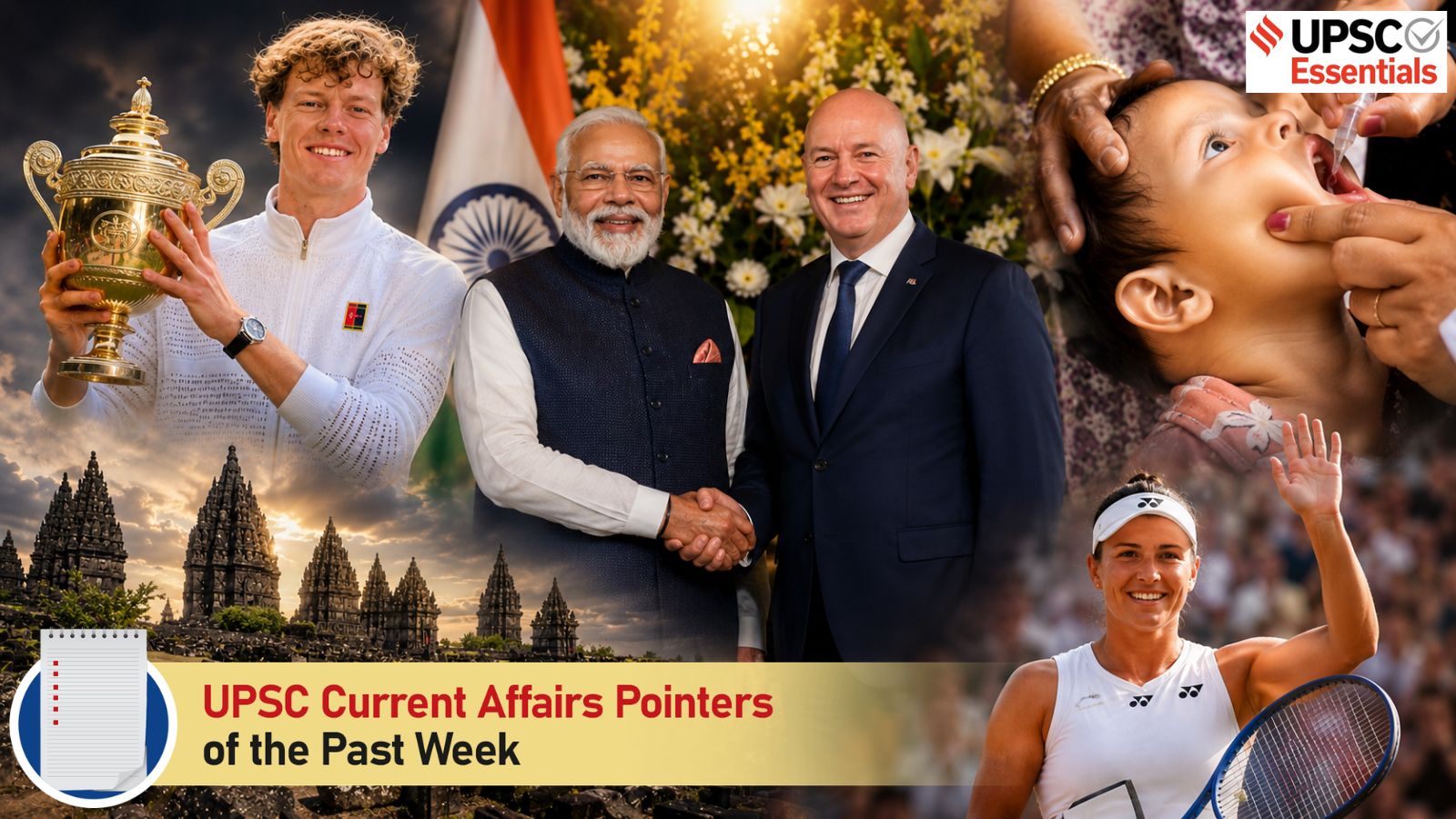
Top 20 UPSC Current Affairs Pointers of the past week | July 6 to July 12, 2026
Every Monday, we bring you UPSC Current Affairs Pointers—a concise, exam-focused guide to help you stay ahead in your Prelims and Mains preparation.
It was, in due course, established that they had been removed from temples in Tamil Nadu and trafficked overseas, sources said. (Express photos)
— Three antiquities from Tamil Nadu, dating back to the 11th and 12th centuries and housed at a museum in Australia, are all set to make their way back to India.
— The repatriation of the antiquities is among the outcomes of the India-Australia summit during Prime Minister Narendra Modi’s visit to the island nation. For its part, India has committed to the repatriation of the relics of an Australian First Nations ancestor presently held at the Government Museum of Chennai.
— The antiquities that will return to India in due course, as per the commitment between the two sides, include:
(i) A stone sculpture of sacred Nandi – the vehicle of Lord Shiva (11th to 12th century): Sculpted in the Tamil Shaiva temple tradition, it originates from Sri Kasiviswanathaswamy Temple, Kollumangudi village in Thiruvarur district.
(ii) A metal trident with the image of Bhadrakali (11th century): Originating from Sri Kasiviswanath- aswamy Temple in Kollumangudi, it was crafted in the
South Indian temple ritual metalwork tradition for religious worship
Story continues below this ad
(iii) A six-headed Karthikeya statue in stone (12th century): Carved in the Chola-period sculptural tradition, it originates from the Naganathswamy Temple, Manambadi village of Thanjavur district.
GI tag to Jodhpuri’s Mojari
— The Centre has granted a Geographical Indication (GI) tag to Jodhpur’s nearly 200-year-old Mojari craft, giving the traditional footwear official recognition and a boost in global branding.
— Jodhpuri Mojari are crafted by members of a caste called Jinagar, who according to researchers, were traditionally saddle makers. Once patronised by the royals, the Mojari gradually evolved into a distinctive craft giving the city a unique identification. Today, artisans practice the craft in over 5,000 households in Jodhpuri.
Polity
Narmada outstanding dues
— Chief Ministers of Gujarat, Madhya Pradesh, Maharashtra, and Rajasthan signed an agreement on 7th July relating to the settlement of outstanding dues of the Narmada Water Disputes Tribunal (NWDT) Award Projects.
Story continues below this ad
— The Centre had constituted the NWDT in 1969, which gave its Award in 1979. The NWDT Award specified the quantum of water that could be utilised by the four states, as well as determined their share of the net power produced at Navagam at Canal Head and River Bed Power Houses.
— While most issues were resolved after the Award’s distribution, issues like dues pertaining to the cost-sharing of the Sardar Sarovar Project and the Indira Sagar Project, Resettlement & Rehabilitation (R&R) Expenditure, Compensation for Submerged land, and the interest burden on borrowings during construction remained pending which are now resolved.
Ethanol blend in petrol
— Amid a raging backlash over a rapid increase in the use of ethanol in petrol from 10% to 20% in just three years, the government is likely to push back the proposed shift to a higher blend of ethanol fuel E25 comprising 75% petrol and 25% ethanol.
— The government had originally planned to dispense petrol blended with 20% ethanol only by 2030. But the E20 fuel — 80% petrol and 20% ethanol — is now the standard petrol variant available nationwide.
Story continues below this ad
— Using a higher ethanol blend in petrol for engines, especially those not designed for these blends, results in a drop in fuel economy depending on when the car was manufactured. Older vehicles fare comparatively worse in this transition.
— While a fuel with 10% ethanol (E10) made little difference to a car’s performance, the transition to E20 did impact the operational parameters of older vehicles.
— Ethanol has lower calorific value than petrol, which results in a perceptible drop in mileage. Also, regular petrol cars running on higher ethanol blends, alongside the drop in mileage, are harder to start on winter mornings because ethanol burns at a higher temperature than petrol.
— The proposed E25 transition requires automakers to do additional engineering and validation work around engine calibration, fuel-system durability, corrosion resistance, and material compatibility and homologation.
Story continues below this ad
Homologation is the process that officially certifies a vehicle or component as compliant with regulations pertaining to safety, environment, and road-worthiness.
International Cooperation
India-Indonesia
— Prime Minister Narendra Modi was in Indonesia on a state visit from 6-8 July 2026.
— PM Modi has become the first Indian Prime Minister to address the Parliament of Indonesia.
— This is PM Modi’s fourth visit to Indonesia and the first bilateral visit since the elevation of ties to a Comprehensive Strategic Partnership in May 2018.
Story continues below this ad
— As a special gesture reflecting deep bilateral ties, President Prabowo conferred the Bintang Adipurna (Medal of Honour) upon Prime Minister Modi.
— The medal is Indonesia’s highest civilian award, reserved for people who have rendered exceptional service to the nation’s unity, continuity, and prosperity.
— The agreements signed between the two nations included
➡️A pact to open an Indian Institute of Management (IIM) Bangalore campus in Indonesia
➡️ The supply of medicines and medical products to Indonesia
➡️ The provision of telecom technology such as wireless and quantum systems
Story continues below this ad
➡️ Efforts for the conservation and restoration of the Prambanan Temple complex in Yogyakarta
➡️ Both agreed to jointly develop Sabang Port near the Strait of Malacca
➡️ Defence cooperation: supply of the ASTRA Mk 1, BrahMos Missiles batteries, among others.
Prime Minister Narendra Modi with his Australian counterpart Anthony Albanese in Melbourne on Thursday. (AP)
India and Australia
— PM Modi visited Australia from 8 to 10 July 2026 for the third Australia–India Annual Summit in Melbourne.
— The historical ties between India and Australia started immediately following European settlement in Australia in 1788. Australia and India upgraded their bilateral relationship from ‘Strategic Partnership’ in 2009 to Comprehensive Strategic Partnership (CSP) in 2020.
Key outcomes:
➡️ The finalisation of the administrative arrangement to operationalise the Civil Nuclear Agreement signed in 2014 and enable the supply of uranium from Australia to India.
➡️ To support India’s domestic renewable energy push, a joint ‘Rooftop Solar Training Academy’ will be established in Gujarat to build technical capacity among women and youth under the PM Surya Ghar Yojana.
➡️ The two leaders also launched the Australia-India Partnership on Cyber, Critical Technologies and Supply Chains (PACTS). The partnership targets supply chain diversification, cybersecurity, digital resilience, and joint semiconductor research.
➡️ Pact for the repatriation of Indian artifacts, with Australia agreeing to return the sacred bull Nandi (11th–12th century, granite), a trident with Auspicious Kali (11th century, bronze), and a six-headed Skanda (12th century, basalt).
➡️ A separate trilateral Memorandum of Understanding (MoU) was also signed under the Australia-Canada-India Technology and Innovation (ACITI) umbrella, cementing a trusted technological alliance between the three Commonwealth nations.
➡️ India-Australia Sports Collaboration Roadmap: Prime Minister Narendra Modi and Australian Prime Minister Anthony Albanese jointly unveiled the India-Australia Sports Collaboration Roadmap at the Melbourne Cricket Ground (MCG).
One of the notable features as a part of this collaboration was the announcement of the inaugural match of the upcoming edition of the Big Bash League being played at MA Chidambaram Stadium (Chepauk) in Chennai this December.
In this screengrab from a video posted on July 11, 2026, Prime Minister Narendra Modi and New Zealand Prime Minister Christopher Luxon participate in a community event, in Auckland, New Zealand. (@NarendraModi/YT via PTI Photo)
India and New Zealand
— During the final leg of the three-nation tour, PM Modi visited New Zealand from July 10 to July 11. He became the first Indian PM to visit New Zealand in 40 years. Both countries elevated their bilateral ties to a Strategic Partnership and signed several agreements and MoUs across key sectors.
Key outcomes:
➡️ India and New Zealand agreed to double bilateral trade to NZ$7 billion or Rs 35,000 crore by 2030, in the context of the Free Trade agreement signed in April this year.
➡️ They agreed to establish a regular Foreign Ministers’ Dialogue and consolidate the practice of annual senior officials’ meetings between India’s Ministry of External Affairs and New Zealand’s Ministry of Foreign Affairs and Trade.
➡️ India welcomed New Zealand’s nomination of Maritime Security as its priority pillar under the Indo-Pacific Oceans Initiative, and both sides agreed to explore specific cooperation activities under this pillar.
➡️ The two sides also signed a pact for enhanced cooperation in animal husbandry and dairying through technical collaboration, knowledge exchange, and best practices. They also decided to launch the ‘Kiwifruit Action Plan and Establishment of two Centres of Excellence for Kiwifruit in Nagaland and Uttarakhand’.
➡️ The India-New Zealand Joint Action Plan on Sport will provide a framework for collaboration in sports, including high-performance sport, sports science, sports medicine and athlete development.
Operation ‘Hardball’
— The Federal Bureau of Investigation (FBI) on 8th July announced a $50,000 (Rs 47.7 lakh approx) reward for information leading to the arrest of gangster Goldy Brar, as part of Operation ‘Hardball’.
— The operation ‘Hardball’ was a covert mission undertaken by law enforcement agencies in the U.S. shortly after Khalistani Hardeep Singh Nijjar’s murder.
— The mission titled ‘Operation Hardball’, is a result of years-long federal investigation into Indian crime syndicates that engage in racketeering, targeted killings, shootings, extortion, trafficking of bulk quantities of narcotics across international borders, according to a media release by U.S. Attorney’s office.
— Last year, US officials also visited the NIA headquarters in Delhi, where they shared their concerns about alleged links between Indian-origin gangsters and US drug cartels. They also shared a list of names and sought assistance in taking action against them.
— The FBI has alleged that Goldy is based in the United States and is the alleged leader of the group in North America. According to a criminal dossier on Goldy prepared by Indian central agencies, he is associated with Babbar Khalsa International, which is listed as a terrorist organisation.
Defence
ASTRA Mk 1
— India and Indonesia on 7th July reached a significant milestone in their growing strategic cooperation by signing a deal for the supply of the ASTRA Mk 1 ‘beyond-visual-range air-to-air missiles’ (BVRAAM).
— The development is significant as it marks India’s first export of ASTRA missiles to another country. These missiles will arm Indonesia’s Su-30 fleet.
— Developed by the Defence Research and Development Organisation (DRDO), Astra is a family of indigenous BVRAAMs that will be integrated with the Air Force and the Navy.
— Beyond-visual-range (BVR) missiles are those capable of engaging beyond the range of 20 nautical miles, or 37 km. Air-to-air missiles are primarily fired from an airborne asset to destroy an airborne target.
— The first in the family, Astra Mk 1, has a range of 80 to 110 km, an altitude of up to 20 km and a speed of Mach 4.5 (or 4.5 times the speed of sound). The key features of this missile include inertial guidance, mid-course update and terminal active radar homing.
— The missile is being integrated with the IAF’s Sukhoi-30 MKI fleet and is also planned to be integrated with the indigenous Light Combat Aircraft Tejas Mk 1 A and the French Rafale jets in future.
— A more advanced version of the Astra Mk 1 — the Astra Mk 2 — has an enhanced range of 200 km, from the earlier decided range of around 160 km.
— The Astra Mk 3 is still under development by the DRDO. Officially named Gandiva, it will be India’s most advanced BVRAAM.
In March, Indonesia said it had entered into an agreement with India to procure BrahMos. The details of the deals with Indonesia and Vietnam are yet to be made public, said the Defence Secretary
BrahMos Missile batteries
— As part of a defence agreement, India has agreed to supply Indonesia with two batteries of BrahMos supersonic cruise missiles valued at $200 million.
— A BrahMos battery typically comprises four launchers and 12 ready-to-fire missiles along with other equipment and vehicles, though the composition can vary between land-based regiments and coastal defence batteries.
— With this, India is now set to export the BrahMos missiles to three countries, including the Philippines and Vietnam. India is also in talks with at least half a dozen other countries for the export of the BrahMos.
— BrahMos is built through the collaboration of India and Russia. An agreement was signed, which led to the formation of BrahMos Aerospace, a joint venture between the DRDO and Russia’s NPO Mashinostroyenia (NPOM).
— BrahMos is a two-stage missile with a solid propellant booster engine. The first stage brings the missile to a supersonic speed, greater than the speed of sound, and it then gets separated.
— The second stage of the liquid ramjet then fires and thrusts the missile to three times the speed of sound in its cruise phase. A liquid ramjet is an air-breathing jet engine that uses liquid fuel, which is injected into the high-speed airstream and ignited to produce thrust.
— BrahMos is an extremely versatile stand-off range ‘fire-and-forget’ type supersonic cruise missile that has proved its capabilities in land-based, ship-based, air launched and submarine-based versions.
Stealth frigate Mahendragiri
— The Indian Navy has commissioned its sixth Project 17A indigenous stealth frigate, Mahendragiri (F38), at Visakhapatnam. It was designed by the Navy’s Warship Design Bureau and built by Mazagon Dock Shipbuilders Limited, Mumbai.
— The warship incorporates advanced stealth features, enhanced survivability, a reduced radar signature, and a high degree of automation.
— The frigate is powered by a modern combined diesel or gas propulsion system, enabling high-speed operations with exceptional endurance across the full spectrum of maritime missions.
— The stealth frigate is equipped with an advanced suite of indigenous and state-of-the-art weapons and sensors, including surface-to-surface and surface-to-air missile systems, sophisticated electronic warfare capabilities, comprehensive anti-submarine warfare systems, and an integrated combat management system.
Science and Technology
BOHR (Betavoltaic Orbital High-Reliability)
— SpaceX has successfully launched what is being described as the world’s first commercially built nuclear-powered satellite, marking a significant milestone for space-based nuclear technology.
— The satellite, called BOHR (Betavoltaic Orbital High-Reliability), was developed by Florida-based company City Labs and lifted off on 7th July aboard a SpaceX Falcon 9 rocket as part of the company’s Transporter-17 rideshare mission from Vandenberg Space Force Base in California.
— BOHR is a demonstration mission designed to test City Labs’ proprietary NanoTritium betavoltaic micropower source in space for the first time.
— Unlike conventional satellites that rely entirely on solar panels, NanoTritium generates electricity by using the beta particles released during the radioactive decay of tritium, a radioactive form of hydrogen. Those particles are converted directly into electrical energy using a semiconductor device.
— The technology differs from the radioisotope thermoelectric generators used on Nasa spacecraft such as the Voyager probes, which generate power from heat emitted by decaying plutonium.
Health
Placenta-on-chip
— The placenta is the temporary organ that connects a mother and her unborn baby. It supplies oxygen and nutrients to the foetus, removes waste products, produces hormones essential for sustaining pregnancy and acts as a selective barrier, determining what passes from the mother’s bloodstream to the developing baby.
— For decades, doctors have had to prescribe medicines during pregnancy with surprisingly little evidence about whether many of them reach the developing foetus via the placenta.
— Now, researchers from Mumbai’s ICMR-National Institute for Research on Women’s Health (ICMR-NIRWoH) and the Indian Institute of Technology Bombay (IIT Bombay) have developed a placenta-on-chip that closely mimics the human placenta.
— This offers scientists a new way to study how drugs, nutrients, pollutants and infectious agents pass from mother to baby.
— Although it remains a laboratory research tool that requires further validation, researchers believe it could accelerate the development of pregnancy-safe therapeutics and provide new insights into conditions such as gestational diabetes, fetal growth restriction and pre-eclampsia (high blood pressure that damages organs).
— Despite its name, it is not an electronic computer chip. It is a transparent plastic device containing a porous membrane on which researchers grow human placental cells alongside human endothelial cells, which line blood vessels.
— Together, these recreate the interface through which nutrients, hormones and other molecules are exchanged between mother and foetus.
Infographics by NotebookLM
Vaccine-derived poliovirus (VDPV)
— Last month, vaccine-derived polio virus (VDPV) was detected in a sewage sample in Ghaziabad. After that, the authorities carried out an extensive polio campaign in the areas nearby.
— A vaccine-derived poliovirus is a strain related to the weakened version of the live poliovirus contained in the oral polio vaccine (OPV).
— ‘Polio drops’ are by and large safe — they have led to the successful eradication of the infection in most countries — but on rare occasions can trigger the disease in children with weak immune systems.
— The WHO defines polio or poliomyelitis as “a highly infectious viral disease, which mainly affects young children. The virus is transmitted by person-to-person, spread mainly through the faecal-oral route or, less frequently, by a common vehicle (e.g. contaminated water or food) and multiplies in the intestine, from where it can invade the nervous system and can cause paralysis.
— Initial symptoms of polio include fever, fatigue, headache, vomiting, stiffness in the neck, and pain in the limbs. In a small proportion of cases, the disease causes paralysis, which is often permanent. There is no cure for polio; it can only be prevented by immunization.”
— There are three types of wild polio virus. Type 2 wild polio virus was eradicated in September 2015, while Type 3 wild polio virus has not been found since November 2012 and was certified eradicated on 24 October, 2019. As of 2022, endemic wild poliovirus type 1 remains in two countries: Pakistan and Afghanistan.
— India was declared free of wild poliovirus in 2014 after decades of mass immunisation, making it one of the 11 countries in South East Asia which have been certified free of wild poliovirus. But environmental surveillance – testing sewage for traces of the virus – continues as an early warning system.
— These cases do not affect India’s polio-free status — only the detection of the wild poliovirus will change that.
Methadone Maintenance Therapy
— On June 26, the International Day Against Drug Abuse and Illicit Trafficking, Punjab Health and Family Welfare Minister Balbir Singh inaugurated six Methadone Maintenance Therapy clinics in government hospitals.
— Methadone Maintenance Therapy (MMT), also known as Methadone Treatment Therapy (MTT), is a medically supervised treatment for people addicted to opioids such as heroin, “chitta” (an adulterated form of heroin), opium and prescription opioid painkillers.
— It uses methadone, a long-acting opioid agonist, under medical supervision to reduce cravings and prevent withdrawal symptoms without producing the intense high associated with illicit opioid use.
— The treatment is combined with counselling, psychosocial support and regular medical follow-up to help patients recover and reduce the risk of overdose, relapse and the spread of infectious diseases.
— Recommended by the World Health Organisation (WHO) and implemented under the guidelines of the National AIDS Control Organisation (NACO), methadone is administered under strict medical supervision.
— Methadone Maintenance Therapy was first introduced in India in 2012 through pilot projects supported by the Ministry of Health and Family Welfare, NACO and the United Nations Office on Drugs and Crime (UNODC).
— Punjab became the first state in the country to introduce MMT in 2012, when a pilot methadone treatment programme was launched at the de-addiction centre of Civil Hospital, Kapurthala.
— The backbone of Punjab’s government de-addiction programme continues to be Buprenorphine-Naloxone (BNX) therapy, provided through over 450 Outpatient Opioid Assisted Treatment (OOAT) centres across the state.
Persons in News
(Just FYI: Noting historical personalities’ anniversaries aids UPSC prep. UPSC often includes such personalities in questions, so revisiting their lives refreshes your static syllabus.)
Teejan Bai was the only person from Chhattisgarh to have been awarded the Padma Vibhushan. (Express Photo)
Teejan Bai
— Renowned Pandavani folk singer Teejan Bai died in Raipur on July 5 following prolonged illness. She was 69 years old.
— Teejan Bai was the only person from Chhattisgarh to have been awarded the Padma Vibhushan.
— Among the many accolades she won over the years were the Padma Shri in 1988, recognition as Shreshth Kala Acharya in 1994, the Sangeet Natak Academy prize in 1996, the Padma Bhushan in 2003, and the Padma Vibhushan in 2019.
Places in News
(Just FYI: The location of the place is important, considering that UPSC has asked several questions about places that were in the news, such as Aleppo and Kirkuk, in the 2018 UPSC Prelims. The best way to remember them is to plot them on a world map.)
Wayanad twin tunnel project
— The Kerala government on 8th July decided to suspend construction of the Wayanad twin tunnel project until all vulnerable factors are reviewed.
— Konkan Railway Corporation is the implementing agency for the project, which is expected to be completed in four years.
— Construction of the tube tunnels has been awarded to Bhopal-based Dilip Buildcon, while the approach roads and bridges in the project will be constructed by Kolkata-based Royal Construct. The tunnel connects Anakkampoyil in Kozhikode to Meppadi in Wayanad.
— The length of the tunnel is measured at 8.2 km, making it one of the longest tunnel roads in India. The estimated cost of the tunnel is Rs 2,400 crore, and the aim is to reduce travel time between Kozhikode and Wayanad districts.
In modern Indonesian, candi means an ancient Hindu or Buddhist temple or shrine, while Prambanan is believed to derive its name from the village to which the temple complex once belonged. Photo: Wikimedia Commons
Prambanan Temple
— Prime Minister Narendra Modi visited the 9th-century Prambanan Temple complex in Yogyakarta along with Indonesian President Prabowo Subianto to inaugurate a joint conservation project.
— The Prambanan Temple Compounds was inscribed on the UNESCO World Heritage List in 1991. In 1998, it was designated as a National Cultural Property and the national law issued in 2010 also supports the protection and conservation of the property.
— The project, spanning 10 years (2026–2036) with a total outlay of Rs 65 crore, will be executed by Archaeological Survey of India (ASI) in collaboration with the Indonesian Heritage Agency, sources added.
— The key activities of the project include LiDAR (Light Detection and Ranging) sensor, and photogrammetric documentation of scattered stone members, archival research, structural, hydrological, and geotechnical studies.
— The Prambanan Temple Compounds, located on the border between Indonesia’s Yogyakarta Special Region and Central Java province on the island of Java, comprise Prambanan Temple (also known as Loro Jonggrang or Candi Prambanan), Sewu Temple, Bubrah Temple, and Lumbung Temple. At the heart of the complex is Prambanan Temple, which originally consisted of 240 large and small temples.
Indira Point
— The Union Ministry of Ports, Shipping and Waterways has proposed protection and development works at Indira Point and the famous lighthouse at the site in the Andaman and Nicobar Islands.
— Indira Point is India’s southernmost tip, located on the Great Nicobar Island (GNI) in the Union Territory (UT) of the Andaman and Nicobar Islands. It is an important maritime landmark, and lies to the south of the Galathea Bay, where a transshipment port has been proposed under the GNI mega infrastructure project.
— The lighthouse located at Indira Point is an important landmark on the Singapore-Colombo international maritime route and is used as a navigational aid by mariners.
— It also holds importance for safe navigation towards the Galathea Bay in the coming times, where a transshipment port has been proposed.
— Earlier, Indira Point was known as Pygmalion Point, but was renamed in 1985, as per the Directorate of Lighthouse and Lightships, after the demise of former Prime Minister Indira Gandhi.
— The lighthouse was commissioned in April 1972 and it is 35 metres high. The lighthouse tower is made of cast iron, painted with red and white bands.
Sports
Jannik Sinner of Italy celebrates after winning a point against Alexander Zverev of Germany men’s singles final at Wimbledon Tennis Championships in London, Sunday, July 12, 2026. (AP Photo/Kin Cheung)
Wimbledon 2026
— Wimbledon, French Open, US Open, and Australian Open are the most prestigious events on the annual tennis calendar, bestowed with the moniker of “Grand Slam”, a term that has been in use for almost a century.
— Wimbledon is the only one to still be played on grass. Of the other three, the Australian Open and the US Open are both played on hard courts, and the French Open is played on clay.
— Through a shared governance structure, Grand Slam Tennis is the partnership between the four Grand Slam tournaments, forming an opportunity to lead a shared vision for advancing the game of tennis at all levels while acting as custodians of the sport’s history and traditions.
Winners of Wimbledon 2026
Category
Winner
Runner-up
Men’s Singles
Jannik Sinner
Alexander Zverev
Women’s Singles
Linda Nosková
Karolína Muchová
Men’s Double
Henry Patten
Harri Heliövaara
Mate Pavić
Marcelo Arévalo González
Women’s Double
Guo Hanyu
Kristina Mladenovic
Luisa Stefani
Gabriela Dabrowski
Mixed Double
Marcelo Arévalo González
Jeļena Ostapenko
Marc David Polmans
Storm Hunter
Test Your Knowledge
(Note: The best way to remember facts for UPSC and other competitive exams is to recall them through MCQs. Try to solve the following questions on your own.)
(1) Which of the following statements with regard to the Grand Slam Tennis Tournaments is/are correct? (UPSC CSE 2026)
1. The tournaments have a shared governance structure establishing the partnership among the four Grand Slam tournaments.
2. They are open for entry to all internationally ranked tennis players above the age of 14.
3. There is a limitation on the number of ‘Wild Cards’ a player may receive to compete in a Grand Slam Tournament.
Select the answer using the code given below:
(a) 1 and 2 only
(b) 2 and 3 only
(c) 1 only
(d) 1, 2 and 3
(2) Which of the following has/have been accorded ‘Geographical Indication’ status?
1. Ponduru Khadi
2. Jodhpuri Mojari
3. Khurasani Imli
Select the correct answer using the code given below:
(a) 1 only
(b) 2 and 3 only
(c) 1 and 3 only
(d) 1, 2 and 3
(3) It is a process to officially certify a vehicle or component as compliant with regulations pertaining to safety, environment, and roadworthiness. What is it?
(a) Calibration
(b) Homologation
(c) Octane rating
(d) Anti-Knock rating
Prelims Answer Key
1. (a) 2. (d) 3. (b)
For your suggestions and feedback, write to [email protected]
Subscribe to our UPSC newsletter. Stay updated with the latest UPSC articles by joining our Telegram channel – IndianExpress UPSC Hub, and follow us on Instagram and X.
🚨 Click Here to read the UPSC Essentials magazine for June 2026. Share your views and suggestions in the comment box or at [email protected]🚨
View original source — Indian Express ↗
Related stories

AllAfrica
TechnologyJul 13, 2026 · 1 min
Mozambique: OCHA Recorded Over 12,000 Displaced Persons Last June
AllAfrica

Lovin Malta
TechnologyJul 13, 2026 · 1 min
Watch: Msida Ġostra Ends With Double Win For MasterChef Malta’s Leigh ‘Il-Banana’
Lovin Malta

Lovin Malta
TechnologyJul 13, 2026 · 1 min
Watch: Tourist Reveals ‘Best Way’ To Experience Malta’s Blue Lagoon Without The Crowds
Lovin Malta

Euronews
TechnologyJul 13, 2026 · 1 min
Europe Today: Iran war flares up as EU weighs sanctions on Israeli settlements
Euronews