Indian Express
47% of CBSE schools offer 2 or more Indian languages, Board tells Supreme Court
3 min readNew DelhiJul 14, 2026 05:50 AM IST
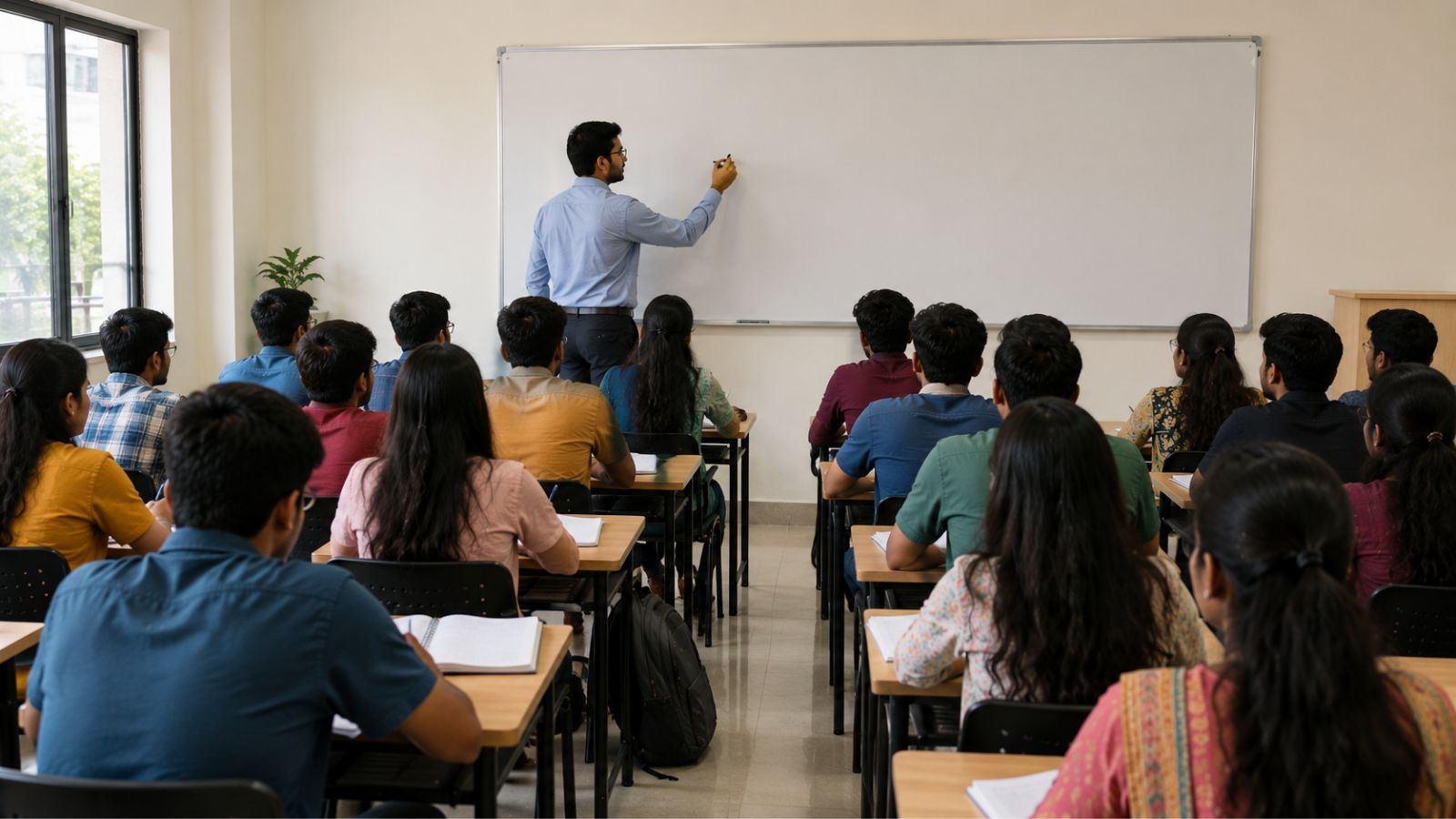
The petition, filed by parents from Delhi, Gurugram, Noida and Chennai along with teachers, challenges CBSE’s May 15 circular making three languages compulsory in Class 9 from July 1, 2026.(Image generated using AI)
SEEKING TO defend the three-language policy before the Supreme Court, the Central Board of Secondary Education (CBSE) on Monday said 47.3% of the 28,848 schools affiliated with the Board already offer two or more native Indian languages to Class 9 students. They are therefore fully compliant with the three-language policy “without any additional teacher”, while 99.19% have at least one Indian-language teacher.
The figures, disclosed in a counter affidavit filed by CBSE, along with separate affidavits from the Education Ministry and NCERT, constitute the Board’s defence of the policy in response to the litigation by parents and foreign-language teachers. “Recognising that schools may require time to build full teaching capacity in different Bhartiya Bhashas, the Board has permitted flexible staffing arrangements as an interim measure,” CBSE stated.
The petition, filed by parents from Delhi, Gurugram, Noida and Chennai along with teachers, challenges CBSE’s May 15 circular making three languages compulsory in Class 9 from July 1, 2026. It will be heard by the Supreme Court Tuesday.
The petition argues that the circular is unconstitutional, arbitrary and violates Articles 14, 19, 21 and 21A, alleging that it abruptly reversed a CBSE notification issued just 36 days earlier, which stated that “R3 (third language) is not applicable till the academic session 2029-30 at the Class 9 level”.
The petition also contends that schools are being asked to implement the policy without textbooks, teachers or a board assessment framework, forcing students to use Class 6 textbooks and allowing schools to deploy teachers of other subjects with only “functional proficiency” to teach the third language.
CBSE argued that the petition has been overtaken by subsequent developments. It told the court that the June 29 implementation guidelines and the July 10 clarification circular had “addressed” the grievances raised by the petitioners, rendering the principal reliefs sought “unnecessary and infructuous”.
Under the three-language policy, Class 9 students will now study three languages, with at least two being Bhartiya Bhashas. However, as a one-time relaxation, students pursuing two non-native languages (example: English + French) can choose any Bhartiya Bhasha.
Story continues below this ad
The Board also disputed the central premise of the challenge — that foreign languages are being pushed out of schools. “There is no prohibition on the study of a foreign language,” the affidavit states, adding that a foreign language may continue either as one of the three languages, or as an additional fourth language. It argues that the petition “wrongly presents a conditional retention of foreign languages as an ‘elimination’.”
In another affidavit, NCERT stated that it had already undertaken the preparation, review, vetting, finalisation and dissemination of textbooks in 22 Scheduled Languages as part of the implementation of the third-language framework. NCERT further stated that the ministry has constituted a High-Powered Task Force, in coordination with CBSE, NIOS and academic experts, to expedite the development of textbooks for the transition phase for Class 9.
© The Indian Express Pvt Ltd
Vidheesha Kuntamalla is a Senior Correspondent at The Indian Express, based in New Delhi. She is known for her investigative reporting on higher education policy, international student immigration, and academic freedom on university campuses. Her work consistently connects policy decisions with lived realities, foregrounding how administrative actions, political pressure, and global shifts affect students, faculty, and institutions.
Professional Profile
Core Beat: Vidheesha covers education in Delhi and nationally, reporting on major public institutions including the University of Delhi (DU), Jawaharlal Nehru University (JNU), Jamia Millia Islamia, the IITs, and the IIMs. She also reports extensively on private and government schools in the National Capital Region.
Prior to joining The Indian Express, she worked as a freelance journalist in Telangana and Andhra Pradesh for over a year, covering politics, rural issues, women-centric issues, and social justice.
Specialisation: She has developed a strong niche in reporting on the Indian student diaspora, particularly the challenges faced by Indian students and H-1B holders in the United States. Her work examines how geopolitical shifts, immigration policy changes, and campus politics impact global education mobility.
She has also reported widely on:
* Mental health crises and student suicides at IITs
* Policy responses to campus mental health
* Academic freedom and institutional clampdowns at JNU, South Asian University (SAU), and Delhi University
* Curriculum and syllabus changes under the National Education Policy
Her recent reporting has included deeply reported human stories on policy changes during the Trump administration and their consequences for Indian students and researchers in the US.
Reporting Style
Vidheesha is recognised for a human-centric approach to policy reporting, combining investigative depth with intimate storytelling. Her work often highlights the anxieties of students and faculty navigating bureaucratic uncertainty, legal precarity, and institutional pressure. She regularly works with court records, internal documents, official data, and disciplinary frameworks to expose structural challenges to academic freedom.
Recent Notable Articles (Late 2024 & 2025)
1. Express Investigation Series
JNU’s fault lines move from campus to court: University fights students and faculty (November 2025)
An Indian Express investigation found that since 2011, JNU has appeared in over 600 cases before the Delhi High Court, filed by the administration, faculty, staff, students, and contractual workers across the tenures of three Vice-Chancellors.
JNU’s legal wars with students and faculty pile up under 3 V-Cs | Rs 30-lakh fines chill campus dissent (November 2025)
The report traced how steep monetary penalties — now codified in the Chief Proctor’s Office Manual — are reshaping dissent and disciplinary action on campus.
2. International Education & Immigration
‘Free for a day. Then came ICE’: Acquitted after 43 years, Indian-origin man faces deportation — to a country he has never known (October 2025)
H-1B $100,000 entry fee explained: Who pays, who’s exempt, and what’s still unclear? (September 2025)
Khammam to Dallas, Jhansi to Seattle — audacious journeys in pursuit of the American dream after H-1B visa fee hike (September 2025)
What a proposed 15% cap on foreign admissions in the US could mean for Indian students (October 2025)
Anxiety on campus after Trump says visas of pro-Palestinian protesters will be cancelled (January 2025)
‘I couldn’t believe it’: F-1 status of some Indian students restored after US reverses abrupt visa terminations (April 2025)
3. Academic Freedom & Policy
Exclusive: South Asian University fires professor for ‘inciting students’ during stipend protests (September 2025)
Exclusive: Ministry seeks explanation from JNU V-C for skipping Centre’s meet, views absence ‘seriously’ (July 2025)
SAU rows after Noam Chomsky mentions PM Modi, Lankan scholar resigns, PhD student exits SAU
A series of five stories examining shrinking academic freedom at South Asian University after global scholar Noam Chomsky referenced Prime Minister Narendra Modi during an academic interaction, triggering administrative unease and renewed debate over political speech, surveillance, and institutional autonomy on Indian campuses.
4. Mental Health on Campuses
In post-pandemic years, counselling rooms at IITs are busier than ever; IIT-wise data shows why (August 2025)
Campus suicides: IIT-Delhi panel flags toxic competition, caste bias, burnout (April 2025)
5. Delhi Schools
These Delhi government school grads are now success stories. Here’s what worked — and what didn’t (February 2025)
‘Ma’am… may I share something?’ Growing up online and alone, why Delhi’s teens are reaching out (December 2025) ... Read More
Tags:
CBSE
supreme court
View original source — Indian Express ↗
Related stories

BBC
WorldJul 14, 2026 · 1 min
Thai police probe safety lapses after deadly Bangkok bar fire
BBC

Stuff
WorldJul 14, 2026 · 1 min
Corrections settles discrimination claim brought by transgender employee
Stuff

South China Morning Post
WorldJul 14, 2026 · 1 min
Navigating the South China Sea dispute, 10 years after Hague ruling
South China Morning Post
ABC News
WorldJul 14, 2026 · 1 min
Vehicle seized but no arrests after fatal Logan hit-and-run
ABC News