Ars Technica
These painted e-tattoos could be the future of wearable biosensors
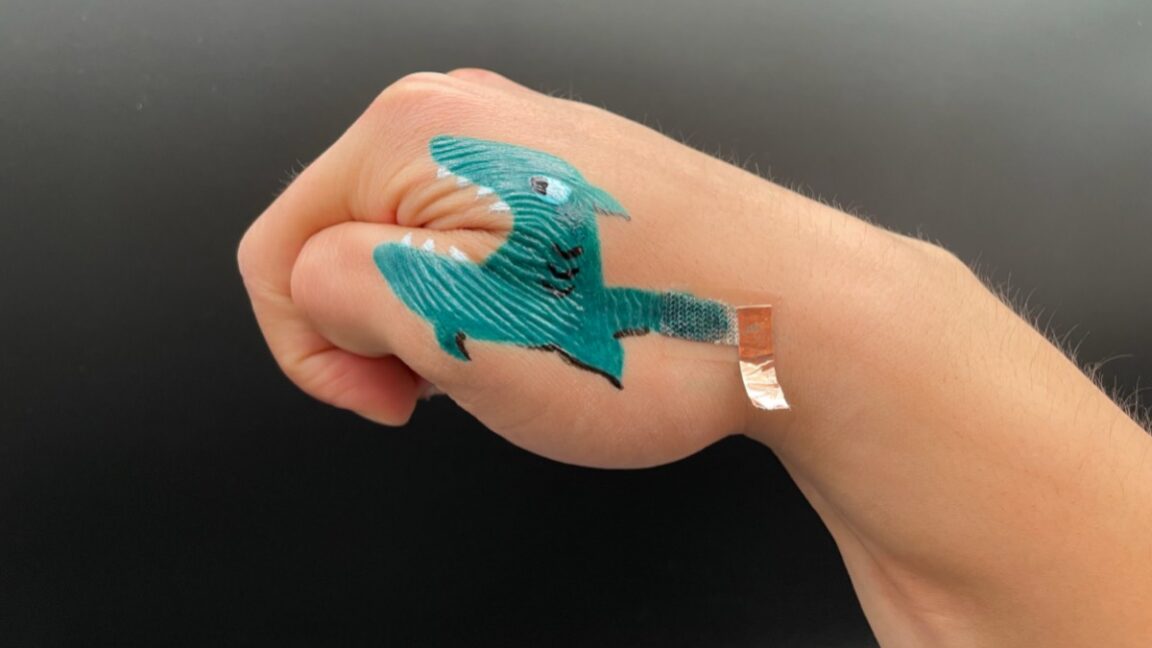
Credit: Wanqing Zhang Credit: Wanqing Zhang Scientists at Pennsylvania State University have developed a novel conductive ink that can be painted directly onto the skin in colorful custom designs, turning into a functional electrode for biomonitoring after drying. They described their work in a new paper published in the Proceedings of the National Academy of Sciences (PNAS). As previously reported , epidermal electronics attached to the skin via temporary tattoos (e-tattoos) have been around for more than a decade. So-called e-tattoos connect to skin without adhesives, are practically unnoticeable, and are typically attached via temporary tattoo, allowing electrical measurements (and other measurements, such as temperature and strain) using ultra-thin polymers with embedded circuit elements. However, these e-tattoos have their limitations, most notably that they don’t function well on curved and/or hairy surfaces, as well as requiring personalized electrode placement design to cover larger areas, since biosignals are spatially distributed. So scientists have been getting creative. For instance, in 2024 , researchers developed special polymer-based conductive inks that can be printed onto a person’s scalp to measure brain waves, even if they have hair. This could one day enable mobile EEG monitoring outside a clinical setting, among other potential applications. Read full article Comments
View original source — Ars Technica ↗
Related stories

Straits Times
TechnologyJul 14, 2026 · 1 min
US unseals charges, offers $10 million reward for info on Russian hackers
Straits Times

The Verge
TechnologyJul 14, 2026 · 1 min
SpaceXAI’s Grok programming tool was uploading its users’ entire codebase to cloud storage
The Verge

ZDNet
TechnologyJul 14, 2026 · 1 min
I tested the Ultrahuman Ring Pro: It's a biohacker's dream that's not for me
ZDNet
ABC News
TechnologyJul 14, 2026 · 1 min
Jewish student tells of her disgust at TikToks in Auschwitz car park
ABC News