The Guardian
Drivers charging electric cars handed shock parking fines
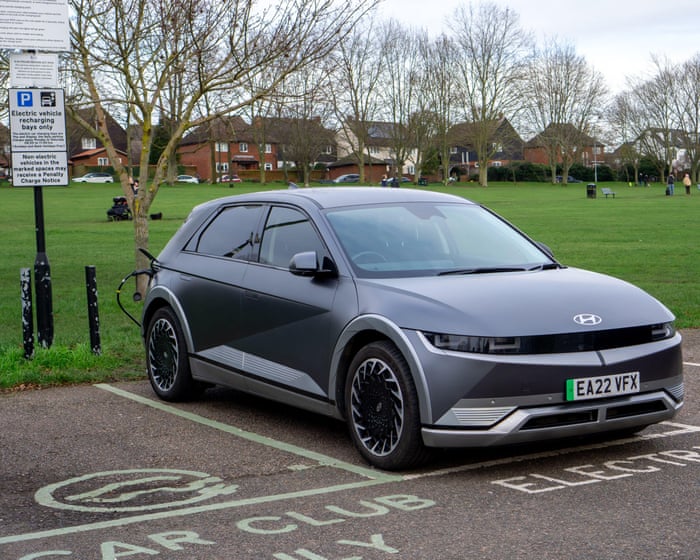
Does refuelling your car class as parking? The answer appears to be yes if it’s an electric vehicle. Guardian Money has been contacted by several readers who were fined after charging their cars away from home.
The motorists report being caught out by signs that fail to make clear that charging points are subject to parking tariffs or to store opening times. Also, they have found some chargers being advertised as available for use when it would be a breach of the car park’s terms and conditions to use them.
Kevin Laban hoped his electric car would save him money as well as the planet. However, after he used a charger in a supermarket car park he received an expensive surprise. Through the post came a £70 parking charge notice (PCN) for using the service when the supermarket was closed.
The app operated by the EV charger operator Pod Point had directed him to a bay in an Aldi car park in Weymouth. Parking is not permitted on the site outside store opening times and, unbeknownst to Laban, EV charging is deemed to be parking by the landowner.
“Pod Point advertises the charger as open to the public, while the car park’s cameras are set to immediately fine anyone who enters to use it,” Laban says. “If the landowner does not want people charging outside store hours, the chargers must be deactivated, or the EV apps must sync with the parking restrictions.”
Laban says there were no signs in the car park, on the charger or on the app stating it could only be used during store opening times.
Aldi cancelled the PCN when Laban complained and insisted that car park terms and conditions are clearly displayed.
Pod Point told Guardian Money that landowners are responsible for notices about parking charges and restrictions displayed in its app and on site and while some prominently detail the relevant terms for EV drivers, others do not.
Laban’s experience exposes an anomaly in the rollout of EV chargers on private land: car park rules have not evolved to accommodate vehicles that stop solely to charge in a designated bay.
Another motorist, Clive Sanders*, paid more than he had bargained for when he charged his new EV in a Devon car park. He received a £100 PCN from the parking operator, Smart Parking, because he had only paid for charging. “There was no indication on the InstaVolt charger that I needed to pay the parking tariff as well as the charging fee,” he said.
“InstaVolt assured me they could get the PCN cancelled and gave me a letter to send to Smart Parking, but it refused to comply.”
InstaVolt said car park rules are set by the landowner and notices around its chargers warn that parking restrictions apply. It offered Sanders a £50 credit for the “inconvenience” after Guardian Money questioned the clarity of the signs.
“Parking terms vary from site to site and may refer to time limits rather than charges, so to tell drivers that ‘parking charges apply when charging’ would not accurately reflect the range of conditions that exist across our network,” a spokesperson said.
“That said, we do recognise that for drivers who are newer to public charging, the distinction between charging fees and site-specific parking terms may not always be immediately obvious.”
Smart Parking said it was up to drivers to check the terms and conditions before using the car park. “There is no free parking and motorists must pay for the duration they stay,” a spokesperson said. “In this case, the driver stayed for nearly an hour without paying for his parking, so was he correctly issued a charge.
Anthony Stone* was hit with a £100 PCN after using an advertised charger in a Holiday Inn car park without registering his number plate at the hotel.
“How many contracts should a driver be expected to enter to charge a vehicle?” he said. “I understood that I was contracting with the charger operator to provide electricity, but it seems I was also entering one with the hotel or its parking operative.”
A spokesperson for Holiday Inn said vehicles are identified by ANPR cameras that do not distinguish between parking and charging. It claimed that the display screen tells drivers to register their cars for free parking before charging. It agreed to cancel the PCN after Guardian Money got in touch.
PCNs for charging are an increasing problem for EV drivers, according to the motoring group the RAC. “Signage needs to be clearer, so drivers realise straight away whether they need to pay for parking, how long they can stay to charge and the hours of operation,” said its head of policy, Simon Williams. “Equally, charge point operators should add a warning to their devices and apps to make drivers aware.”
The Ministry of Housing, Communities and Local Government said that private car parks are governed by contract law and that tariffs for using EV chargers must be clearly displayed. It said it plans to publish a new code to raise standards for private parking later this year.
* Names have been changed
View original source — The Guardian ↗
Related stories

Lovin Malta
TechnologyJul 15, 2026 · 1 min
Live Blog: Day 13 Of Yorgen Fenech’s Murder Trial Is Underway
Lovin Malta

The Verge
TechnologyJul 15, 2026 · 1 min
Starlink’s V5 dish is now available — here’s how it compares
The Verge

Lovin Malta
TechnologyJul 15, 2026 · 1 min
Watch: Malta Represented In Paris During Bastille Day Celebrations
Lovin Malta

The Guardian
TechnologyJul 15, 2026 · 1 min
Afternoon Update: Albanese vows to protect creatives from AI ‘theft’; local council scraps Lime bikes; and a string of…
The Guardian