Times of Israel
Israel’s latest strikes said to kill 12 in Gaza, including Hamas police officers
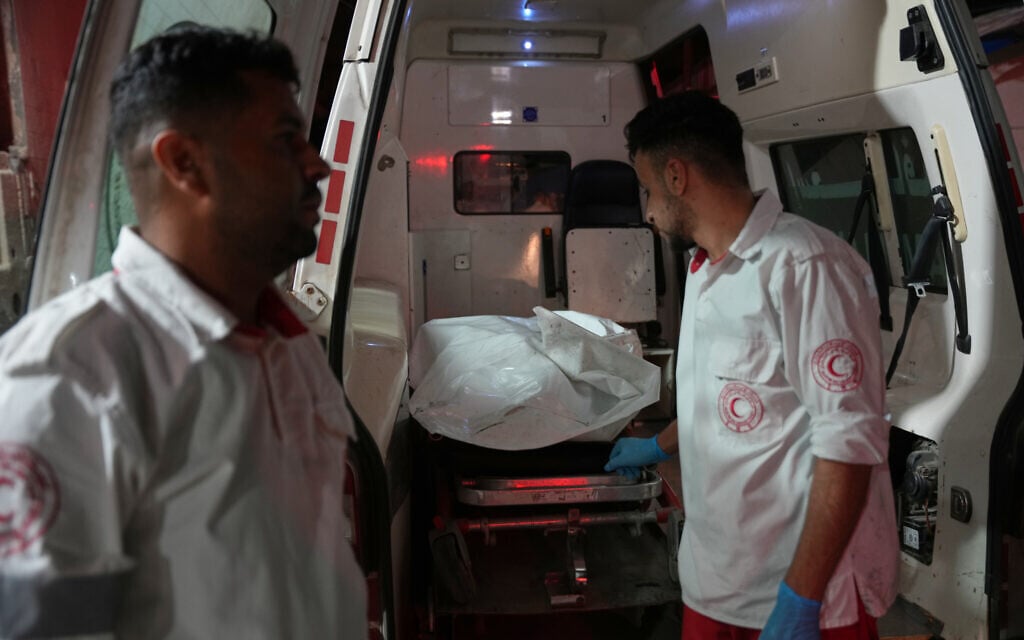
Israeli airstrikes killed at least a dozen people in Gaza over the past two days, local health officials said on Wednesday.
The latest violence came as Morocco signed on to be part of an international military stabilization force in post-war Gaza, and as Hamas leaders wrapped up another round of truce talks in Cairo, as part of US President Donald Trump’s Gaza peace plan, which halted the war last October.
Media outlets in Gaza affiliated with Hamas reported that three people were killed overnight in an Israeli strike on a house in Deir al-Balah.
According to the reports, the three were a married couple — Omar Abu Qasem and Asma Abu Qasem — and their six-year-old daughter, Habiba.
Their three-year-old son, Sami, survived but was injured, medics said.
Get The Times of Israel's Daily Edition
by email and never miss our top stories
By signing up, you agree to the terms
An Israeli military official told The Times of Israel that the strike targeted a Hamas operative.
???? صورة | الشهيد عمر سامي أبو قاسم (33 عامًا) وطفلته حبيبة، اللذين ارتقيا مع زوجته في قصف إسرائيلي استهدف شقة سكنية لعائلة أبو قاسم قرب دوار البركة بمدينة دير البلح. pic.twitter.com/8H3PntKAYx
— وكالة شهاب للأنباء (@ShehabAgency) July 15, 2026
On Tuesday, a woman and six police officers were among those killed in an airstrike on a police station in the densely populated Jabaliya refugee camp in northern Gaza, hospital officials said. A man died in the bombing of a tent camp in Khan Younis in the south, Nasser Hospital officials said. And Israeli forces shot and killed a child in the Muwasi area outside the southernmost city of Rafah, according to hospital officials.
The Israeli military did not immediately comment on the strikes in central and southern Gaza. In a statement on the attack in Jabaliya, it claimed that four of the slain police officers were Hamas operatives.
One of the officers, Col. Mohamad Marwan Salem, was a senior police commander and head of the Jabaliya police station, the Hamas-run Interior Ministry said.
Hamas, which ruled Gaza for years, maintains an armed wing as well as police and security services that are overseen by its Interior Ministry. Throughout the war, Israel has targeted local police. Israel’s military has said it considers police stations legitimate targets if they’re “being used to advance military activities, or if those present are military operatives involved in advancing terrorist activities.”
It did not say what military activities it believed were taking place at the Jabaliya police station. Hamas says the police force is engaged in maintaining law and order.
Morocco signs on to join stabilization force
Trump’s Gaza peace plan envisions, in its second phase, allowing a US-backed Palestinian technocratic committee to assume power from Hamas, the deployment of an international security force, and the start of the reconstruction of Gaza, which has been devastated by the war.
Morocco signed an agreement Wednesday to participate in the International Stabilization Force (ISF) for Gaza, state media reported.
The agreement was signed in Rabat at a meeting attended by Moroccan Foreign Minister Nasser Bourita, senior defense officials, and Board of Peace envoy for Gaza Nickolay Mladenov, and with a delegation including the commander of the ISF, the state news agency MAP said.
The agreement “reflects the shared determination to contribute, through concrete humanitarian and security actions, to the establishment of a climate of peace and security in the region,” MAP quoted a statement from the Moroccan defense administration as saying.
Trump’s Board of Peace and ISF leadership welcomed Morocco’s decision to join the initiative, citing its planned deployment of senior military officers, gendarmerie and police personnel, as well as the creation of a military field hospital, MAP said.
Morocco has been listed among ISF contributing countries since January, so the agreement appeared to be more of a formality.
While three other countries — Albania, Kazakhstan and Kosovo — have also agreed to contribute troops to the ISF — Morocco is slated to be the first of them to actually deploy troops in Gaza, officials familiar with the Board of Peace’s plans have told The Times of Israel.
The Board of Peace envisions Moroccan troops will be tasked with securing the borders of a humanitarian pilot zone that the Board of Peace aims to establish in the area of the flattened southern Gaza city of Rafah, the officials said.
But there is no timeline for when construction of that humanitarian zone will actually begin, with a senior Arab official familiar with the matter saying no major progress is expected until after the October Israeli elections, since Prime Minister Benjamin Netanyahu’s government has become increasingly reticent to cooperate with any Gaza relief projects as the vote approaches.
Among the steps that Israel has dragged its feet on advancing has been the signing of Status of Forces Agreement (SOFA) with each ISF contributor country, in order to establish the legal guardrails of foreign military personnel stationed abroad. ISF troops can’t deploy without those agreements being signed.
Another source familiar with the matter said ground is unlikely to break on the humanitarian pilot zone until early 2027, meaning the ISF won’t deploy before then regardless.
In the meantime, small delegations from ISF contributing countries are arriving in Israel and operating out of a base in the country’s south.
Hamas leaders wrapped up another round of truce talks in Cairo on Tuesday. The discussions — mediated by Egypt, Turkey and Qatar — were aimed at implementing the second phase of Trump’s Gaza peace plan.
The talks included the disarmament of Hamas — which it has so far refused to do — and the Israeli military’s withdrawal from the strip, according to sources close to the talks, who said there had been little progress amid deep distrust between the sides.
The fragile ceasefire deal in October attempted to halt a two-year-long war between Israel and Hamas that began when the Palestinian terror group led an invasion of southern Israel on October 7, 2023.
The heaviest fighting has subsided, but at least 1,123 people have been killed in Gaza since the ceasefire took effect, according to the territory’s Health Ministry. The ministry, which is part of the Hamas-led government, maintains detailed casualty records that are seen as generally reliable by UN agencies and independent experts. It does not give a breakdown of civilians and fighters but claims women and children make up most of the dead.
Gunmen have carried out shooting attacks on troops, and Israel says its strikes are in response to those and other violations. Five Israeli soldiers have been killed since the ceasefire.
View original source — Times of Israel ↗
Related stories

The Hill
PoliticsJul 15, 2026 · 1 min
Cassidy, Senate Democrats grill Trump health nominees over vaccine pressures
The Hill
South China Morning Post
PoliticsJul 15, 2026 · 1 min
US launches more Iran strikes, hits oil tanker trying to break Hormuz blockade
South China Morning Post

The Hill
PoliticsJul 15, 2026 · 1 min
Trump restarts ‘vicious cycle’ on Iran
The Hill

The Hill
PoliticsJul 15, 2026 · 1 min
Fetterman warns he would leave Democratic Party if it turns back on Israel
The Hill