Indian Express
‘Just keep him in jail for two days’: A day at Delhi’s first women police station
At 10 am on a humid July morning, a woman in a plain salwar-kameez walks hesitantly through the gates of a police station in North Delhi’s Sabzi Mandi.
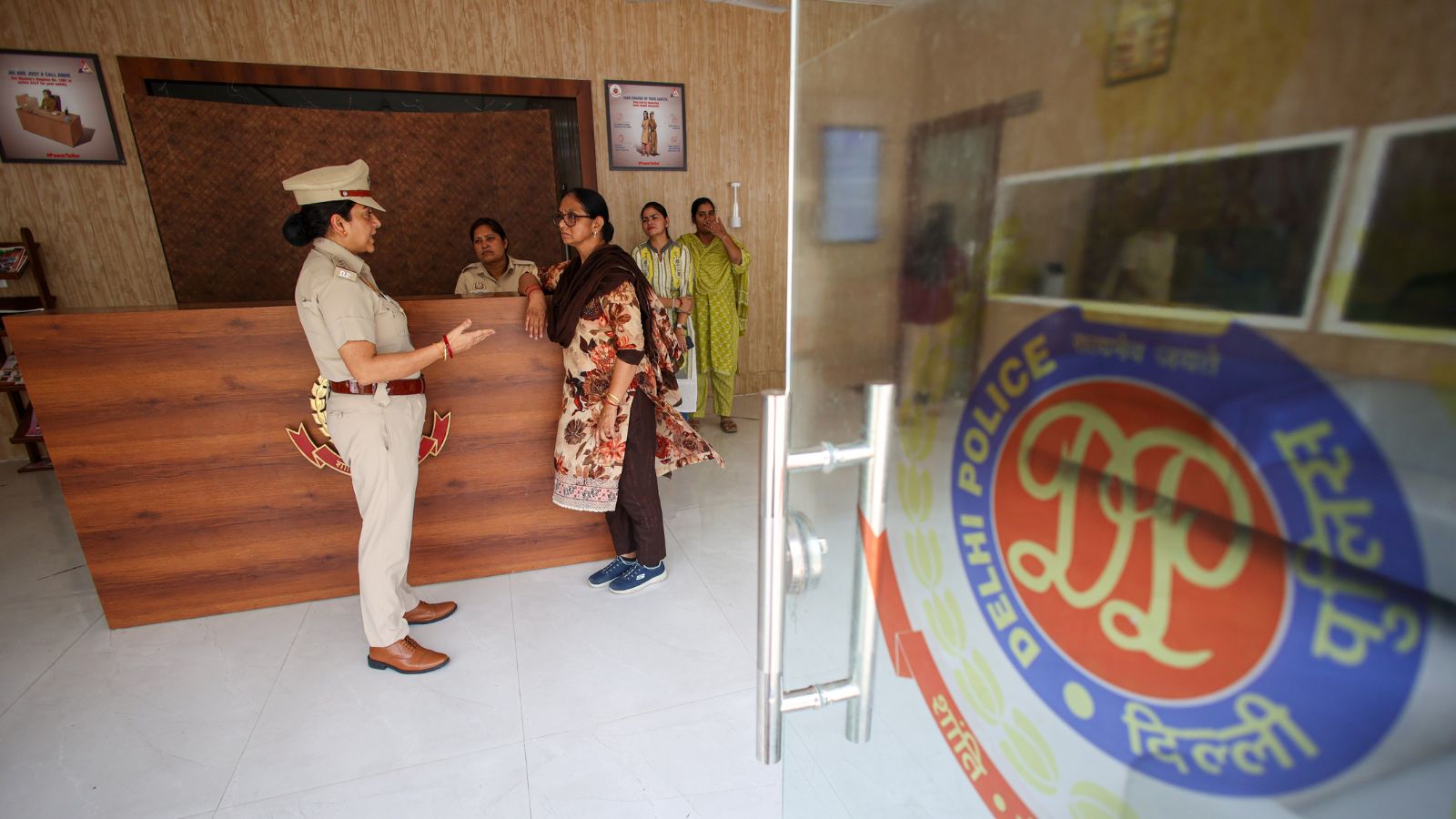
Clutching a white polythene bag bulging with copies of identity documents, she heads towards the duty desk manned by Assistant Sub-Inspector (ASI) Meenu Bala.
She identifies herself as 40-year-old Radhika. She tells Bala that she got married in 2016, but the relationship was turbulent from the start. Hoping things would improve, she endured years of domestic abuse. Now, with a child to care for, she says she no longer wants to suffer in silence.
Bala nods, making notes on a complaint paper. Every now and then, she asks a question about the timeline of events.
“This is the most important part of the job,” she explains later. “The duty officer is the first person anyone meets when they enter a police station. That first interaction matters. If someone feels heard, half the hesitation disappears.”
The duty officer’s desk sits immediately to the right, separated from complainants by a glass partition. A separate room is available for women who wish to speak in private. (Express Photo by Praveen Khanna)
Barely a month after it opened on June 19, Delhi’s first women police station has become the single point of contact for complaints ranging from domestic violence to sexual offences in the North district. Integrated with the Crime Against Women (CAW) Cell, it was set up to bring counselling and criminal investigation under one roof.
At 57, Bala is from the 1994 batch of the Delhi Police. Before being posted here, she served as duty officer at Rani Bagh and Kamla Market police stations.
By 4 pm, she had spoken to 21 women.
Story continues below this ad
Some narrate their complaints matter-of-factly. Some cry before they can complete the first sentence. Others spend several minutes simply gathering the courage to speak.
Why this station exists
For years, women approached different police stations in the North district and then their complaints were transferred to the CAW for counselling and mediation before criminal proceedings began, often requiring them to move between different offices and police units.
Now, the counselling mechanism and the police station function as one unit, allowing complaints to move through a single system.
The idea, officers say, is to reduce delay and confusion.
Story continues below this ad
In less than a month, the station has 279 complaints on its books.
Of these, 125 were received after the police station became operational. The remaining complaints came with the merger of the CAW Cell.
What women want, what the law allows
Station House Officer Lakshmi Singh spends much of her day moving between investigation rooms, reviewing case files and speaking to officers.
Station House Officer, Inspector Lakshmi Singh, inside her office. (Express Photo by Praveen Khanna)
Barely a month into the station’s functioning, she says one request is heard often. “Women often come to us and say, ‘Bas unhe 48 ghante ke liye jail mein rakh dijiye. Sudhar jayenge, (Just keep him in jail for two days. He’ll change)’.”
Story continues below this ad
The request is understandable, she says, but can’t be executed. Many women are not necessarily looking for prolonged criminal proceedings, they just hope a brief spell in custody will act as a warning and save the marriage.
“But policing doesn’t work like that,” Singh says.
Since its inauguration, the station has registered nine FIRs, most of them transferred from other police stations: three relate to dowry harassment, two concern molestation, two involve rape/POCSO charges.
Police officials say action has been initiated in all the cases, particularly those involving sexual offences.
Inside the station
Unlike a conventional police station, where complainants often find themselves navigating multiple rooms before locating the right officer, this building has been designed around accessibility.
Story continues below this ad
The station opens into a large hall flooded with daylight. The duty officer’s desk sits immediately to the right, separated from complainants by a glass partition. A separate room is available for women who wish to speak in private.
The reception is in the centre. Behind it are the investigation officer’s room, a conference room, the Station House Officer’s office, a gym and women’s barracks.
A brightly painted children’s room occupies one corner, a space for women who bring children along.
While the duty officer records complaints and provides the first point of contact, investigation officers take over recording statements, examining evidence, counselling parties where required and initiating criminal proceedings wherever offences are made out.
Story continues below this ad
Nearly 60 per cent of the personnel are women, while the remaining 40 per cent are men. In all, the station has around 57 women personnel, seven are Sub-Inspectors, thirteen are Assistant Sub-Inspectors.
Officials say male officers continue to play an important operational role, particularly during night arrests, medical examinations, handling violent accused persons and situations where women accused are accompanied by aggressive male relatives.
Some challenges
But staffing remains among the station’s biggest challenges. Women Sub-Inspectors are required to investigate rape and Protection of Children from Sexual Offences (POCSO) cases.
Yet several officers are currently unavailable because of maternity leave, medical leave or other reasons. Officials say only one officer is presently available full-time to handle such investigations.
Story continues below this ad
Infrastructure is another challenge. The reception area does not yet have air-conditioning. Because the structure is prefabricated, it heats up rapidly during summer, making conditions uncomfortable for both visitors and police personnel.
These are teething troubles, officers say. The larger objective remains creating a police station where women feel comfortable enough to report crimes.
Back at the duty officer’s desk, Bala continues working through the day’s complaints. Every few minutes, a complainant walks in. Some arrive alone, others come with parents or siblings.
“Every complaint represents a family in conflict,” she says. “Some will end in criminal prosecution. Some may end in reconciliation. Many will require months of counselling before reaching either stage.”
View original source — Indian Express ↗
Related stories

The Punch
WorldJul 16, 2026 · 1 min
VIDEO: My wife handles my money, I’m a reckless spender — Davido
The Punch
The Punch
WorldJul 16, 2026 · 1 min
Peter Obi, Adebayo mourn ex-Aso Rock chaplain William Okoye
The Punch
The Punch
WorldJul 16, 2026 · 1 min
Nigeria, Gambia agree to revive joint commission, deepen ties
The Punch
The Punch
WorldJul 16, 2026 · 1 min
Ex-Aso Rock chaplain dies, CAN mourns
The Punch