Indian Express
Young India is done calling every setback a ‘skill issue’
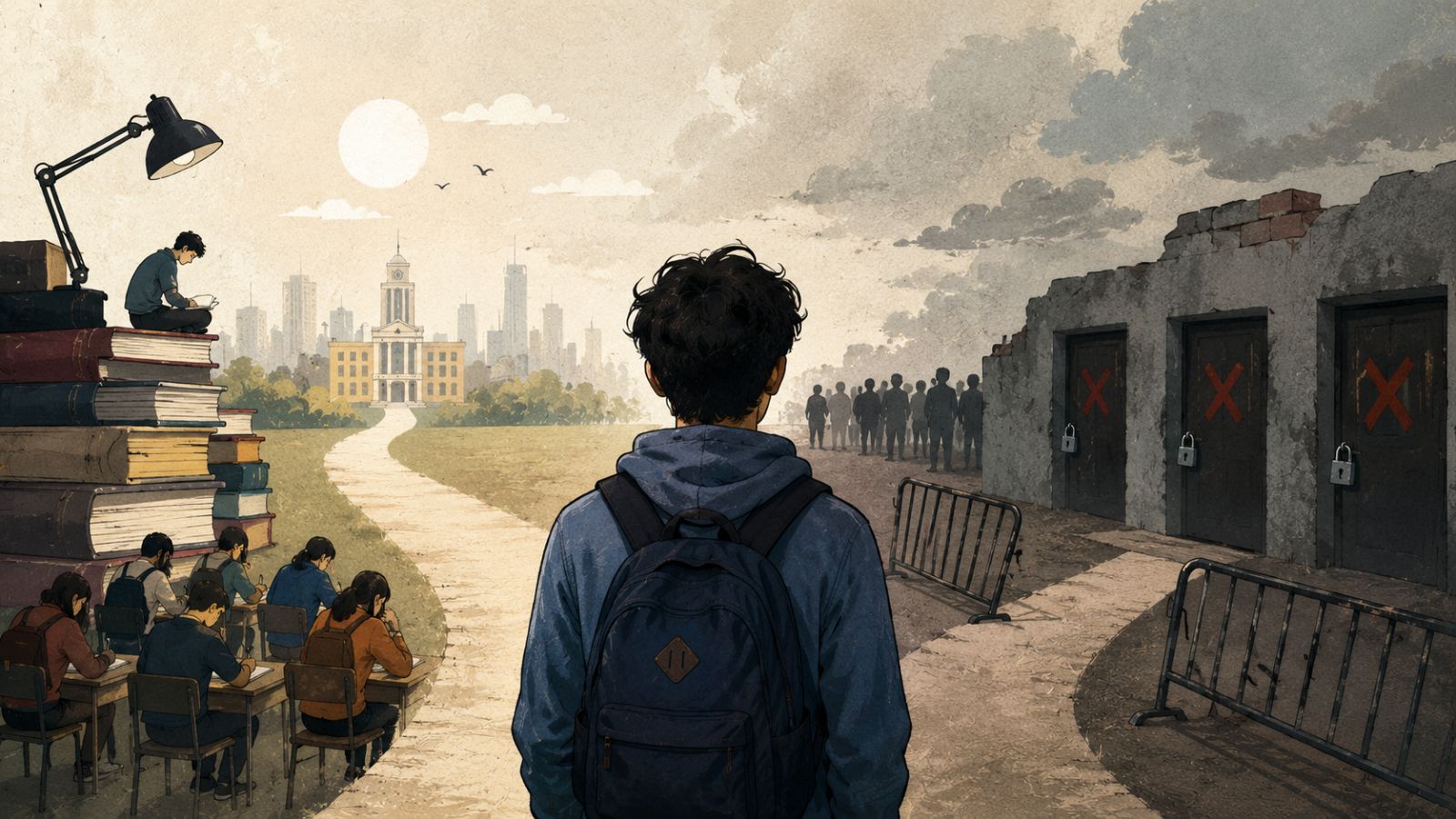
Every generation inherits a promise. For young Indians, that promise has long been deceptively simple: study hard, score well, earn a degree, and a stable future will follow. It is a narrative repeated in classrooms, reinforced by coaching institutes, echoed around family dinner tables, and celebrated in political speeches. Success, we are told, is the inevitable reward for hard work. Failure, by extension, becomes evidence of insufficient effort.
But after years of paper leaks, delayed recruitments, cancelled examinations, shrinking job markets and endless advice to “just upskill”, a growing number of young Indians are beginning to ask a different question: what if the problem isn’t always the individual? What happens when millions do everything they were asked to do and still find themselves waiting for employment, examination results, recruitment processes to resume, or simply an opportunity that never arrives? At what point does individual failure become institutional failure?
Across India, this question is beginning to shape the way young people talk about success and failure. Recent youth-led campaigns on social media, including symbolic protests against the culture of self-blame, are not merely expressions of frustration. Behind the memes, sarcasm and viral posts lies a deeper shift in how an entire generation understands merit, opportunity and accountability. Rather than asking why young people are failing, they are asking why the systems designed to reward hard work are failing them.
This shift deserves serious attention because it forces India to confront an uncomfortable question: can a society continue to celebrate meritocracy when structural inequalities and institutional inefficiencies increasingly determine outcomes?
The myth of merit
The language of merit has occupied a sacred place in India’s educational imagination. Competitive examinations such as NEET, JEE, UPSC, SSC, banking examinations, and various state recruitment tests are presented as neutral mechanisms through which talent naturally rises. Their legitimacy rests on one simple assumption: everyone begins from the same starting line.
But that assumption has always been more comforting than accurate.
Story continues below this ad
Educational opportunity in India remains profoundly unequal. A student attending an elite private school in Delhi, Bengaluru, or Mumbai benefits from experienced teachers, advanced coaching, reliable internet access, English-language proficiency, and financial security. Another student, perhaps the first in their family to complete higher education, may prepare using outdated books while balancing domestic responsibilities, part-time work, or poor digital connectivity. Both appear for the same examination. Both answer identical questions. Yet pretending they competed under identical circumstances ignores the vast inequalities that shape educational outcomes long before examination day.
Merit cannot be understood merely as the result of effort. It is also shaped by privilege, institutional support, infrastructure, and opportunity. Recognising this does not diminish achievement; it simply makes our understanding of success more honest.
Unfortunately, public discourse often reduces these complex realities to motivational slogans. Students who fail are told to “work harder.” Graduates unable to secure employment are advised to “learn new skills.” Aspirants waiting years for recruitment are encouraged to “remain patient.”
The implication is subtle but powerful: if success belongs to individuals, failure must too.
Story continues below this ad
While resilience undoubtedly matters, these responses subtly transfer responsibility from institutions to individuals.
Waiting for a fair chance, not false hope
When education outpaces opportunity
The contradiction becomes even sharper after graduation. India produces millions of graduates every year, yet job creation has struggled to keep pace. Government recruitment examinations are postponed, cancelled, or compromised by paper leaks. Vacancies remain unfilled despite overwhelming demand. Selection processes often stretch across years, forcing candidates to spend significant portions of their youth preparing for opportunities whose outcomes remain uncertain.
These delays are not merely administrative inconveniences; they reshape lives. Preparing for competitive examinations has become a full-time occupation for countless young Indians. Families invest savings in coaching centres, accommodation, study materials, and repeated examination fees. Aspirants postpone careers, relationships, financial independence, and even personal milestones because they continue believing that perseverance will eventually be rewarded.
For many, uncertainty has become less of an exception and more of a way of life.
Story continues below this ad
When recruitment processes collapse because of institutional negligence, the consequences extend far beyond delayed employment. They undermine public trust in institutions meant to guarantee fairness. In such circumstances, asking individuals to simply “try harder” becomes an incomplete response. Hard work cannot compensate for examination systems vulnerable to repeated failures, recruitment pipelines that remain stalled, or labour markets incapable of absorbing an increasingly educated workforce.
Demographic dividend means little if institutions cannot convert education into opportunity.
When ‘work harder’ stops making sense
This disconnect reveals one of the defining contradictions of contemporary India. Political leaders frequently celebrate India’s demographic dividend, describing young people as the country’s greatest strength. But a demographic dividend means little if institutions cannot convert education into opportunity.
When expectations consistently exceed available opportunities, disappointment gradually evolves into distrust. The promise of upward mobility begins to lose credibility—not because young people have stopped believing in hard work, but because they have begun questioning whether hard work alone can overcome broken systems.
Over the past decade, resilience, entrepreneurship and self-reliance have increasingly been presented as the solution to youth unemployment. These are valuable qualities, but resilience should not become a substitute for institutional accountability. Governments cannot celebrate young people as the nation’s greatest asset while recruitment systems stagnate. Universities cannot focus only on degrees while ignoring employability. Personal responsibility matters. But it cannot replace institutional responsibility.
Story continues below this ad
The cost of constant waiting
Perhaps the deepest consequence of this crisis isn’t economic—it’s psychological.
For many young Indians, stress is no longer tied to examinations alone. It comes from existing in a state of permanent waiting: waiting for recruitment notifications, examination dates, appointment letters or vacancies that may never materialise.
Every postponement, every cancelled examination and every paper leak extends not only a career timeline but an emotional one.
Families often measure self-worth through examination success. Coaching institutes celebrate toppers while quietly ignoring the thousands who never make the final list. Social media amplifies stories of extraordinary success, making failure appear deeply personal when it is often widely shared.
Story continues below this ad
Over time, institutional failures become internalised as personal shortcomings. Young people begin questioning their intelligence, discipline and worth—even when many of the barriers before them lie entirely beyond their control.
A fair chance, not false hope
Ultimately, India’s future depends not only on the ambition of its youth but on the credibility of its institutions.
Young people continue preparing for examinations despite repeated setbacks. They continue pursuing degrees despite uncertain returns. They continue believing in education even when the system repeatedly tests that belief.
That resilience deserves admiration. But it should not become an excuse for preserving broken systems.
Story continues below this ad
The question confronting India today is no longer whether its youth are willing to work hard. Their commitment has rarely been in doubt. The real question is whether the institutions responsible for rewarding that effort are prepared to meet them halfway.
Young people are not demanding guaranteed success. They are demanding something far more fundamental: a fair chance.
And perhaps that’s the biggest shift of all. For years, failure in India was treated as something to be overcome individually. A growing generation is now asking whether some failures belong not to people, but to the systems that were meant to support them. That’s not a rejection of merit. It’s a demand that merit finally mean what it promised.
(The author is a freelance writer and student of foreign affairs at Jamia Millia Islamia)
View original source — Indian Express ↗
Related stories

The Punch
WorldJul 16, 2026 · 1 min
VIDEO: My wife handles my money, I’m a reckless spender — Davido
The Punch
The Punch
WorldJul 16, 2026 · 1 min
Peter Obi, Adebayo mourn ex-Aso Rock chaplain William Okoye
The Punch
The Punch
WorldJul 16, 2026 · 1 min
Nigeria, Gambia agree to revive joint commission, deepen ties
The Punch
The Punch
WorldJul 16, 2026 · 1 min
Ex-Aso Rock chaplain dies, CAN mourns
The Punch