Times of Israel
Ultra-Orthodox extremists block roads, clash with public over arrest of draft dodgers
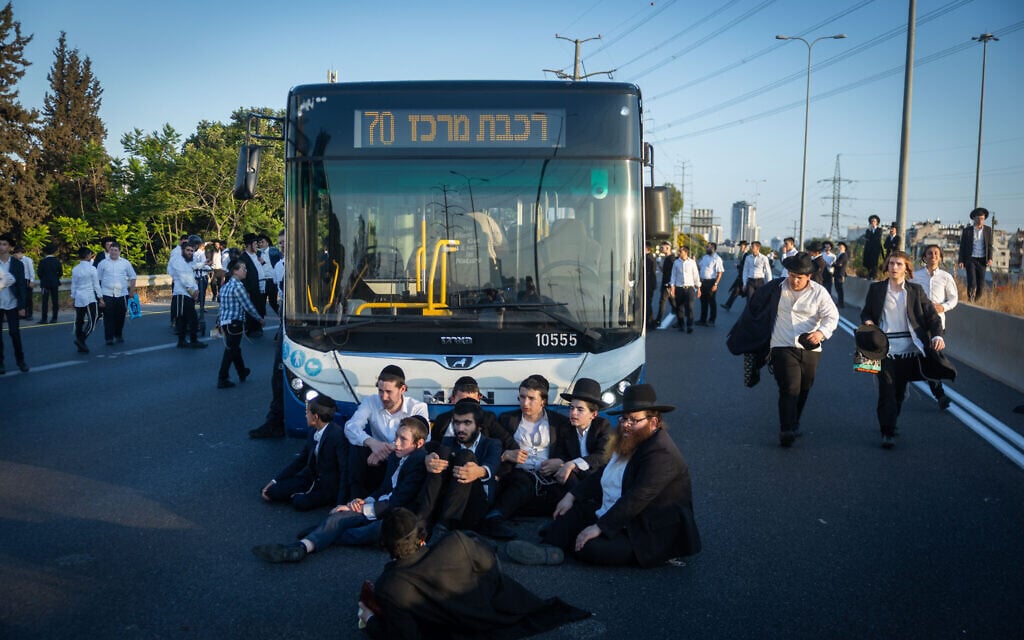
Hundreds of extremist ultra-Orthodox men blocked roads in central Israel on Thursday in protest of the recent arrests of Haredi draft evaders, where they clashed with police forces and members of the public.
The demonstrations came even as the government passed sweeping laws in recent days aimed at halting the arrests of ultra-Orthodox draft dodgers and elevating the status of yeshiva students.
The demonstration was organized by a sub-sect of the extremist Jerusalem Faction, which called to block central Israel’s Route 4 highway from Aluf Sade Interchange to Em Hamoshavot Interchange, a stretch of some 6.7 kilometers (4.1 miles).
The timing of the protest coincided with rush hour, causing additional traffic and delays during what were already some of the busiest hours of the day to be on the road.
The demonstrators — many of whom were underage — sat in the middle of the road to block traffic with their bodies. In one instance, the Haaretz daily reported that the protesters smashed the wing mirrors of a car that attempted to push through the blockage.
Get The Times of Israel's Daily Edition
by email and never miss our top stories
By signing up, you agree to the terms
The Israel Police later said that a car windshield was shattered by protesters throwing stones, although it was unclear if this was the same incident.
The demonstration turned violent after the police declared it illegal and ordered those blocking the road to clear the area. When they refused, mounted troops were sent in and officers used force to disperse the demonstration.
Protesters threw bottles and other objects at law enforcement, lightly injuring one officer, police said.
Two protesters were arrested.
עימותים קשים בין רוכב אופניים שעבר במקום לבין מפגינים חרדים. בין הצדדים התפתח עימות שכלל יריקות, דחיפות ומכות. pic.twitter.com/THdOjIa5NK
— יעקב הרשקוביץ | Yaakov hershkowitz (@yaakov_hershko) July 16, 2026
Video footage from the demonstration also showed a group of protesters swarming a cyclist as he tried to bike through their blockade. The protesters can be seen throwing things at him, slapping him, and trying to grab his bike. After a protester runs up to the cyclist and hits him hard on the chest, he falls to the ground. A paramedic can be seen approaching him as the video cuts off.
It was unclear whether the cyclist was injured in the incident.
Among the grievances prominently displayed on banners held by the protesters was the existence of the IDF’s Haredi Hasmonean Brigade.
The infantry brigade was established in late 2024 as part of the military’s efforts to expand the enlistment of ultra-Orthodox men amid wartime personnel shortages. It also aims to demonstrate, despite opposition to enlistment from leading Haredi rabbis, that military service can go hand in hand with ultra-Orthodox observance.
Many remain unconvinced, however, and banners at Thursday’s protest proclaimed that it was “better to die Haredi than to enlist in the Hasmonean Brigade.”
Others held signs with the trademark slogan of the anti-conscription protests — “we will die and not enlist.”
Drivers were advised by police to use alternative routes to avoid the demonstrations, only to discover that these too had been blocked by the Haredi protesters.
Public transport was also affected, and the Tel Aviv light rail was forced to operate along a shortened route that excluded the Petah Tikva area due to the protests near that city and in Bnei Brak, as well as Route 4’s Geha Interchange, located between the two cities.
Several women’s rights activists and candidates standing in The Democrats party primaries organized a small counterprotest on the sidelines of the Haredi demonstration.
The counterdemonstration did not appear to focus directly on the issue of military conscription for ultra-Orthodox men but rather on recent efforts to increase gender segregation in public spaces, after the Knesset voted on Thursday to expand it in higher education, and as the Bnei Brak municipality was reported to be working to establish single-gender sidewalks in the city.
“A woman. Not a second-class citizen,” one hand-drawn poster declared.
Later on Thursday night, some 2,000 men from the Sanz Hasidic sect gathered near the Neve Tzedek Military Prison, also in central Israel, to protest against the arrest of two draft evaders from their community.
The protests were organized days after the government passed legislation barring the arrest of ultra-Orthodox draft evaders.
The law, passed in a vote of 58-54 on Tuesday, grants tens of thousands of Haredi draft evaders immunity from arrest until late January 2027, and extends that protection to those who become eligible for military service after it takes effect, effectively eliminating the threat of arrest and making it easier to refuse to enlist during that period. It also suspends ongoing criminal proceedings against those already facing enforcement measures.
The High Court froze implementation of the law a day later, however, and scheduled a hearing on the matter for July 28.
Some 72,000 ultra-Orthodox men aged 18 to 24 are currently believed to be eligible for military service, but have not enlisted, despite mounting calls for their conscription as Israel has fought wars on multiple fronts since the Hamas-led October 7, 2023, attack, while facing a growing manpower shortage.
Although only a few ultra-Orthodox draft evaders have actually been arrested, they have caused the ultra-Orthodox parties and the coalition a severe political headache, prompting the passage of new legislation freezing the arrests just days before the end of the current Knesset term.
The Haredi legislative push comes after the High Court ruled unanimously in 2024 that the government must draft ultra-Orthodox yeshiva students into the military since there was no legal framework to continue the decades-long practice of granting them blanket exemptions from army service.
View original source — Times of Israel ↗
Related stories

The Punch
PoliticsJul 16, 2026 · 1 min
ADC mourns Amaechi’s mother, prays for family
The Punch
The Punch
PoliticsJul 16, 2026 · 1 min
Bandits kill vigilante leader in Katsina
The Punch
The Punch
PoliticsJul 16, 2026 · 1 min
Tinubu mourns former Aso Villa Chaplain under Obasanjo, Jonathan
The Punch

TASS
PoliticsJul 16, 2026 · 1 min
No deadline for US Senate consideration of bill on sanctions against Russia — Axios
TASS