Times of Israel
As Likud challenges the election watchdog, some fear it may challenge the election outcome, too
Last month, the Central Elections Committee tapped its recently retired legal adviser, Dean Livne, as acting director general, replacing outgoing chief Orly Adas, who resigned on April 30 after 15 years on the job amid a political pressure campaign.
Livne’s appointment was immediately condemned by members of Prime Minister Benjamin Netanyahu’s ruling Likud party, with MK Avichay Buaron calling the acting chief “clearly politically biased” and the choice “worrying and invalid.”
Diaspora Affairs Minister Amichai Chikli issued a similar critique, saying it was a “scandalous political appointment that casts a heavy shadow over the integrity of Israel’s upcoming election.”
What may have gotten them and others in a huff were comments Livne made to the Kan public broadcaster in April regarding his concerns that plans were being made to contest the results of the October 27 general election.
“We’ve seen that one of the players, one or more, are trying to cast doubt on the results even before there are results,” he said.
Get The Times of Israel's Daily Edition
by email and never miss our top stories
By signing up, you agree to the terms
Livne did not name the object of his concern, but there seemed little doubt who he was referring to. Only one major party had challenged the appointment of a new Central Elections Committee legal adviser, Yifat Siminovski, who replaced Livne — the same party whose members were now casting doubt on Livne’s role in the body himself.
As Israel heads into its first election season in four years, Likud politicians’ long history of questioning the integrity of top Central Elections Committee officials and, by extension, the body itself has led some legal experts to express concern that the party and its leader, Prime Minister Benjamin Netanyahu, could be laying the groundwork to either dispute the results, or to pressure the body into more favorable rulings.
Likud is placing “a sword of Damocles above the head of the committee” so that its members will “think twice” about whether any decision can be construed as biased against the party, said Yaniv Roznai, vice dean of Reichman University’s Harry Radzyner Law School.
“But the bigger project, of course, is delegitimation of the committee to prepare for [election day] in case they lose,” added Roznai, who recently participated in several Zoom meetings on election integrity, including an event hosted by Yair Lapid in which the opposition leader accused Likud of planning to lie and cheat to steal the election.
Lapid insisted that his Yesh Atid party had “identified patterns of interference,” adding: “I don’t think the Netanyahu government will try to interfere in the elections. I know it.”
A Likud source denied any such plot, insisting that the party was poised for a win that would obviate the need for ploys.
The committee’s role, and its battles
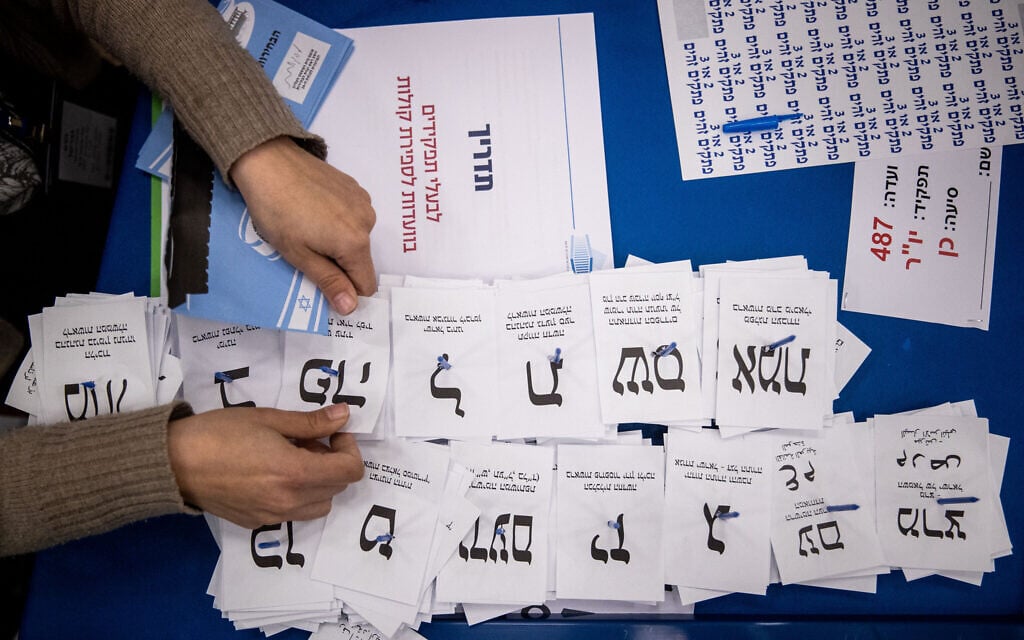
The Central Elections Committee acts as the state’s main arbiter for setting the ground rules for elections, playing referee to ensure a fair and honest vote and tallying votes once the public has had its say.
The body is chaired by a Supreme Court justice, currently the conservative Deputy Supreme Court President Noam Sohlberg, and comprises representatives of the various factions in the Knesset.
Ahead of elections, it has the power to disqualify parties or candidates deemed outside the bounds of legitimate political discourse, such as those espousing racist or terror-supporting views, though those decisions are often overturned by the Supreme Court.
It also enforces campaign rules, fining parties for election advertisements and rhetoric that violate the law, such as in 2020 when it penalized the ultra-Orthodox Shas party for handing out charms and candles promising protection against coronavirus at polling stations — or, more recently, when it ordered Likud to take down a manipulated image that appeared to show Naftali Bennett and Yair Lapid joining hands with Arab party leaders.
Likud members have long accused the committee of unfairness, including in 2021, when then-Knesset speaker Yariv Levin attacked it as “biased” and its decisions as “illogical.”
He denied at the time that the remarks were part of a plan to dispute the results should Netanyahu lose.
“There were unacceptable events in the previous elections,” Levin told the Kan public broadcaster.
Two years earlier, Netanyahu had claimed that the committee’s disqualification of cameras in polling stations had led to fraudulent votes being cast for Arab party Balad, preventing his bloc from winning a Knesset majority.
In March 2023, Likud MK Eliyahu Revivo filed, and quickly withdrew, a bill to allow the Knesset speaker to appoint the committee chairman, which would have effectively stripped the body of its independence.
The coalition has also advanced a bill making it easier to disqualify Arab lawmakers and a measure preventing the Supreme Court from overturning the Central Elections Committee’s disqualification of parties.
‘We didn’t trust her’
Following committee head Orly Adas’s resignation announcement on April 30, one jubilant senior Likud official celebrated the end of her tenure as an “important victory,” telling the Ynet news site: “We didn’t trust her.”
Adas’s resignation came after Ilan Bombach, an attorney representing both Netanyahu and Likud, sent letters to Sohlberg demanding to know why the director general’s tenure was being extended.
Sohlberg’s decision sparked anger on the right, with Buaron insisting that it was “damaging the public’s trust in the integrity of the elections.”
According to the Haaretz newspaper, Adas resigned because she feared attacks on her from the right would harm public faith in the election process.
The newspaper said that in private conversations, Adas discussed her concerns that she would face the kind of public assaults that had been directed at Supreme Court President Isaac Amit, with whom the government has refused to work after trying to thwart his selection.
Haaretz also noted that the Knesset Finance Committee had cut the Central Elections Committee’s budget by NIS 50 million ($16.9 million) in February, despite significant concerns that both foreign interference and the emergence of generative artificial intelligence could adversely affect the election.
Outgoing State Comptroller Matanyahu Englman warned in December that Israel is unprepared to tackle foreign interference at the ballot box and that such meddling could undermine public confidence in the vote itself. In January, the committee announced that it was setting up a dedicated team in conjunction with the Shin Bet security service to examine concerns about AI influence on the upcoming election. (Last week, Englman further warned that the government has no policy to combat foreign interference in elections.)
Opposing a legal adviser
Tensions between Likud and the Central Elections Committee initially ramped up in March, when the committee unanimously selected attorney Yifat Siminovski, an artificial intelligence expert, to serve as its new legal adviser.
As legal adviser, Siminovski’s input will help the committee decide on the legality of alleged election law violations. She will also play a key role in providing guidance regarding everything from the disqualification of parties to the interpretation of relevant statutes.
Her appointment was immediately contested by the Prime Minister’s Office, which attempted to claim that it was invalid due to an alleged procedural flaw.
Bombach argued at the time on behalf of Likud and Netanyahu that Siminovski’s appointment should be halted because it had not been made in consultation with the civil service commissioner, creating a legal “defect that goes to the root” of the process.
Sohlberg rejected Bombach’s argument, saying there was “no basis for what was claimed and requested.”
Days later, Bombach sent a follow-up letter questioning whether Siminovski’s cyber and technology background qualified her for the role of legal adviser, despite the committee emphasizing that it was exactly this background that was needed in the era of artificial intelligence and the threat of AI influence on the upcoming election.
‘They are going to falsify the election results’
Israeli elections have historically been broadly free of fraud (with some minor exceptions), and, despite heated rhetoric, Netanyahu and his allies have always ultimately backed the legitimacy of electoral results.
However, recent comments by Likud lawmakers, as well as the attacks on Siminovski, have generated concern among some legal scholars.
Addressing Sohlberg during a recent interview with Radio Galei Israel, Regional Cooperation Minister David Amsalem called on the judge to install cameras in polling stations, a longtime Likud priority, alleging that election results were going to be falsified.
“They will falsify [votes] in the Arab sector, they will falsify [votes] in the kibbutzim… democracy doesn’t interest them,” he said, reviving claims from seven years ago.
In separate remarks in the Knesset, Amsalem further stated that he had warned Sohlberg that “leftists” would “falsify the elections.”
Last month, Likud MK Amit Halevi also called for installing cameras in polling stations, arguing that doing so would deter voter fraud. Likud representatives of the committee have also opposed moves to put polling stations in old age homes, whose residents generally skew more to the left than the general population.
According to Assaf Shapira, head of the Israel Democracy Institute’s Political Reform Program, both Amsalem’s statements and the timing of Netanyahu’s attempt to halt Siminovski’s appointment raised questions about the prime minister’s intent, because, he argued, the proper time to have contested her appointment would have been months earlier, when her candidacy was first announced, “through a formal appeal, not through letters leaked to the media.”
Knowing that his appeal to the nation’s top court has little chance of success, Netanyahu’s effort appeared to be geared for public consumption rather than the confines of legal briefs, allowing his party to call into question both the qualifications of the committee’s top legal official and the judgment of its chairman. This, Shapira said, could be aimed at laying the groundwork for disputing any adverse rulings by the committee, he said.
“There are several theories as to why Likud is doing this. One is preparation for a ‘Stop the Steal’-style campaign, like in the US, to say the elections were forged or stolen because the Central Elections Committee was political and dysfunctional,” Shapira said, referring to US President Donald Trump’s attempts to contest his 2020 loss to Joe Biden.
Another possibility is that Netanyahu could be trying to create an atmosphere in which the public believes that the Central Elections Committee is biased, in hopes that the panel will attempt to correct the perception.
“Sohlberg will feel pressured to make decisions more in favor of Likud just to prove he isn’t against them,” Shapira predicted.
Asked if Netanyahu was trying to lay the groundwork for challenging the election results should he lose, a spokesman for Likud called the question itself part of a campaign against the prime minister.
A Likud source who spoke to The Times of Israel on condition of anonymity, meanwhile, stated that Netanyahu has never believed in the neutrality of the Central Elections Committee nor liked its top personnel, framing the party’s recent rhetoric as just “a continuation of that thought process and tradition and history.”
“Everything that you’re seeing here is just business as usual. I don’t think that there’s any preparation here for anything after the election,” the source said.
Part of the reason why prominent experts are concerned stems from Likud’s rhetorical and legislative attacks on the so-called “gatekeepers” of Israeli democracy: officials and institutions that serve as checks on government power, such as the judiciary, attorney general and Shin Bet security service.
Ministers’ calls to ignore the attorney general’s orders and High Court rulings, and Justice Minister Yariv Levin’s longtime refusal to acknowledge the legitimacy of Supreme Court President Isaac Amit, are unprecedented and may hint at future rejections of Central Elections Committee rulings, the experts say. Last month, for the first time, moreover, the government explicitly stated that it would disobey a High Court ruling.
Asked why, if Likud has not previously tried to overturn an election, he fears it may do so in 2026, Shapira replied that in 2020, Likud representatives on the Central Elections Committee “abstained from the vote to certify the election results,” showing a willingness to contest a vote.
He also noted that in 2022, Adas and Amit, who was then chairman of the committee, rebuffed public claims by Likud regarding alleged voter irregularities at certain polling stations in Arab communities, which the party said were part of a “wide-scale effort to violently forge the election results.”
Netanyahu said at the time that he was waiting for the “real count, not the fake count that somebody is trying to subvert by violence or intimidation,” adding that he was demanding “a full accounting of votes, because that is the basis of democracy.” This came weeks after Netanyahu said Likud would film the vote count, which was not permitted at the time. (Last week, committee head Livne said he is planning a live broadcast of the election count, as part of a push to increase public trust in the process and the results.)
In a recording broadcast by Army Radio, Amit could be heard telling Bombach that he hoped “that what we are seeing from you is not, God forbid, the beginning of a planned delegitimization of the election results.”
“Ahead of the upcoming elections, we are seeing increasing attacks on the Central Elections Committee, even compared to previous elections, including more personal attacks against both its chair and its legal adviser. When this is combined with growing polarization and the perception of the judicial system as political and part of the ‘deep state,’ there is a real risk that the phenomena we saw in previous election cycles will intensify,” Shapira warned.
Contacted by The Times of Israel about the Likud campaign against Siminovski and Amsalem’s warnings about election fraud, a spokesman for the Central Elections Committee declined to comment, only stating that the panel “operates a mechanism of election integrity inspectors, who are stationed at all polling stations across the country” and that such inspectors “will also be stationed during the elections for the 26th Knesset.”
Roznai noted that shortly after resigning as Knesset speaker in 2020, Likud’s Yuli Edelstein kicked off a constitutional crisis when he openly refused to heed a High Court order mandating that he call a plenum vote to choose a new speaker.
And as the party has pursued an agenda to overhaul the judiciary, supporters have “violently interrupted Supreme Court hearings,” he pointed out.
“We already forgot because that [2020] constitutional crisis is almost peanuts compared to what we are witnessing now,” Roznai said, highlighting, like Shapira, that the government refuses to acknowledge the legal appointment of the president of the Supreme Court.
In 2021, after Bennett and Lapid took power, he recalled, Likud members “continued to call Netanyahu the prime minister.”
Jeremy Sharon and Times of Israel staff contributed to this report.
View original source — Times of Israel ↗
Related stories

The Local
PoliticsJul 17, 2026 · 1 min
Nicaragua cuts ties with Italy over 1978 PM assassination dispute
The Local

Lovin Malta
PoliticsJul 17, 2026 · 1 min
258 Fake Blue Disability Badges Collected In Malta Since 2023
Lovin Malta
ABC News
PoliticsJul 17, 2026 · 1 min
Breaking: Moira Deeming ousted as Liberal candidate after apology stand-off
ABC News

Straits Times
PoliticsJul 17, 2026 · 1 min
Trump’s claims that China stole voters’ data unlikely to derail September summit
Straits Times