Indian Express
A bride, a groom and jail: High court allows prison wedding of 2 convicts in Rajasthan
6 min readNew DelhiUpdated: Jul 17, 2026 02:37 PM IST
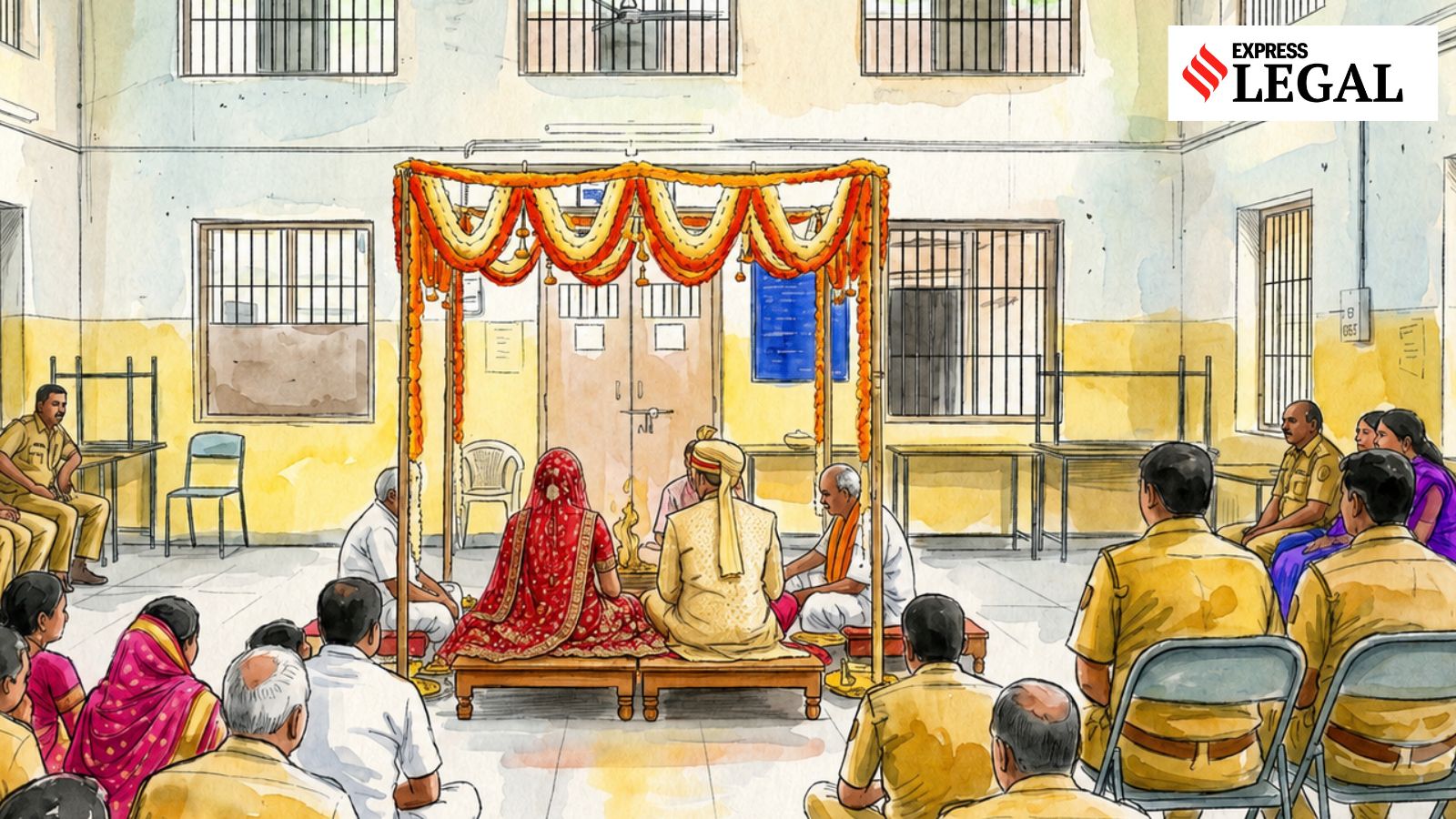
The Rajasthan High Court said that marriage between two consenting adults is an intrinsic facet of the right to life and personal liberty guaranteed under Article 21 of the Constitution. (AI-generated image)
A Jodhpur jail is set to host an unusual wedding after the Rajasthan High Court has allowed a 33-year-old murder convict, who is serving his sentence in the Open Air Camp at Mandor, to marry a fellow woman convict who is currently out on bail.
Holding that imprisonment does not extinguish fundamental rights under Article 21, the court said that marriage between two consenting adults remains an intrinsic part of the right to life and personal liberty guaranteed under the Constitution. The wedding date is yet to be finalised.
Justices Pushpendra Singh Bhati and Praveer Bhatnagar were hearing a temporary suspension of sentence application filed by a murder convict at the Mandor Open Air Camp in Jodhpur. “The solemnisation of marriage between two consenting adults is an intrinsic facet of the right of life and personal liberty guaranteed under Article 21 of the Constitution of India. The institution of marriage finds recognition across all major religions and cultures and has constituted a foundational unit of society,” the court said on July 15.
Justice Pushpendra Singh Bhati and Praveer Bhatnagar directed prison authorities to facilitate the ceremony under specific safeguards. (Image enhanced using AI)
The man was convicted by a trial court in Nagaur on August 19, 2023, for murder, causing disappearance of evidence, and misappropriation of property belonging to the deceased under the Indian Penal Code. In custody since February 16, 2017, he was shifted to the Open Air Camp at Mandor after meeting the eligibility criteria and receiving the required recommendation from prison authorities.
Advocates Kalu Ram Bhati and Shrawan Singh Rathore, appearing for the man, informed the court that he wished to marry a woman convict who has since been released on bail. It was argued that permitting the marriage would further his rehabilitation and reformation while allowing the couple to settle down and plan their future together.
Weddings Behind Bars: A Timeline of Prison Marriages in India
From court-ordered ceremonies to jail gurdwara weddings — courts across India have increasingly recognised that the right to marry does not end at the prison gate.
5 documented cases across Bihar, Punjab and Haryana | 2013 to 2025 | Undertrials, life convicts and a landmark HC precedent
THE TIMELINE — 2013 TO 2025
2013
Life Convict Marries Girlfriend at Court Complex
📍 Jind Court Complex, Haryana
Life convict Sanjay married his girlfriend Mamta while in custody at the Jind court complex — conducted under police escort during a court appearance. One of the earliest documented instances of a prison-linked marriage in India.
2016
⚖️ Legal Precedent
P&H HC Recognises Prisoner's Right to Marry
📍 Punjab & Haryana High Court
Landmark ruling: HC upheld prisoner Sumeet Bajwa's right to marry and directed authorities to facilitate the ceremony. Established the judicial principle that incarceration does not extinguish the fundamental right to marry — the legal foundation for all subsequent prison weddings.
2019
🏛️ First in Nabha
First Wedding Inside Nabha Maximum Security Jail — Prison Gurdwara
📍 Nabha Maximum Security Jail, Punjab
Life convict Mandeep Singh married Pawandeep Kaur inside the prison's gurdwara — the first ever wedding held within Nabha jail's premises. A historic moment for the high-security facility known for housing dangerous criminals.
2019
Nikah Inside Nabha Jail — Life Convict Marries Fiancée
📍 Nabha Maximum Security Jail, Punjab
Life convict Mohammed Wasim married his fiancée inside Nabha jail after the court permitted the nikah within prison premises. Two court-facilitated marriages at the same high-security facility in the same year.
2025
Undertrial Marries Widowed Sister-in-Law Inside Bihar Jail
📍 Madhubani Jail, Bihar
Undertrial Chhotu Yadav alias Badri Yadav married his widowed sister-in-law Geeta Kumari inside Madhubani jail after a court order. Jail staff acted as witnesses and fellow inmates served as the wedding party (baraatis) — an extraordinary ceremony within prison walls.
📌 The Legal Principle Behind Every Prison Wedding
Courts across India have progressively held that incarceration restricts liberty — but does not extinguish fundamental rights. The right to marry flows from Article 21 (right to life and personal liberty) of the Constitution. Once a court is satisfied the marriage is voluntary and legally valid, it may direct prison authorities to facilitate the ceremony — with appropriate security measures in place.
What is an open jail?
Open prisons have relatively less stringent rules compared to controlled jails. They go by many names, like minimum-security prison, open air camps or prison without bars. The fundamental rule of an open prison is that the jail has minimum security and functions on the self-discipline of the inmates.
The Rajasthan Prisoners Open Air Camp Rules, 1972, define open jails as “prisons without walls, bars and locks.” Inmates in Rajasthan open prisons are free to step out of the jail after the first roll call and have to return before the allotted second roll call. The jail does not confine them completely but requires them to earn a living to support their families, living with them inside the jail.
Story continues below this ad
Weddings Behind Bars: A Timeline of Prison Marriages in India
From court-ordered ceremonies to jail gurdwara weddings — courts across India have increasingly recognised that the right to marry does not end at the prison gate.
5 documented cases across Bihar, Punjab and Haryana | 2013 to 2025 | Undertrials, life convicts and a landmark HC precedent
THE TIMELINE — 2013 TO 2025
2013
Life Convict Marries Girlfriend at Court Complex
📍 Jind Court Complex, Haryana
Life convict Sanjay married his girlfriend Mamta while in custody at the Jind court complex — conducted under police escort during a court appearance. One of the earliest documented instances of a prison-linked marriage in India.
2016
⚖️ Legal Precedent
P&H HC Recognises Prisoner's Right to Marry
📍 Punjab & Haryana High Court
Landmark ruling: HC upheld prisoner Sumeet Bajwa's right to marry and directed authorities to facilitate the ceremony. Established the judicial principle that incarceration does not extinguish the fundamental right to marry — the legal foundation for all subsequent prison weddings.
2019
🏛️ First in Nabha
First Wedding Inside Nabha Maximum Security Jail — Prison Gurdwara
📍 Nabha Maximum Security Jail, Punjab
Life convict Mandeep Singh married Pawandeep Kaur inside the prison's gurdwara — the first ever wedding held within Nabha jail's premises. A historic moment for the high-security facility known for housing dangerous criminals.
2019
Nikah Inside Nabha Jail — Life Convict Marries Fiancée
📍 Nabha Maximum Security Jail, Punjab
Life convict Mohammed Wasim married his fiancée inside Nabha jail after the court permitted the nikah within prison premises. Two court-facilitated marriages at the same high-security facility in the same year.
2025
Undertrial Marries Widowed Sister-in-Law Inside Bihar Jail
📍 Madhubani Jail, Bihar
Undertrial Chhotu Yadav alias Badri Yadav married his widowed sister-in-law Geeta Kumari inside Madhubani jail after a court order. Jail staff acted as witnesses and fellow inmates served as the wedding party (baraatis) — an extraordinary ceremony within prison walls.
📌 The Legal Principle Behind Every Prison Wedding
Courts across India have progressively held that incarceration restricts liberty — but does not extinguish fundamental rights. The right to marry flows from Article 21 (right to life and personal liberty) of the Constitution. Once a court is satisfied the marriage is voluntary and legally valid, it may direct prison authorities to facilitate the ceremony — with appropriate security measures in place.
Prisons can’t erase fundamental rights
While allowing the plea, the court heavily relied on its 2022 decision in Nand Lal v State Department of Home, which recognised that prisoners retain their constitutional rights and that incarceration should not sever family relationships.
Quoting from the earlier judgment, the court noted, “The purpose of parole is to let the convict re-enter into the mainstream of the society peacefully after his release.” The bench also recalled another observation: “The wife of the prisoner has been deprived of her right to have progeny whilst she has not committed any offence and is not under any punishment.”
The earlier judgment had held that denying conjugal rights for the purpose of having children adversely affects the rights of an innocent spouse. It examined the issue from constitutional, religious and sociological perspectives before concluding that the right to family life survives imprisonment.
The court further referred to the Punjab and Haryana High Court‘s landmark ruling in Jasvir Singh, which held, “The right to procreation survives during incarceration.” It noted that the right to procreation falls squarely within the ambit of Article 21 of the Constitution.
Story continues below this ad
No objection to marriage
The Rajasthan government did not oppose the convict’s request. Public prosecutors C S Ojha and Shrawan Singh Rathore produced a report dated July 13 stating that the man and woman were already in a live-in relationship and wished to celebrate their marriage.
When asked by the bench whether such a marriage could legally take place inside an open-air camp, the prosecutors submitted that there was no legal obstacle. They pointed out that the Rajasthan Prisoners Release on Parole Rules, 2021, already recognise emergent parole in deserving cases and said the marriage could be conducted inside the prison while preserving its decorum and sanctity.
Accepting the state’s stand, the court concluded that there was no reason to deny the couple the right to marry.
Wedding under prison supervision
The high court directed prison authorities to facilitate the ceremony under specific safeguards. It allowed up to 21 family members, including those performing the marriage rituals, to enter the open-air camp. Authorities were given discretion to permit more guests if they considered it appropriate.
Story continues below this ad
The couple will intimate the date of the wedding, following which prison officials will grant permission. Authorities have also been empowered to impose conditions necessary to maintain discipline and decorum within the open jail. The court further directed that the man would bear the entire cost of the wedding and related ceremonies.
With these directions, the high court disposed of the application, paving the way for what could become one of Rajasthan’s most unusual weddings, one that the court viewed as an extension of constitutional rights and the reformative spirit of the criminal justice system rather than an exception to it.
The verdict reinforces the reformative philosophy of India’s prison system, recognising that inmates continue to enjoy constitutional protections even while serving their sentences.
© IE Online Media Services Pvt Ltd
Vineet Upadhyay is an Assistant Editor with The Indian Express, where he leads specialized coverage of the Indian judicial system.
Expertise
Specialized Legal Authority: Vineet has spent the better part of his career analyzing the intricacies of the law. His expertise lies in "demystifying" judgments from the Supreme Court of India, various High Courts, and District Courts. His reporting covers a vast spectrum of legal issues, including:
Constitutional & Civil Rights: Reporting on landmark rulings regarding privacy, equality, and state accountability.
Criminal Justice & Enforcement: Detailed coverage of high-profile cases involving the Enforcement Directorate (ED), NIA, and POCSO matters.
Consumer Rights & Environmental Law: Authoritative pieces on medical negligence compensation, environmental protection (such as the "living person" status of rivers), and labor rights.
Over a Decade of Professional Experience: Prior to joining The Indian Express, he served as a Principal Correspondent/Legal Reporter for The Times of India and held significant roles at The New Indian Express. His tenure has seen him report from critical legal hubs, including Delhi and Uttarakhand. ... Read More
Tags:
Indian prisoners
Indian wedding
Rajasthan High Court
View original source — Indian Express ↗
Related stories

The Punch
WorldJul 17, 2026 · 1 min
2026 JAMB highest scorer recieves ₦1m scholarship
The Punch
The Punch
WorldJul 17, 2026 · 1 min
NDLEA declares drug kingpin, three associates wanted, freezes N9.8bn linked to syndicate
The Punch
The Punch
WorldJul 17, 2026 · 1 min
Alonso axes five Chelsea senior players — Report
The Punch

TASS
WorldJul 17, 2026 · 1 min
Press review: Trump weighs Iran op expansion and EU rules out fast-track Ukraine accession
TASS