Times of Israel
Inspired by IDF training, Israeli activist spearheads fight against global wildlife crime
When Ofir Drori arrived in Africa in the 1990s, laws against illegal wildlife trafficking were on the books, but there had been virtually no prosecutions.
The corruption that was responsible for the impunity still exists, but thanks to a grassroots activist model that Drori, now 50, established, some 3,000 major traffickers are behind bars.
Born and raised in Tel Aviv, Drori has been hooked on Africa ever since his father told him Tarzan stories as a boy. He was headed for an academic career in the sciences until a pre-army trip to Kenya changed his world.
Abandoning his tourist safari, he set off alone into the bush, got lost and eventually reached a Masai village, where he stayed for 10 days, leaving deeply impressed by the culture and generosity of the people he met.
He returned to the continent after completing compulsory military service in 1998, traveling 650 kilometers (over 400 miles) over two years by camel, horse, canoe and on foot to visit some of Africa’s most remote tribes. He became an activist, a teacher and a photojournalist covering humanitarian issues there.
He credits much of his success to Israeli chutzpah and the ability to think outside the box, as well as IDF officer training that equipped him with skills in management, team building, team motivation, undercover investigations and sting operations.
The Times of Israel spoke with Drori via Zoom from his office in Nairobi, where over the course of a typical workday he might spy butterflies, chameleons, sunbirds and vervet monkeys in the lush vegetation outside his window.
The following interview has been edited for brevity and clarity.
The Times of Israel: You began fighting wildlife trafficking after you escaped to Cameroon from Nigeria, where your research for a magazine article on radical Islam put a price on your head. What was your first exposure to the illegal wildlife trade?
Ofir Drori: Jane Goodall had written that apes were on borrowed time because of the illegal trade in chimp and gorilla bushmeat. I thought I’d write about it for an international magazine to raise money for NGOs fighting it. I wrote 20 pages, but I couldn’t finish because there were no heroes and nobody to fundraise for.
It’s said that wildlife trafficking is the third biggest form of global organized crime after drugs and weapons.
Millions of animals, among them elephants, rhinos, pangolins and gorillas, are slaughtered for body parts that are used in Asian medicine and command high prices. There’s also a robust trade in live wild animals and in their meat, which many Africans consider a status symbol.
Your first “mission” was particularly meaningful. Can you tell us about it?
Yes. In rural Cameroon, some traffickers tried to sell me a tiny chimp for $100. I reported them to the authorities, but there, they just asked for bribes and even tried to sell me another baby chimp.
This baby would have had all of his family killed. He was strapped so tightly to someone’s waist that he was bleeding. I was so angry that during the night, I wrote down everything that was wrong with the system and created an outline for the NGO I would set up months later.
It had undercover agents to infiltrate these criminal networks to find the kingpins and corrupt officials. It had lawyers to ensure the criminals were arrested, charged and convicted, and not released by corrupt police officers or bribed judges. And it publicized convictions widely as a deterrent.
The next day, I went back to save the little chimp. I showed the traffickers the law, but it had no effect. So I bluffed them. I said I was part of a new NGO with a big office that fights corruption to enforce the law, and that a car was on its way to take them to court.
After that, all they wanted was to get rid of the chimp. They untied him. I spread my arms, and the little animal climbed up my leg to my chest and gave me a huge hug. From that moment, he remained stuck to me. I named him Future and became his father and mother.
Since writing that outline for an NGO, you’ve established EAGLE — Eco Activists for Government and Law Enforcement, among other organizations.
EAGLE is the umbrella organization for seven projects in Cameroon, Congo, Togo, Ivory Coast, Senegal, Uganda and Guinea.
We have more data on this trade than any other NGO and many international authorities worldwide. Our tentacles reach into other continents, and we collaborate with others, sometimes through Interpol or directly with governments. We mine phones, we do house searches, we do interrogations. But there’s also so much that we don’t know.
‘This is about transnational organized crime that creates demand and ensures supply, with one foot in Africa and the other in Asia’
Who are the main drivers of this trade?
This is about transnational organized crime that creates demand and ensures supply, with one foot in Africa and the other in Asia. For example, there was a story about a Vietnamese politician who hoarded rhino horns, then sold them after announcing the horns had helped cure him of cancer. It put Vietnam on the trafficking map.
The trade varies geographically. Lion skins and ivory are popular in Texas. Live animals like leopards and lions are sent to Arab countries, as well as to Texas and Florida. There are many clandestine zoos, and even some official ones, that obtain animals through traffickers. The bushmeat trade is smaller, but you can find ape meat in every African diaspora, from DC to Paris, Brussels and New York.
What are you proudest of?
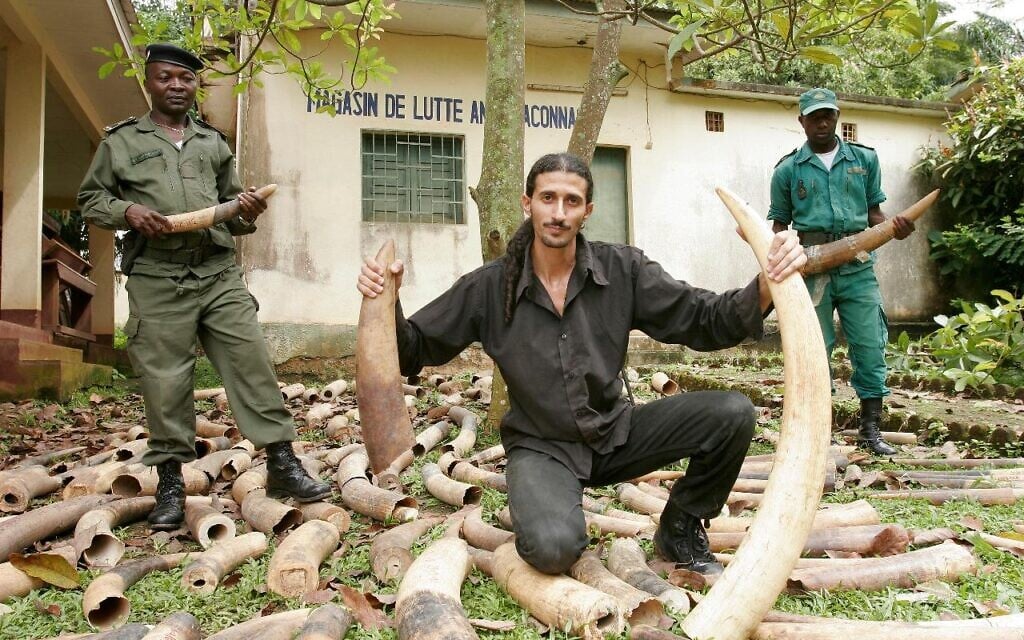
Dismantling three Asian syndicates involved mainly with trafficking elephant parts, but also pangolin scales and rhino horns. Each syndicate had already killed around 30,000 elephants. That’s 10 percent of all the African elephants living today! We’ve also saved many live animals. And we’ve taken down politicians, a colonel, police commissioners, a deputy minister…
Your work must be very dangerous.
Traffickers once kidnapped an investigator, but we rescued him. We’ve had people being shot at. Politicians who were jailed tried to frame me twice by bribing people in the justice system. What stopped them was that I had seven ambassadors and two ministers on my side saying this was clearly revenge.
‘Traffickers once kidnapped an investigator, but we rescued him. We’ve had people being shot at’
Because of my army training, I made security the top priority. I lost two friends during my military service. I know what this does to families. We work like an army, with discipline. We conduct regular drills on multiple contingency plans so that our people know what to do when things get nasty. They must never underestimate the danger.
Ironically, the most serious injury you’ve endured was from a crocodile.
Yes, in late 2013, on the Omo River in Ethiopia. I was evacuated to Israel in a bad state. When I recovered, I moved to Kenya.
Given the dangers, what kind of people agree to work for you?
Our interviews are not about skills, which I can teach. I look for people with a fighting spirit, a moral backbone and a commitment to doing something for the world rather than making money. This isn’t a job or a career path. We have 80 people working in seven countries. There’s an elite team in each place. That’s also an Israeli thing. It’s lean, with the best of the best.
You are very critical of the big international aid agencies.
These are not businesses, so they can get away with having no accountability. Conservation bodies like to offer workshops and other activities that are not measurable. You donate, and they send you a photo of a smiling child or a sweet animal, often using the same photo for other donors. You have no way of knowing whether your gift is helping to improve the reality on the ground.
How do you measure your impact?
We can’t measure our impact on world trade, but when I intercept a container carrying 300 elephant tusks, I know I’ve saved the lives of another 300 elephants. When I arrest a trafficker and dismantle the operation, I know what I’m neutralizing. When you put a senior official in jail, it makes news. It shows all the rest that greed is no longer unchecked, that there are consequences.
Sadly, every trafficker we arrest is part of an exponentially growing business because the margins are so high if you get away with it.
What is your budget?
With changes in the priorities of the US and European governments and foundations, our funding has been severely cut. We need $400,000 just to keep going.
How do you remain optimistic?
I see more animal bodies than live ones, but I know I’m doing something about it, and that gives me meaning in life.
Where is Future the chimp today?
He’s an alpha male in a sanctuary in Cameroon, in a group that will be returned to the wild.
View original source — Times of Israel ↗
Related stories

The Punch
WorldJul 18, 2026 · 1 min
Fuel imports surged by 207% in June — NMDPRA report
The Punch

Philippine Daily Inquirer
WorldJul 18, 2026 · 1 min
PCG joins US, Mexican forces in maritime security drills at Rimpac 2026
Philippine Daily Inquirer

TASS
WorldJul 18, 2026 · 1 min
IRGC forces strike US fuel terminal in Kuwait — agency
TASS

Indian Express
WorldJul 18, 2026 · 1 min
Punjab police officer arrested in FBI-linked extortion case tied to gangster probe
Indian Express