VnExpress
South Korea's top resort island fights over letting Chinese tourists drive
A senior Jeju official's suggestion to let Chinese tourists drive rental cars has revived a decade-old safety debate on South Korea's busiest resort island and forced the provincial government to walk it back within days.
The idea surfaced on July 2 at the first expanded senior officials' meeting of Jeju's new administration, which took office July 1 under Governor Wi Seong-gon.
Asked how the island could lift tourist spending, Administrative Vice Governor Park Cheon-su pointed to the rental-car rules that keep Chinese visitors off the road, Munhwa Ilbo reported.
"A large portion of independent foreign travelers are Chinese, but they cannot use rental cars at the moment," Park said, in remarks quoted by The Korea Times. "If necessary, we could consider providing several hours of driving training in a short period so they can drive, as part of easing regulations."
The meeting was streamed live for the first time, and the remark spread within hours, Yonhap News reported.
Residents online asked who would be liable in a crash, and whether an island already strained by heavy traffic could absorb foreign drivers unfamiliar with Korean roads.
Rental cars cause a bigger share of accidents on Jeju than anywhere else in South Korea. They were involved in 2,414 crashes between 2021 and 2025, killing 26 people and injuring 4,032, Seoul Shinmun reported, citing Jeju Self-Governing Police data released in May.
At 11.4% of all local accidents, Jeju is the only regional government in the country where rental cars reach double digits.
Drivers in their 20s were the largest group in last year's rental-car crashes, at 23.6%, according to The Korea Herald.
After a run of rollovers and head-on collisions involving young and drunk drivers, Jeju police named May and June special enforcement months and tightened rental checks on high-risk drivers, Seoul Economic Daily reported.
The provincial government retreated on July 4, calling the idea "not a reviewed or decided policy," according to The Digital Times.
Allowing short-term visitors to drive would require international agreements, revisions to national law and consultation with the central government, so Jeju cannot act alone, the province said.
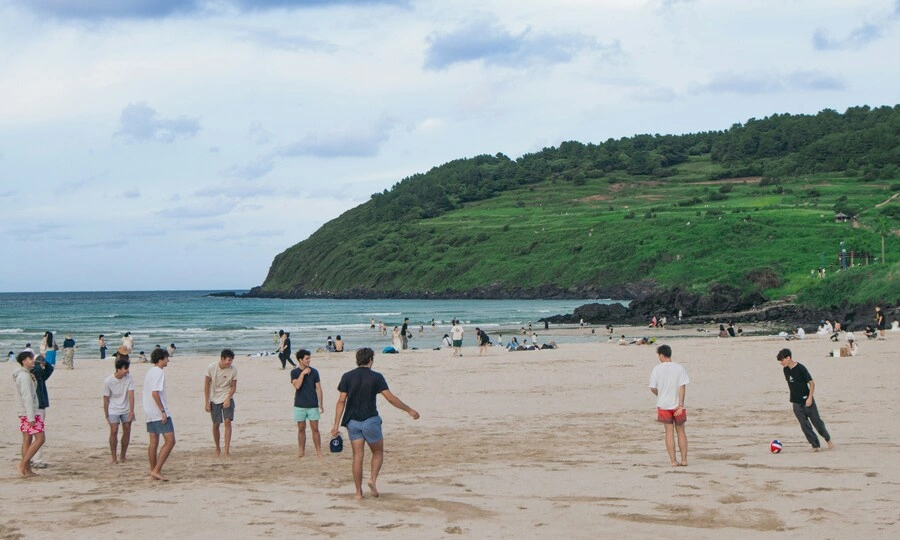
Tourists on Hamdeok Beach, Jeju Island, South Korea. Photo by Unsplash
Jeju is South Korea's most-visited holiday island, a volcanic destination that draws around 13 million tourists a year, Kookmin Ilbo reported.
The air corridor linking it to Seoul ranked as the world's busiest passenger route in 2025, with 14.4 million seats scheduled across seven carriers, according to aviation data firm OAG.
Chinese travelers are the largest bloc of foreign visitors, yet the law keeps them out of the driver's seat. China has not signed the Geneva Convention on Road Traffic, so neither Chinese licenses nor international permits issued in China are recognized in South Korea.
Chinese visitors must earn a Korean license to rent a car. South Korean tourists, by contrast, can secure temporary permits to drive in China, an imbalance supporters of change say Jeju should no longer accept.
Jeju first tried to loosen the rules in 2014, as Chinese arrivals surged, Yonhap News reported.
Its proposed exception under the Jeju Special Act would have let short-staying Chinese nationals obtain a 90-day local permit after identity checks, a written test and safety training.
The measure cleared a Cabinet meeting on Nov. 18, 2014, then was stripped on April 28, 2015, in a National Assembly committee over thin insurance provisions and safety concerns.
Seoul and Beijing opened talks in October 2019 on mutually recognizing each other's licenses, but the effort collapsed during the pandemic, Munhwa Ilbo reported.
At the Jeju Forum in May 2024, Kim Ui-geun, a professor at Jeju International University and then head of the Jeju Tourism Society, urged the island to reopen the question.
In October 2025, the National Police Agency told lawmakers it was studying a model that would recognize Chinese licenses if holders declared them on arrival and obtained a temporary driving certificate, Yonhap News reported.
Moon Sung-jong, a tourism policy professor at Jeju Halla University, cautioned against dropping the debate.
"It's time to discuss this seriously," he told The Korea Times. "Opening immediately without any preparation would be hasty."
He laid out a phased path, starting with better public transport, visitor education on local road conditions, a public consensus and clearer rules.
"In the long term, allowing Chinese tourists to drive rental cars on Jeju will be difficult to avoid," he said. "We need to prepare thoroughly and approach the issue step by step."
View original source — VnExpress ↗
Related stories

The Punch
WorldJul 18, 2026 · 1 min
UK warns young travellers against accepting ‘free holidays’ from drug gangs
The Punch
The Punch
WorldJul 18, 2026 · 1 min
Outcry as Imo pupils sit for examinations in darkness after delays
The Punch

Antara News
WorldJul 18, 2026 · 1 min
East Java has highest number of Sekolah Rakyat schools: Governor
Antara News

Mexico News Daily
WorldJul 18, 2026 · 1 min
Postcards from Mexico: On the Paseo de Montejo in Mérida
Mexico News Daily