Ars Technica
Police tout using drone to disarm incapacitated person in “nationwide first”
Skip to content
Drone-jutsu
Promo video comes as more US police departments fly drones as first responders.
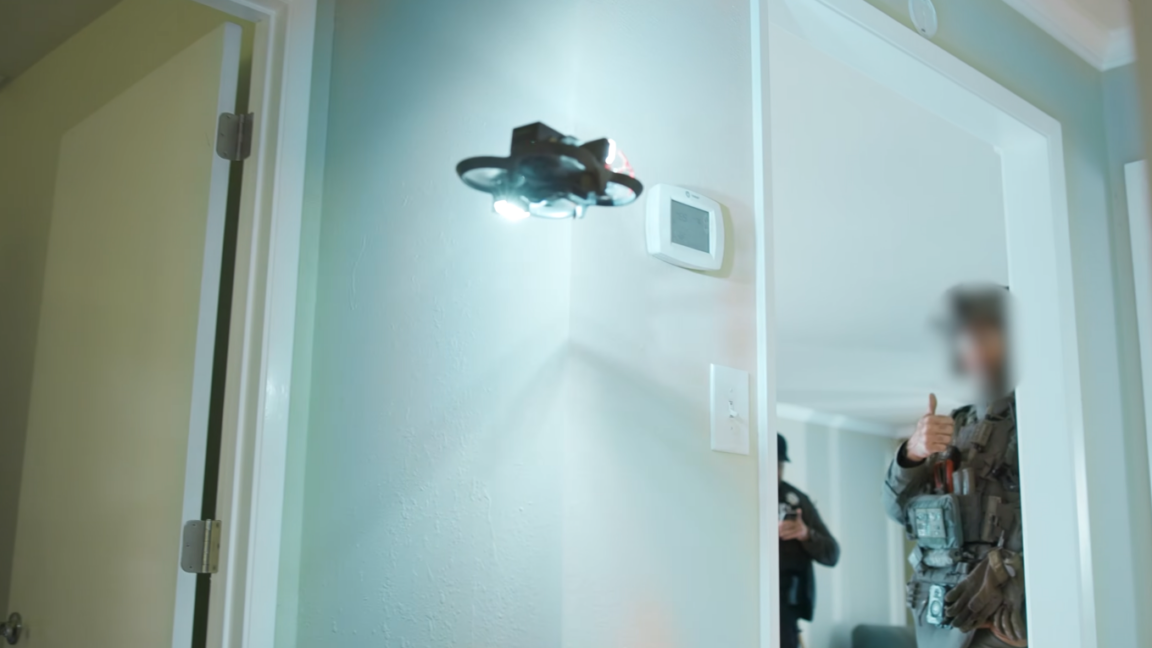
In a supposed “nationwide first” use of drones to disarm a person, the Sacramento County Sheriff’s Office in California promoted a video showing how a small quadcopter drone used a dangling magnet to remove a knife from the hand of a motionless suspect.
The promotional video shared to Facebook and Instagram on June 22, 2026, uses the Mission: Impossible film franchise theme to dramatize video footage of the incident that took place earlier in the month, which involved what the video describes as a “felony suspect armed with a knife and a firearm” who “was not responding to negotiators.” The sheriff’s office is just one among hundreds of US police departments and sheriff’s offices that have deployed camera-equipped drones to assist first responders.
In a Facebook post, the Sacramento County Sheriff’s Office described having surrounded the suspect’s residence with a SWAT team after the “known felon and parolee-at-large was seen earlier with a firearm.” A first drone deployed to the scene located the suspect hiding in a corner of the garage, but also spotted the motionless suspect holding a knife in one outstretched arm.
Piloted by an officer wearing a drone operator’s first-person view goggles, a second small drone equipped with a magnet on a cable flew into the garage. The video shows the motionless suspect in a gray hoodie lying facedown on a chair or sofa while still clutching the knife.
The drone then used the dangling magnet to grab the knife by the blade and pull it free from the apparently unresisting suspect’s hand. A final shot from the video shows the drone flying outside with the dangling knife spinning freely beneath it, enabling police officers to retrieve the drone. Some of the action in the video is also captured from the camera perspective of the first observer drone.
It is unclear what happened to the gun that the suspect supposedly possessed at one point.
The sheriff’s office praised the “incredible display of creativity, skill and precision by the drone pilot” in its Facebook post. But several comments on the sheriff’s office Facebook post alluded to the fact that the suspect was not actively moving, including a popular comment from Vic Moss, CEO and cofounder of the Drone Service Providers Alliance, a drone industry trade association based in Lakewood, Colorado.
“The dude was comatose,” Moss wrote in the Facebook comment. “You could’ve disarmed him with a marshmallow. But congrats on good use of the drone.”
In an interview with The Hill on NewsNation, Jim Cooper, head of the Sacramento County Sheriff’s Office, said the suspect “may have overdosed” after initially responding to law enforcement. But he praised a patrol officer for coming up with the magnet idea and said it “possibly saved someone’s life, preventing us from taking a life.”
Such opportunities to safely disarm an armed suspect using a drone may still be rare as long as the person is fully conscious. In an October 2025 incident, a man armed with a rifle shot down one of the drones operated by the Sacramento County Sheriff’s Office before officers negotiated his surrender.
Rise of drones as first responders
The main law enforcement use of drones is still geared toward scouting for situational awareness and overhead surveillance. Cooper told The Hill that his officers use drones “all the time to fly into houses, through a garage door, doggy doors.” The sheriff’s office has previously shared other promotional videos featuring drones, including a video about one of the drone operators on its SCOUT (Sheriff’s Craft Observation, Utilizing Technology) team posted on March 5, 2026.
The Electronic Frontier Foundation’s Atlas of Surveillance database lists more than 1,800 police departments and sheriff’s offices as having operated drones in the United States. The nonprofit organization also highlighted a notable rise in US law enforcement adopting “drone as first responder” programs in 2025, with tech and drone companies teaming up to sell law enforcement on drones with enhanced surveillance capabilities.
Such companies pitching drone surveillance systems tailored for law enforcement include Flock Safety, Axon and Skydio, and Brinc and Motorola Solutions. For example, Flock’s drones carry the company’s automated license plate readers.
“Flying cameras are bad enough,” wrote Beryl Lipton, a senior investigative researcher at the Electronic Frontier Foundation, in reference to the drone-as-first-responder programs. “They can see and record footage from a special vantage point, capturing video of your home, your backyard, and your movements that should require clear policies around retention, audits, and use, including when the cameras shouldn’t be recording.”
The Sacramento County Sheriff’s Office listed 18 drones in its inventory for its 2025 annual report, including commercial multirotor drones made by Chinese drone manufacturers DJI and Autel, along with a single fixed-wing drone from the Ohio-based company Event 38 capable of vertical takeoffs and landings.
In September 2025, Sacramento County supervisors unanimously approved the purchase of another 27 drones for the sheriff’s office with a starting price of $5,000 per drone, according to the KCRA 3 TV station. The drone purchases came as part of a larger $1 million package for the sheriff’s office that also included a robot and a Bearcat armored vehicle, along with other military-style equipment.
Jeremy Hsu is a reporter exploring a wide range of topics across deep tech and AI. He has previously written for New Scientist, Scientific American, IEEE Spectrum, Wired, Undark Magazine and MIT Tech Review, among many other publications, about topics such as deepfakes, data centers, drones, battery tech, robotics, and GPS jamming. He also has a Master of Arts in Journalism from NYU, and a bachelor's degree from University of Pennsylvania in History and Sociology of Science, with a minor in English.
30 Comments
View original source — Ars Technica ↗
Related stories

The Punch
TechnologyJun 23, 2026 · 1 min
Instagram suffers global outage, users report login, server errors
The Punch

TechCrunch
TechnologyJun 23, 2026 · 1 min
Superhuman acquires AI detection startup GPTZero
TechCrunch

ZDNet
TechnologyJun 23, 2026 · 1 min
My favorite color e-reader is at the lowest price I've ever seen it for Prime Day
ZDNet

The Guardian
TechnologyJun 23, 2026 · 1 min
Morning Mail: bird flu risk to 150 native species, France roasts in heatwave, Ronaldo record
The Guardian