Indian Express
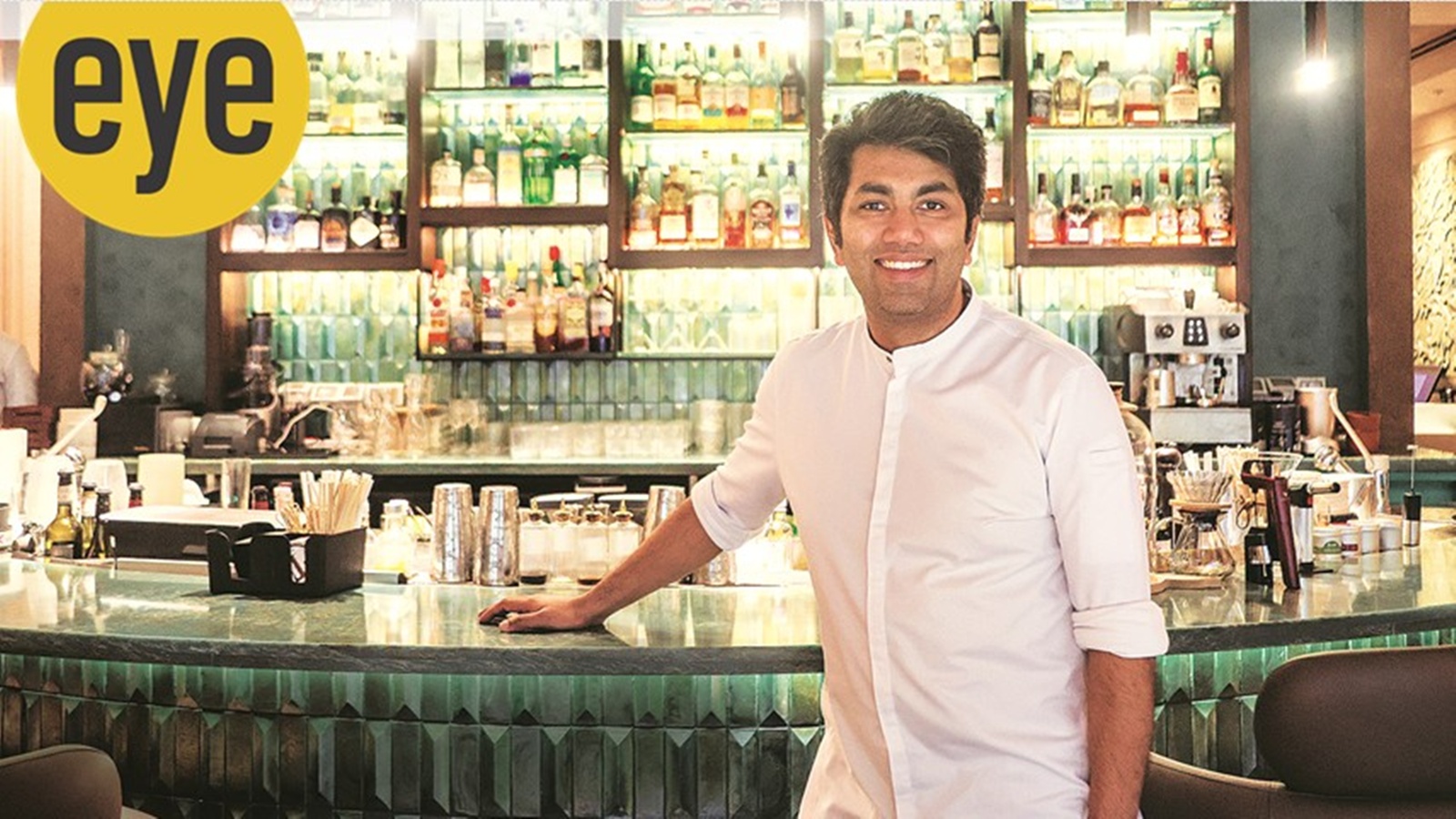
From old Delhi to three Michelin stars: The journey of chef Himanshu Saini
This has not been a 100-ft journey,” said chef Himanshu Saini, when Trèsind Studio (Dubai) won three-Michelin Stars last year, becoming the first Indian restaurant in the world to do so. “It has been a marathon for many years.” He means it in every sense. The restaurant took seven years to find its footing. The chef took longer.
Saini grew up in Sui Walan galli, a neighbourhood in old Delhi, in a joint family home of around 50 people — 20 rooms across three floors, a courtyard at the centre, and a store room large enough to hold the copious quantities of food. Everything was made from scratch: spices ground at home, wheat cleaned, peas shelled, papads and pickles. “The whole conversation in the house revolved around food. What are we eating next?,” he recalls, sitting at Trèsind Mumbai recently where he had come for a pop-up with Chef Manish Mehrotra and Chef Sarfaraz Ahmed.
Saini, who lives in Dubai, admits that he became a chef because he loved to eat. The cooking came later, and initially from necessity. “You are 10. You don’t have money. You are hungry. What do you do? You make something for yourself,” he says, recalling how he would buy a ready-made pizza base for Rs 10, put some sauce, veggies, cheese and made himself a meal. “Or find aloo gobhi, add some spices, sauces and turned it into a sandwich,” he adds.
Saini wasn’t academically inclined, being a chef, he admits, was his destiny. His first interview was with Old World Hospitality in Delhi, after his graduation. “As a trainee, I had to spend a month each at their 18 restaurants. Sometime in the third month, I was working at a largely empty restaurant at the Manor Hotel when chef Manish Mehrotra came from London in 2008, to do trials for what would become Indian Accent. Mehrotra left, came back two months later, and asked for the same team. “If I had been in any other kitchen at that moment, my life would have been completely different,” he says.
Saini stayed there for five years; it transformed him. Mehrotra used umeboshi and soy sauce alongside Indian spices, treated the cuisine not as a fixed thing but as a living one. “He introduced such an extraordinary inventory of ingredients.” The influence ran deep — when Saini later went to open the Masala Library followed by Farzi Café, the Indian Accent imprint on his cooking was visible, and he took some criticism for it. “But it was the only kitchen I had trained in. That was what I had,” he says.
Initially, Saini refused to join the Tresind. New York was the dream of every chef, and Saini was all set to leave for it when he received a call from Bhupendra Nath, founder of Passion F&B. He initially refused but two months later, he reached out to Nath and joined Trèsind just 12 days before its grand launch was announced in Dubai. He walked in, changed the entire menu, and never looked elsewhere. The year was 2014.
Trèsind Studio came four years later, and born out of a specific frustration. Their initial menu, he says, was ambitious and a bit stupid. “It was an Indian menu structured on the skeleton of a French classical tasting menu. It drew regulars and then they stopped returning,” he says. “In a large restaurant, even a great dish doesn’t get the respect it deserves when it’s one of 50. Servers sell what they like and understand — if they don’t connect with a dish, they won’t push it. If it doesn’t move fast, it sits in the kitchen losing freshness, losing the care it was given in the trial. You do a trial in controlled conditions, you make the dish with complete focus, you eat it immediately — and it’s extraordinary. In an à-la-carte kitchen cooking 100 orders, that dish has a completely different value,” he says.
Story continues below this ad
Then, they changed the menu every three months and with each new menu they changed the look of the restaurant entirely — painting walls themselves and rethinking the palette.
But Covid hit. The Studio shut, and reopened with a street food concept at Dhirams 200. To his surprise, that worked. “It was the most affordable, the least technical, the most comforting. We built upward from there,” he says.
The chef in the restaurant kitchen (Akash Patil)
The real turning point came with a collaboration. As Dubai reopened ahead of the rest of the world, post pandemic, Saini reached out to Ana Roš, among the most sought-after chefs in the world. She came for a two-day pop-up (at Trèsind Studio Dubai) and stayed for a week.
Until then, Saini had been using luxury ingredients — caviar, truffle, wagyu — partly because the market seemed to require them. What Roš changed was his perspective. “I was making a strawberry chutney — I started with kalonji and fennel seeds, put in star anise, did a tadka, then the strawberries — and she was fascinated because the way we use truffle and caviar is how they use our spices,” he says. The realisation that followed was simple but consequential: The strength lay in what he already knew. “That was the first moment where we said: Let’s go back, restrain ourselves, challenge ourselves and make our life a bit more difficult than using ingredients that are merely handy.”
Story continues below this ad
The second turning point came in 2022. Now holding his first Michelin star, Saini was invited to speak at a food festival in Croatia. There were three rooms — a 500-seat auditorium, a medium one, and a small 50-seat room where he was placed. Ten people showed up. Midway through his presentation on modern Indian food, he stopped and asked those 10 people to name five Indian dishes. They could not name one. Not even butter chicken. On the flight back, Saini kept turning over one question: What was the point of calling the food modern or progressive when people had no foundation for understanding Indian food at all?
The answer to his question became Rising India — a menu of 15 dishes built around five macro regions: the Northern Plains, the Himalayan Mountains, the Deccan Plateau, the Coastal Plains, the Thar Desert — which was part of the pop-up in Mumbai.
A 3D map of India on canvas comes to the table at the start of the meal. The host explains the structure, returns with each new region, and speaks only about what’s relevant to the dishes coming next. A physical tablescape stays on the table through each section — for the Himalayas, actual rocks, arranged carefully, lasting two courses.
“Guests leave having understood something: why Thar Desert food is built around dairy? Because of water scarcity. Why is Chettinad so spicy? Because the body needs to sweat in extreme heat,” he says, adding that he is careful about not giving them a geography lesson but understanding the cuisine. “Then they go to another Indian restaurant with more open eyes. They understand why there is coconut milk. They know that the souring agent changes: vinegar in Goa, kokum in Maharashtra, raw mango on the Andhra side.”
Story continues below this ad
Before leaving we ask if he could say anything to that young boy making pizza from a ready-made base, he smiles before saying: “Trust your destiny, work hard. When I was in college, people used to say work smart, not hard. I always said the opposite. Smartness takes you ahead in the short term. Hard work takes you forever.”
View original source — Indian Express ↗
Related stories

The Punch
WorldJul 4, 2026 · 1 min
Iran’s supreme leader Khamenei’s funeral ceremonies begin
The Punch
Antara News
WorldJul 4, 2026 · 1 min
Lampung exports 14 thousand Palm Kernel Expeller to New Zealand
Antara News

Times of India
WorldJul 4, 2026 · 1 min
'Planning wedding for 4 months': Siya Goyal's fiancé Ketan's old video resurfaces
Times of India

Philippine Daily Inquirer
WorldJul 4, 2026 · 1 min
'Moana 3' in the works, says Dwayne Johnson
Philippine Daily Inquirer