Indian Express
Why artist Aban Raza is racing to paint India’s renamed cities before they disappear
Last month, Aban Raza was in Landour. The month before that in Aurangabad. Or was it last year? She can’t recall the exact timeline. There were also Faizabad and Allahabad. Between the constant travelling and painting, the last few years have become a blur. The only thing she is certain of is her next destination: Mughal Sarai.
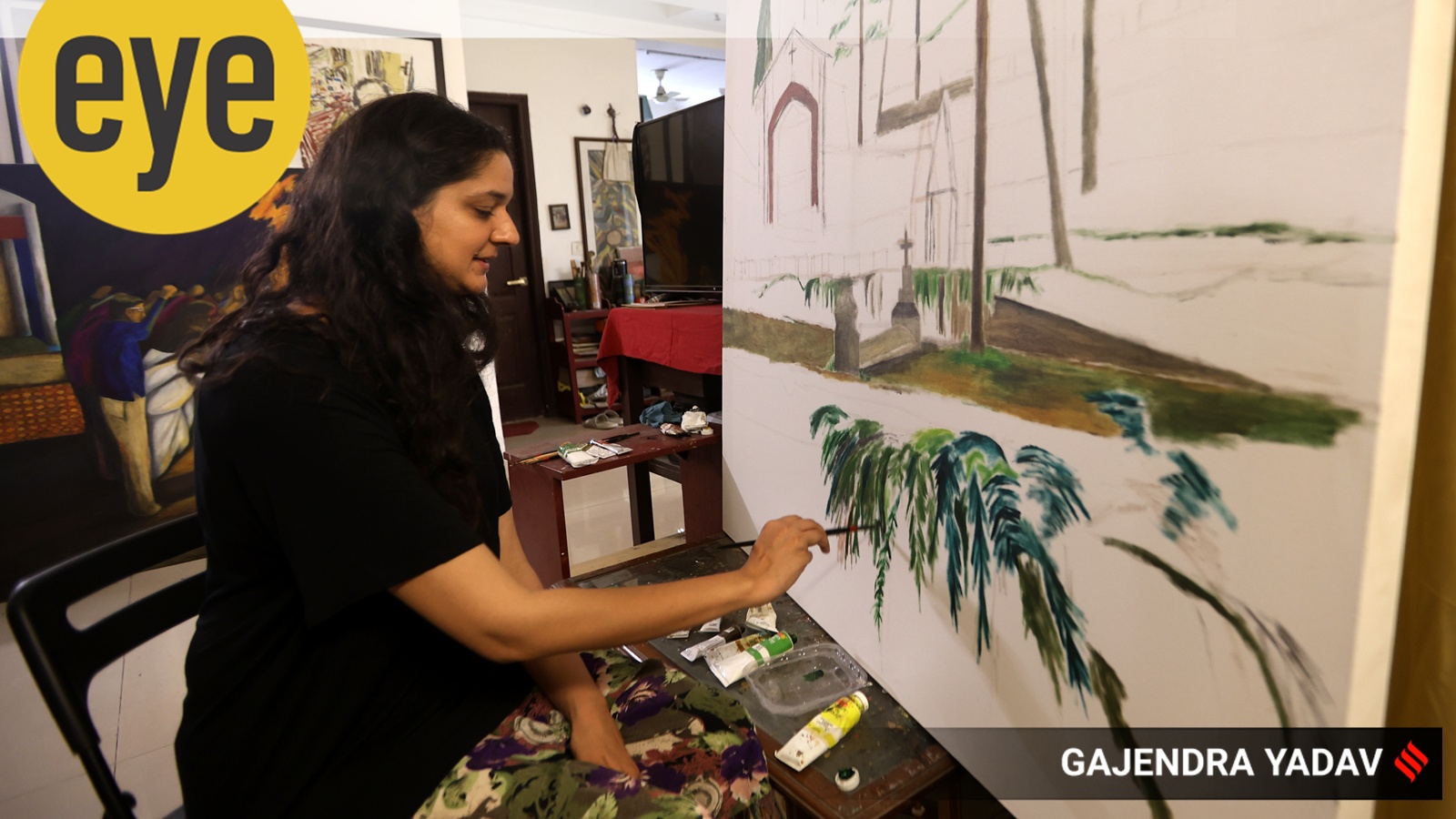
“These are places that have, or are proposed to have, been renamed,” says Raza, about her ongoing yet-to-be-titled series, prompted by an urge to document the “slow erasure” of India’s history.
Mughal Sarai became Pandit Deen Dayal Upadhyaya Nagar. Aurangabad, Chhatrapati Sambhajinagar. Faizabad, Ayodhya, and Allahabad, Prayagraj. More names — Hyderabad, Hoshangabad — in faded ink and pinned on a board give away that she has been thinking about this revisionism well before she put brush to canvas in 2023.
She began with landmarks in Delhi — the Mughal Gardens and Aurangzeb Road. But the lead up to her solo exhibition last year, ‘Nothing Alien is Human to Me’, that documented protest sites and the people who lead them, put a brief pause in the series that resumed only in early 2025.
“After ‘Chhaava’ released, right-wing bodies wanted to break Aurangzeb’s tomb in Aurangabad,” recalls the artist. She was in Delhi at the time and rushed to the site afraid it may be lost forever. “Thankfully, they couldn’t enter since it is an ASI site,” she says, adding that painting Aurangabad was more about preserving the place but the incident did give her series a new lease of life.
Aban Raza’s work depicting the Mahad Satyagraha anniversary (Gajendra Yadav)
In her Noida home-cum-studio, she is flanked by a towering canvas — sketched on but barely painted, with only a few green strokes. “This is Landour,” she says. “It has been proposed to be renamed as Ramgir. The other instances seemed like communal decisions, but Landour shows their problem with all things British as well. Good, bad or ugly, all of this is part of our civilisational history, and I feel the need to document these places before they cease to exist as we know them,” adds the artist, whose oil paintings are priced upwards of Rs 2.5 lakh.
There is a conspicuous urgency about Raza’s work in the way it chronicles contemporary India with the abstract distortion of German Expressionism. But what draws the viewer in is the fact that it’s the artist that drives the art, not the other way round; a rarity in an increasingly commercialised art world. Raza’s voice, ideology and personality are all palpable in her work, much of which has been shaped by her early exposure to and subsequent work with the Safdar Hashmi Memorial Trust, which included visiting protest sites since the age of three.
A recently finished oil painting that sits in her living room, is proof. On the large-scale canvas, she recreates the annual celebration of the Mahad Satyagraha — BR Ambedkar burnt the Manusmriti in Maharashtra’s Mahad in 1927. “I don’t know where or when it will be exhibited but I witnessed the moment last December and knew I had to paint it. I am quite proud of this work,” she says.
A painting of Aurangzeb’s tomb in Aurangabad, Maharashtra, by Aban Raza
Raza’s clarity of purpose is also evident in her career progression. She graduated in 2013 after a BFA (Painting) and an MFA (Printmaking), both from Delhi’s College of Art, but she secured representation with Galerie Mirchandani + Steinruecke, and her first solo, ‘Luggage, People and a Little Space’ only in 2020.
Even as she dabbled in teaching, filmmaking and research work to pay the bills, she never felt tempted to try a trans-disciplinary installation practice that dominates the contemporary Indian art scene. She admits wanting to work with printmaking more often but that’s about it. Oil and printmaking — that she is certain of.
View original source — Indian Express ↗
Related stories

The Punch
WorldJul 4, 2026 · 1 min
Iran’s supreme leader Khamenei’s funeral ceremonies begin
The Punch

VnExpress
WorldJul 4, 2026 · 1 min
Hanoi student wins places at China's most elite universities Tsinghua, Peking, and Fudan
VnExpress

Philippine Daily Inquirer
WorldJul 4, 2026 · 1 min
Decomposing bodies of elderly couple found in Bukidnon home
Philippine Daily Inquirer
Antara News
WorldJul 4, 2026 · 1 min
Lampung exports 14 thousand Palm Kernel Expeller to New Zealand
Antara News