Indian Express
Humblebrag! Out of Station is now Oxford English—pass the nihari
4 min readUpdated: Jul 8, 2026 05:52 PM IST
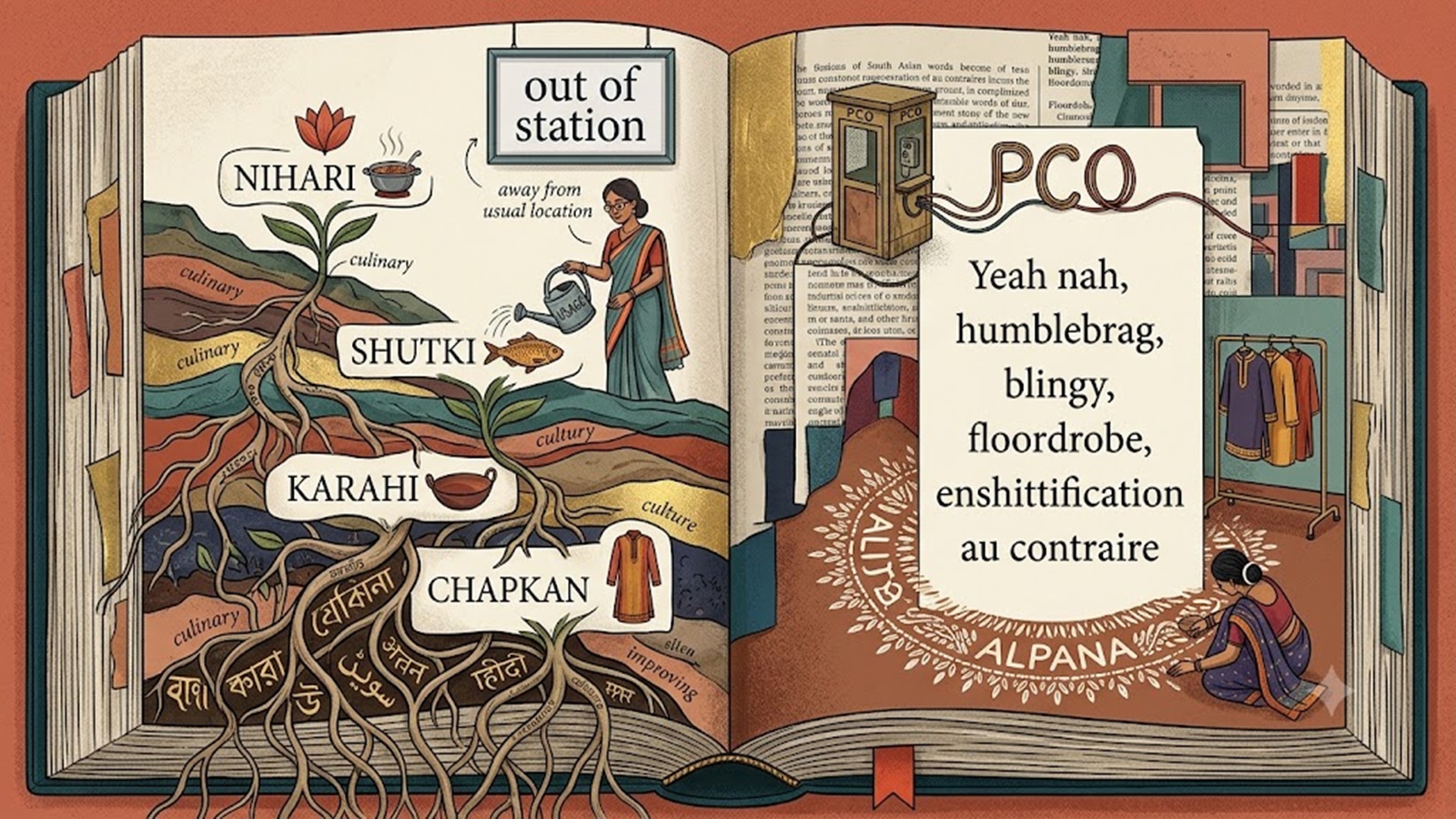
Of 900 new entries to the Oxford English Dictionary this quarter, 13 are from South Asia. (Generated using AI)
‘Yeah nah’, not to ‘humblebrag’ but the Oxford English Dictionary has added a clutch of words from South Asia, which some will agree have made it tastefully ‘blingy’. It has also made an effort to clear its proverbial ‘floordrobe’, a bulwark against ‘enshittification,’ and reviewed older entries from the Indian subcontinent. So, next time your teacher snaps at you for using the Indianism ‘out of station,’ refer her to the OED, and tell her just as ‘au contraire’ is no longer just French, the phrase is also now proper English.
Of the 13 entries from South Asia, some like nihari and alpana, are borrowed from the many languages and cultures of the region, while others are English words that have been bastardised much like ‘out of station’ (“away from one’s usual location”) from outstation, and are largely unknown in the rest of the world.
Australia (15) Canada (6) Scotland (9) South Asia (10) World (13)
Slang built on wit, understatement, and a healthy disregard for taking things too seriously.
AUOED
Donkey vote
Originally a bonus vote for property owners (historical); now a lazy, sequential ballot vote.
AUOED
Branch stacking
Recruiting fake members to rig internal party votes.
AUOED
Flannie
A flannel shirt.
AUOED
Scungies
Old, worn-out clothes (dated); also swim briefs or underwear.
AUOED
Curly one
A tricky question or situation.
AUOED
Flog
Once an overly studious person; now a contemptible person.
AUOED
Checkout chick
A female supermarket cashier.
AUOED
Dishlicker
A racing greyhound.
AUOED
Grey nomad
A retiree who travels the country by camper van.
AUOED
Love job
An unpaid favour or task done out of goodwill.
AUOED
Snot block
A vanilla slice pastry.
AUOED
Kafoops
A placeholder name for someone whose name you've forgotten.
AUOED
Doover
A thingamajig, whatchamacallit.
AUOED
Horse doovers
A jokey phonetic spelling of "hors d'oeuvres."
AUOED
Yeah nah
A vague agreement-slash-disagreement — "yes, but…"
Curling culture, Indigenous-language influence, and everyday practicality.
CAOED
Elbows up
Being ready to defend oneself or fight back.
CAOED
Cashspiel
A curling tournament with a cash prize.
CAOED
Grunt
A stewed-fruit dessert topped with dough.
CAOED
Kitty-corner
Diagonally opposite.
CAOED
Point form
Bullet-point list format.
CAOED
Kokum
Grandmother, from Cree.
Rich, textured dialect words — some tender, some blunt.
SCOED
Take the crow road
To die, or be near death.
SCOED
Chippy sauce
A condiment served in fish-and-chip shops.
SCOED
Rowie
A flat, flaky bread roll from Aberdeenshire.
SCOED
Toorie
A round woollen or cloth cap with a bobble; also the bobble itself.
SCOED
Gowp
Of the heart or blood, to pulse rapidly; of a wound, to throb painfully.
SCOED
Loup
An older term for the heart beating or blood pulsating.
SCOED
Scaffie
Shabby, scruffy.
SCOED
Scrunted
Stunted or shrivelled (of a plant); short in stature (of a person).
SCOED
Stowed / stowed out
Crowded, packed full.
Loan words from Urdu, Bengali, Persian, and Punjabi — chiefly from Pakistan and Bangladesh English.
SAOED
Nazim
From Urdu and Persian, ultimately Arabic for "one who arranges." Named a Mughal provincial governor; since 2000, the elected head of a union or village council in Pakistan.
SAOED
Chapkan
Borrowed into Pakistani English from Urdu and Persian, probably via a Turkic root. A long, close-fitting coat buttoned at the front, worn especially in North India and Pakistan.
SAOED
Nihari
From Panjabi nihārī ("breakfast"), via Persian. A dish of meat, especially beef and mutton, slow-cooked in a spicy stew, now especially associated with Pakistan.
SAOED
Affectee
A person affected or harmed by a particular action, course of events, or set of circumstances (chiefly Pakistani English).
SAOED
Public call office
A public payphone (Indian and Pakistani English).
SAOED
Alpana
A stylized, geometric design painted in rice-flour pigments on a floor, used to decorate for Bengali holy days and festivals.
SAOED
Shutki
Dried fish used in Bengali cooking.
SAOED
Upazila
One of the areas that a district in Bangladesh is divided into for administrative purposes.
SAOED
Karahi
A bowl-shaped cooking pot with two handles used in South Asian cuisine; also a tomato-based curry cooked in one.
SAOED
Out of station
Once described ships out of a designated area; now used in South Asian, East African, and West African English for a person away from their usual location.
Words that belong to no single country anymore — internet culture and modern life made them universal.
WOOED
Fiending
An intense craving.
WOOED
Blingy
Shiny or flashy with jewels.
WOOED
Floordrobe
A pile of clothes on the floor, standing in for a wardrobe.
WOOED
Long game
A long-term strategy.
WOOED
Life hack
A clever shortcut or tip.
WOOED
Humblebrag
Bragging disguised as modesty.
WOOED
Enshittification
The gradual quality decline of online platforms or products.
WOOED
Jerry-rig
A hastily improvised fix.
WOOED
Bucket of bolts
An old, rundown vehicle.
WOOED
Au contraire
"On the contrary."
WOOED
Folksonomy
A user-generated tagging or classification system.
WOOED
Joggering
Busking, or street performing.
WOOED
Four-legged friend
An affectionate term for an animal companion.
Food and cooking: Three of the words incorporated from South Asia have to do with food and cooking. This includes the dish nihari (red meat slow-cooked in a spicy stew) and shutki (a Bengali dried fish). The karahi, “a bowl-shaped cooking pot with two handles,” which might be used to prepare the said dishes has also been included.
Dress: Two traditional robes, usually worn by men, have also found mention. They are are the chapan, a long loose open robe worn as an overcoat, which does not have a collar, and chapkan, a “long, close-fitting coat buttoned at the front.”
Administration From Bangladesh, the OED takes upazila, a district sub-division, and Nazim comes from the Mughal era, referring to the governor of a province who was responsible for military and judicial affairs.
Picked up from Pakistan, ‘affectee’ has been floating around since at least 1939. It defines “a person affected or harmed as a consequence of a particular action, course of events, set of circumstances, etc.” An example in a sentence would be: The landslide affectees were paid a compensation of Rs 50,000.
Then there is a public call office, the full form of the once ubiquitous PCO, a public payphone booth that anybody who grew up in India and Pakistan before mobile phones will remember.
Story continues below this ad
Art: Borrowed from Bengali folk art comes the word alpana, a “geometric design” painted on the floor on an auspicious occasion. The paint is created using rice flour and water.
Other “Englishes”
Not just South Asia, the OED also legitimised words from Australia, Canada and popular culture, such as ‘yeah nah’ a alang popular among Australians and New Zealanders, used as either an acknowledgement, to suggest one is not sure about something or an emphatic no, ‘elbows up’, a term that comes from Canadian ice hockey, but was co-opted by Canadian Prime Minister Mark Carney during election to indicate his aggressively defensive stance towards US tariffs, and humblebrag (an self-deprecating statement made to draw attention to an achievement), floordrobe (a heap of clothes on the floor), life hack, long game, folksonomy (tagging system in fan forums), and finally at last, the French word au contraire was declared English.
These updates validate Chinese-American author R F Kuang’s assertion in her 2022 novel Babel that English–the global lingua franca–was a “Frankenstein vernacular” stitched together with loanwords from around the world. The cache from India and the larger South Asian sub-continent famously included words such as pakka, bungalow, loot, pajamas, juggernaut and karma, and subsequent reviews have further enriched the language, ensuring that people from around the world, be it Dhaka, Toronto, Sydney, Manipur, Scotland, and even parts of the ever-evolving internet can actually understand each other, and not descend to actual babel.
© IE Online Media Services Pvt Ltd
Aishwarya Khosla is a senior editorial figure at The Indian Express, where she spearheads the digital strategy and execution for the Books & Literature and Puzzles & Games sections. With over eight years of experience in high-stakes journalism, Aishwarya specializes in literary criticism, cultural commentary, and long-form features that explore the complex intersection of identity, politics, and social change.
Aishwarya’s analytical depth is anchored by her prestigious Nehru Fellowship in Politics and Elections. This intensive research fellowship in policy analysis and political communications informs her nuanced approach to cultural journalism, allowing her to provide readers with unique insights into how literature and media reflect broader political shifts.
As a trusted voice for the Indian Express audience, she authors the popular newsletters, Meanwhile, Back Home and Books 'n' Bits, and hosts the podcast series, Casually Obsessed.
Before her current role, Aishwarya spent several years at Hindustan Times, where she provided dedicated coverage of the Punjabi diaspora, theater, and national politics. Her career is defined by a commitment to intellectual rigor, making her a definitive authority on modern Indian culture and letters.
Areas of Expertise
Literary Criticism, Cultural Politics, Political Strategy, Long-form Investigative Features, and Newsletter Curation.
Write to her
You can reach her at [email protected] or [email protected]. You can follow her on Instagram:
@aishwarya.khosla, and X: @KhoslaAishwarya.
Her stories can be read here. ... Read More
Tags:
books
english
Oxford Dictionary
reading
View original source — Indian Express ↗
Related stories

The Punch
WorldJul 8, 2026 · 1 min
Delta gov donates operational vehicles to Nigerian Correctional Service
The Punch
The Punch
WorldJul 8, 2026 · 1 min
Police arrest father, son with four firearms in Bayelsa
The Punch

Antara News
WorldJul 8, 2026 · 1 min
RI high-level delegation departs Thursday for Khamenei's funeral
Antara News

Portugal Resident
WorldJul 8, 2026 · 1 min
Free Tejo wine tastings return to Portugal’s beaches this summer
Portugal Resident