Philippine Daily Inquirer
Teodoro bats for stronger deterrence, bigger defense budget
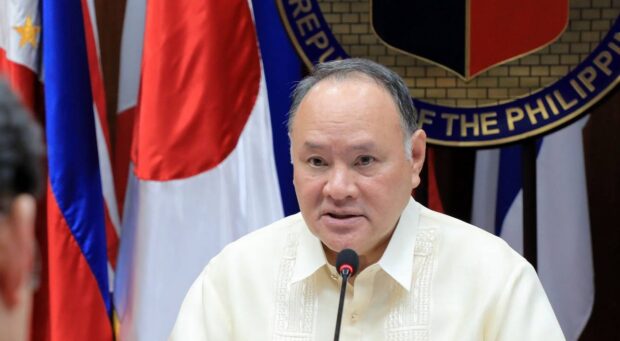
Ten years after the Philippines secured a landmark legal victory in the South China Sea arbitration, Defense Secretary Gilberto Teodoro Jr. said on Saturday that strengthening the country’s defense capabilities remains crucial to protecting its maritime rights.
Teodoro said the Department of National Defense (DND) and the Armed Forces of the Philippines would continue their efforts to uphold the 2016 arbitral award and preserve the country’s territorial integrity amid continuing challenges in the West Philippine Sea, waters within the country’s 370-kilometer exclusive economic zone (EEZ).
He said the DND and the military would continue their “unstinting” struggle to enforce the arbitral ruling while remaining focused on building a “strong, capable, responsive and deterrent defense system,” particularly through the AFP’s Comprehensive Archipelagic Defense Concept, while maintaining gains in internal security.
Article continues after this advertisement
“Without public support this task cannot be achieved,” he said.
FEATURED STORIES
WWW
WWW
WWW
4 percent of GDP
On Friday, Teodoro said he was pushing to raise the country’s defense spending to as much as 4 percent of gross domestic product (GDP), as the country needed to build a stronger military to deter external threats as tensions with China continued.
Speaking to reporters on the sidelines of the Stratbase Institute’s forum to commemorate the 10th anniversary of the landmark July 12, 2016, arbitral award in Makati City, Teodoro said defense spending should gradually increase “to at least 2 to 3 to 4 percent of GDP” to support the country’s military modernization and deterrence efforts. Rogelio Alicor Panao, Inquirer Metrics data scientist and associate professor at the University of the Philippines, said that from 1987 to 2024, the Philippines spent an average of only 1.5 percent of its GDP on the military—extremely modest for an archipelago with well-known geostrategic vulnerabilities.
Congress appropriated P305.87 billion for the DND in 2026.
NATO benchmark
While there is no universally accepted “ideal” level of military spending, the North Atlantic Treaty Organization, or NATO, had set two percent of GDP as a prudent benchmark for maintaining credible defense capability.
Article continues after this advertisement
This puts Philippines still below the suggested military spending threshold.
Panao said that although the country has embarked on modernization efforts in recent years, much of its defense spending continues to support internal security and counterinsurgency rather than external defense.
Article continues after this advertisement
Asked where the government could source the additional funding, Teodoro deferred to the country’s economic managers.
“That is up to somebody else. All I’m saying is we need to increase,” he said. “The basis really is to build our own internal deterrence mechanisms as quickly as possible.”
He added that the Armed Forces of the Philippines would increase patrols not only in the West Philippine Sea but also in the Philippine Rise and the Pacific Ocean.
“Mind you, even in the Pacific Ocean and in the Philippine Rise we need to do that, because once we are remiss in that, then somebody else may claim ownership over it,” he said.
Increasing cooperation
The defense chief said the Philippines should focus on strengthening its own military capabilities even as it expands defense cooperation with allies.
In his statement on Saturday, Teodoro pointed to increasing international cooperation with countries that share the Philippines’ position on international law, saying the partnerships would be based on “fundamental freedoms, transparency, and the rule of law.”
The Philippines has become a “convergence hub” for upholding international law, particularly the 1982 United Nations Convention on the Law of the Sea, he said.
He highlighted growing public awareness of the West Philippine Sea, citing a recent survey that showed 86 percent of Filipinos supported working with like-minded countries to defend the country’s maritime interests.Teodoro said the government would continue efforts to increase public understanding of the West Philippine Sea and strengthen national resolve against attempts to challenge Philippine rights.
Your subscription could not be saved. Please try again.
Your subscription has been successful.
“Ultimately, we will resist and combat any attempt to deny our rights and entitlements in the West Philippine Sea—for these are not only ours to protect, but also those of future generations of Filipinos,” he said. -WITH A REPORT FROM INQUIRER RESEARCH
For comprehensive coverage, in-depth analysis, visit our special page for West Philippine Sea updates. Stay informed with articles, videos, and expert opinions.
View original source — Philippine Daily Inquirer ↗
Related stories
Philippine Daily Inquirer
WorldJul 12, 2026 · 1 min
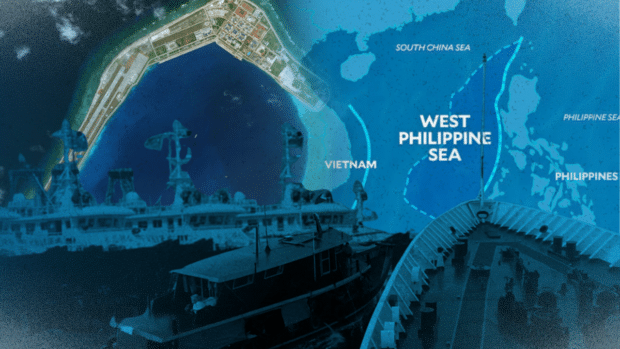
WPS: 14 countries reaffirm ruling vs Beijing's South China Sea claims
Philippine Daily Inquirer
Philippine Daily Inquirer
WorldJul 12, 2026 · 1 min
Habagat to continue bringing rain to Cebu, but expected to weaken
Philippine Daily Inquirer

The Hindu
WorldJul 12, 2026 · 1 min
U.S. military says it is striking Iran in response to attack on civilian vessel in Strait of Hormuz
The Hindu

Philippine Daily Inquirer
WorldJul 12, 2026 · 1 min
Tarlac State University opens doors to first blind students
Philippine Daily Inquirer