Times of Israel
Coordinated anti-Israel propaganda campaign blindsided the West after Oct. 7, author says
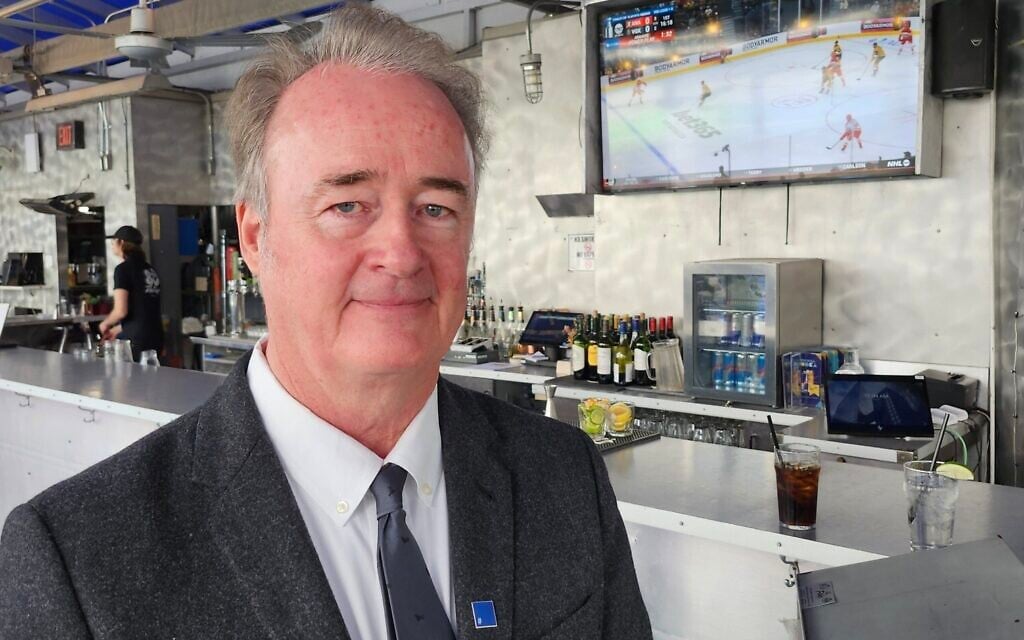
TORONTO — Shortly after the Hamas atrocities of October 7, 2023, Warren Kinsella began noticing what he considered the fingerprints of a professional propaganda campaign.
A Canadian political strategist who has worked for decades in war rooms advising prime ministers and political campaigns in Canada, the United States and Israel, Kinsella makes that case in his new book, “The Hidden Hand: The Information War and the Rise of Antisemitic Propaganda.”
According to Kinsella, Hamas and its networks, along with their Western followers, had thousands of social media accounts primed, protest banners ready, and talking points translated into multiple languages long before the IDF’s response to the carnage had even begun.
Kinsella believes that what may appear to be spontaneous outrage on Western streets and social feeds is, in fact, a coordinated political operation that could only be executed by state actors and professional agitators.
His new book claims Jew-hatred is being mainstreamed by outlaw states and extremist groups who use tools of modern campaigning such as message discipline, cash payouts and logistics training. These actors push slogans like “From the river to the sea” and “Globalize the Intifada” so quickly and uniformly that they cannot be dismissed as organic, Kinsella said.
Get The Times of Israel's Daily Edition
by email and never miss our top stories
By signing up, you agree to the terms
And, he says, Western democracies have barely begun to respond.
“Almost immediately after October 7, I looked around and quickly formed the opinion that what I was seeing was an organized, professional-style political campaign, pushing out this vile, hateful propaganda against Jews, the Jewish state and Western democracy,” Kinsella, a resident of Prince Edward County, Ontario, told The Times of Israel. “I spoke to other political people I know, and they all had the same reaction.”
In October 2023, “there were thousands of protests around the planet using the same slogans,” said Kinsella, who is also a columnist for the Toronto Sun and founder of the Daisy Consulting Group.
That, to Kinsella, was either “one hell of a coincidence” or evidence of central planning.
Kinsella sees that conclusion as central to the book’s thesis and points to comments by US Director of National Intelligence Avril Haines, who has accused Iran of seeking to fund and encourage anti-Israel protests.
“The bad guys,” he said, “have unlimited resources and armies of propaganda,” with which they have successfully convinced Westerners that Israel is an “apartheid state” and a “white supremacist colonial state bent on destroying a powerless non-white minority.”
Kinsella’s documentary film “The Campaign” — which complements the book — was first screened in Toronto on March 30. Last month, it was shown in Tel Aviv at Israel’s largest documentary film festival, Docaviv, and at Canada’s Parliament Hill for legislators.
Kinsella noted on social media that 21 people “slipped out” of the Tel Aviv showing — one of whom was a woman from the hard-hit Kibbutz Be’eri, at which 101 civilians and 31 security personnel were murdered, and 32 hostages abducted to the Gaza Strip, in the October 7 terror onslaught.
“I didn’t know what to say,” Kinsella wrote on his Facebook feed. “The documentary contains many, many disturbing images — including Hamas footage of some of the atrocities that took place at Be’eri. I didn’t know what to say to her, so I apologized. She told me I didn’t need to apologize. Instead, she thanked me for making the documentary… She said it is hard for many Israelis to again experience the terrible events of that day — and the cruel things that have happened around the world in the days since. So she closed her eyes during the difficult parts… And then she thanked me again.”
From Hamas to Aryan Nations fanatics
Kinsella has spent more than 30 years in the trenches fighting against hate. He has confronted Aryan Nations fanatics — who jammed a rifle into his chest — dealt with bomb threats and firebomb plots, fended off lawsuits from Holocaust deniers and helped put neo-Nazi propagandists behind bars. His earlier books, “Unholy Alliances” and “Web of Hate,” document the far right’s evolution from street gangs to online networks.
The book cites Marc Ginsberg, head of the Washington-based online watchdog Coalition for a Safer Web, who claims Iran and Qatar were two of the top funders of paid protesters, professional organizers, and top-tier lobby efforts, which worked together to disseminate messages designed to capture the support of legislators, voters and the media.
Kinsella argues that the campaign found fertile ground on campus quads, where fringe pro-Palestinian groups had already built networks. It was aided, he says, by widespread ignorance of basic Holocaust and Israel-related facts among young people.
“That ship has sailed for the time being. [Young people] are receiving most of their information about current affairs, and also that history, through the lens of TikTok and X, and it’s a distorted reflection of reality,” Kinsella said.
The book also posits that money, training, legal support and narrative framing helped turn fringe hatreds into mass movements.
Kinsella details, for example, a local chapter of the Arab Resource and Organizing Center that helped students at an elite San Francisco high school “before, during, and after their walkout,” providing talking points, media training, signage and even Arabic chants for students to shout out.
The book quotes the Anti-Defamation League as saying that AROC “consistently engage[s] in strident and extreme anti-Israel activism and traffic[s] in anti-Semitic tropes.”
In Victoria, British Columbia, the book claims, a group called the Plenty Collective spent roughly $20,000 a month on protest-related costs, including funds paid directly to “activists” for participating in anti-Israel rallies. The book also alleges that the Plenty Collective received financing directly from the Victoria Foundation, an established, partly publicly funded charity, as well as from the Belfry Theatre, a nonprofit that channeled additional funding that it received from the Victoria Foundation.
The scenes will be familiar elsewhere. Activists arrive in rental vans, unload professionally printed signs that can cost up to $100 each, lay out food and drink, and distribute scripts and legal hotlines in case of arrest. Organizers in reflective vests and walkie-talkies marshal chants and photo ops. In some cases, outside groups “completely run a protest,” Kinsella said.
There is “political infrastructure out there to ensure that these anti-Israel pro-Hamas people are well supported.”
West asleep at the wheel for decades
Kinsella says Western democracies “[pay] insufficient attention to how [their] money is being used,” while agitators know how to walk “right up to the line” of criminality without crossing it.
What has changed since October 7, he argues, is not the content of the hatred, but its reach and its impunity.
Digital forensics firm Cyabra analyzed social media after October 7, finding that 20% of pro-Hamas content came from fake or inauthentic accounts, Kinsella writes.
“The harm,” he said, is that “major social media platforms are not enforcing their own end-user agreements. They’re supposed to be ensuring that people do not use anonymity to cause harm, and to defame people, and to spread racism and antisemitism and hate.”
The seeds of today’s proliferation, Kinsella writes, may have been planted more than 30 years ago. In the early 1990s, consultant Gary Wexler met Ameer Makhoul, executive director of Ittijah, a network for Palestinian non-governmental organizations founded in Israel in 1995.
Speaking to Wexler, Makhoul laid out a detailed plan: Palestinian activists would organize on campuses worldwide, recruit campus activists globally, and secure funding from the European Union, Arab governments, and wealthy donors. “We will get more coverage than you ever have,” Wexler recalled Makhoul saying in Kinsella’s book.
Makhoul was arrested by the Shin Bet in 2010 and admitted to spying for the Lebanese terror group Hezbollah as part of a plea bargain. He was sentenced by the Haifa District Court to 10 years in prison, one of which was suspended.
The success of the hate messaging now means Israel has a lot of catching up to do, Kinsella believes.
“I love Israel. I love these Israeli people, but they have done a bad job at communicating how wonderful Israel is and how tolerant and diverse Israel is,” Kinsella said. “We need to show those kids that Israel is, in fact, a diverse, pluralistic, tolerant, democratic nation surrounded by tyranny and dictatorships.”
“Since 1948, but also a continual war since October 7, they’ve just not had the bandwidth to move themselves to fight this propaganda war,” he said. “The time is now to turn its mind to doing that, because, as you can see around Western democracies, Israel is losing the information war.”
View original source — Times of Israel ↗
Related stories

Philippine Daily Inquirer
WorldJul 12, 2026 · 1 min
WPS: 14 countries reaffirm ruling vs Beijing's South China Sea claims
Philippine Daily Inquirer
Philippine Daily Inquirer
WorldJul 12, 2026 · 1 min
Habagat to continue bringing rain to Cebu, but expected to weaken
Philippine Daily Inquirer

The Hindu
WorldJul 12, 2026 · 1 min
U.S. military says it is striking Iran in response to attack on civilian vessel in Strait of Hormuz
The Hindu

Philippine Daily Inquirer
WorldJul 12, 2026 · 1 min
Tarlac State University opens doors to first blind students
Philippine Daily Inquirer