CNA
CNA Explains: Why China's rare missile test is putting the Pacific on edge
East Asia
China has tested a long-range missile into the Pacific for only the second time in decades. The move is raising questions about its growing nuclear strength - and what it means for the Indo-Pacific.
New: You can now listen to articles.
This audio is generated by an AI tool.
10 Jul 2026 11:22AM
China’s recent test of a long-range ballistic missile into the Pacific has raised alarm across the region and drawn scrutiny from the United States and its allies.
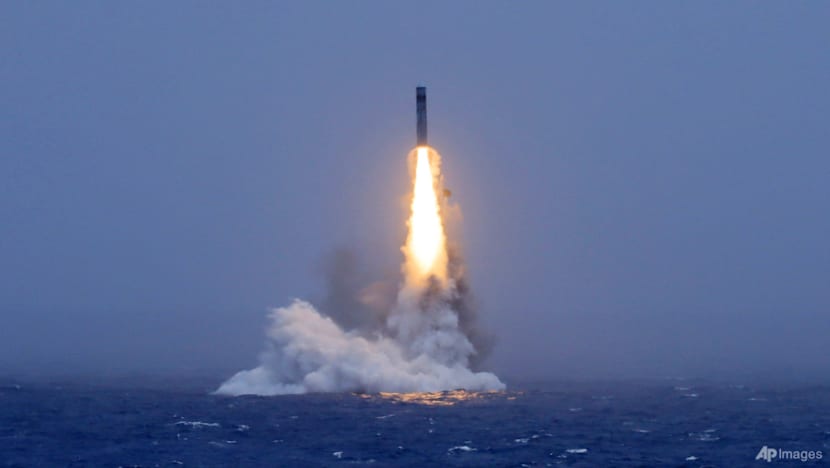
The missile, carrying a simulated warhead, was launched from a nuclear-powered submarine on Monday (Jul 6), and travelled about 7,300km before landing in international waters in the South Pacific.
It marked only the second time since 1980 that China has fired a ballistic missile into international waters - and its first publicly known test of a submarine-launched ballistic missile (SLBM) over such a distance.
What exactly did China launch?
China has not publicly identified the missile used. But experts said it was most likely the JL-2 submarine-launched ballistic missile, which has a range of 8,000km, rather than the more advanced JL-3 cited by some state media.
The JL-3 missile has a range that exceeds 10,000km.
The missile carried a simulated training warhead and likely overflew parts of the Philippines before landing in the South Pacific Nuclear Free Zone, according to the Center for Strategic and International Studies (CSIS).
The zone, established under the 1986 Treaty of Rarotonga, prohibits the testing and deployment of nuclear explosive devices in the region. China ratified the protocols in 1987.
While the test did not involve a nuclear warhead, it has raised concerns among Pacific nations about whether such launches are consistent with the spirit of the treaty. New Zealand said it was troubled by what appeared to be a "recurring pattern", following a similar launch in 2024.
China also drew criticism over limited advance notice.
The US said the few hours’ notice it received fell "considerably short" of the standards adopted by all other P5 nuclear-weapon states.
The P5 - permanent members of the United Nations Security Council - are the only countries recognised as nuclear-weapon states under the 1968 Nuclear Non-Proliferation Treaty.
Why is this test significant?
Analysts said the launch is a major step in China’s efforts to strengthen its nuclear deterrent, particularly at sea.
Submarine-launched ballistic missiles are designed as “second-strike” weapons. This means they allow a country to retaliate even if it comes under nuclear attack.
"So, they are designed to deter other nuclear-armed countries," Sam Roggeveen, director of the Lowy Institute's International Security Program, told CNA.
He said the launch was a signal to the US, and to some degree, Russia.
“(The) main message is to remind the US that China, which has long clung to a minimalist nuclear posture, has embarked on a major expansion of this capability … We should expect more such tests as a result,” Roggeveen said.
Lyle Morris, senior fellow on foreign policy and national security at Asia Society Policy Institute, described the test as a “major development”, noting that previous SLBM tests were not publicly disclosed and took place closer to China’s shores.
“The launch demonstrates that China's nuclear deterrent is no longer centred solely on land-based missiles,” Morris said, adding that it also showed the Chinese navy could target the continental US from bastions close to Chinese waters.
The test also signals Beijing's progress towards a credible nuclear triad - the ability to launch nuclear weapons from land, air and sea.
Did China already have this capability?
Yes - but it is evolving.
China has had SLBM capability for some time, but its submarine fleet has historically lagged behind those of the US and Russia, particularly in stealth.
Analysts said the latest test shows growing confidence in China’s submarine operations, missile reliability and command systems.
Dr Malcolm Davis, senior analyst at the Australian Strategic Policy Institute, said the launch demonstrated the effectiveness of China’s sea-based nuclear deterrent and its ability to project power over long distances.
Was the timing deliberate?
The timing has drawn attention, coming just hours after Australia and Fiji signed a new defence pact. The Ocean of Peace alliance commits Australia and Fiji to defend each other if attacked.
With China and Western powers vying for influence in the Pacific, some analysts believe the timing was intentional.
Dr Davis said the test could be seen as a signal of China’s displeasure at Pacific nations strengthening defence ties with Western partners.
“Although it is highly likely that China had been preparing for this test for some weeks, they chose the very day that Australia and Fiji signed an important mutual defence alliance agreement,” Dr Davis told CNA.
“Had China wanted to avoid linking this test to that treaty signing, they could have easily delayed the test a week, but they deliberately chose to conduct the test within hours of the treaty signing.”
On the other hand, Morris noted that such launches are typically planned months or even years in advance.
“Even if China intended to time the launch with a historical event, much depends on submarine crew readiness and weather, which can change at a moment’s notice,” he said.
Roggeveen likewise viewed the timing as coincidental, but said Beijing's decision not to postpone the test still sent a message.
“The fact that Albanese's Pacific tour did not rise to a level of importance in Beijing to warrant a delay of the test is itself an indicator of where China's priorities lie,” he said.
Why are countries concerned?
The launch comes against the backdrop of China’s rapidly expanding nuclear arsenal.
CSIS estimates China’s stockpile has grown from about 200 to more than 600 warheads in the past six years. The Pentagon has projected that the number could exceed 1,000 by 2030.
Dr Davis said the test reinforced concerns about nuclear proliferation and Beijing’s rapid buildup of its nuclear capabilities.
While China aims to achieve nuclear parity with the US by the early 2030s, there are also concerns that it may continue to expand its arsenal to achieve nuclear superiority, he said.
“Testing this submarine-launched ballistic missile reinforces this trend, and the US will recognise this test as an important step forward towards a secure second-strike capability,” he said.
Such capabilities could make it easier for China to use force below the nuclear threshold while being shielded by a secure deterrent, Dr Davis added.
Jacob Stokes, senior fellow at the Center for a New American Security, said the launch marked clear progress in China’s nuclear development.
"You saw the land-based intercontinental ballistic missile in September 2024 and so this is another leg of the triad, the water-based leg," said Stokes, noting that "if the pattern holds, we should see an air-launched ballistic missile in the future”.
"One of the signals coming out of this is that ... China is increasingly in that category with the United States and Russia as a very capable nuclear force,” he said.
What does this mean for the Pacific?
Analysts said such missile tests are likely to become more frequent as China modernises its military.
"The Chinese nuclear-powered submarine fleet has over the past few years undergone a significant push for modernisation and expansion," said Alex Luck, a naval analyst focused on Chinese military modernisation.
"In line with this trend, we should expect a significant increase in missile testing and the frequency of such tests getting conducted."
The latest launch is also likely to heighten concern among US allies and partners in the Pacific and drive closer cooperation.
Already, Pacific Island leaders are considering a "very strong" joint statement condemning China's missile test, Australia's Prime Minister Anthony Albanese said.
Morris said the launch would bring US allies closer together and fuel concern over China’s nuclear modernisation trajectory.
Similarly, Dr Davis said Beijing’s show of nuclear force might turn the Pacific islands away from China instead.
“Far from being intimidated and coerced by Beijing's use of a nuclear missile to influence Southwest Pacific states to align with China, they have banded together to condemn China's action, and it is much more likely that they will seek closer defence relations and cooperation with Australia and New Zealand,” he said.
Want an issue or topic explained? Email us at digitalnews [at] mediacorp.com.sg. Your question might become a story on our site.
Source: CNA/co(gs)
Related stories

Philippine Daily Inquirer
WorldJul 10, 2026 · 1 min
Pagasa warns of heavy rain across Cebu Friday
Philippine Daily Inquirer

Philippine Daily Inquirer
WorldJul 10, 2026 · 1 min
Oriental Mindoro town suspends afternoon classes due to Inday
Philippine Daily Inquirer

Philippine Daily Inquirer
WorldJul 10, 2026 · 1 min
Mandaue: P8.9M lost in Tipolo building fire
Philippine Daily Inquirer

Antara News
WorldJul 10, 2026 · 1 min
Indonesia closely monitors China's long-range ballistic missile test
Antara News